Artwork
Christ on the Cross between the Two Thieves
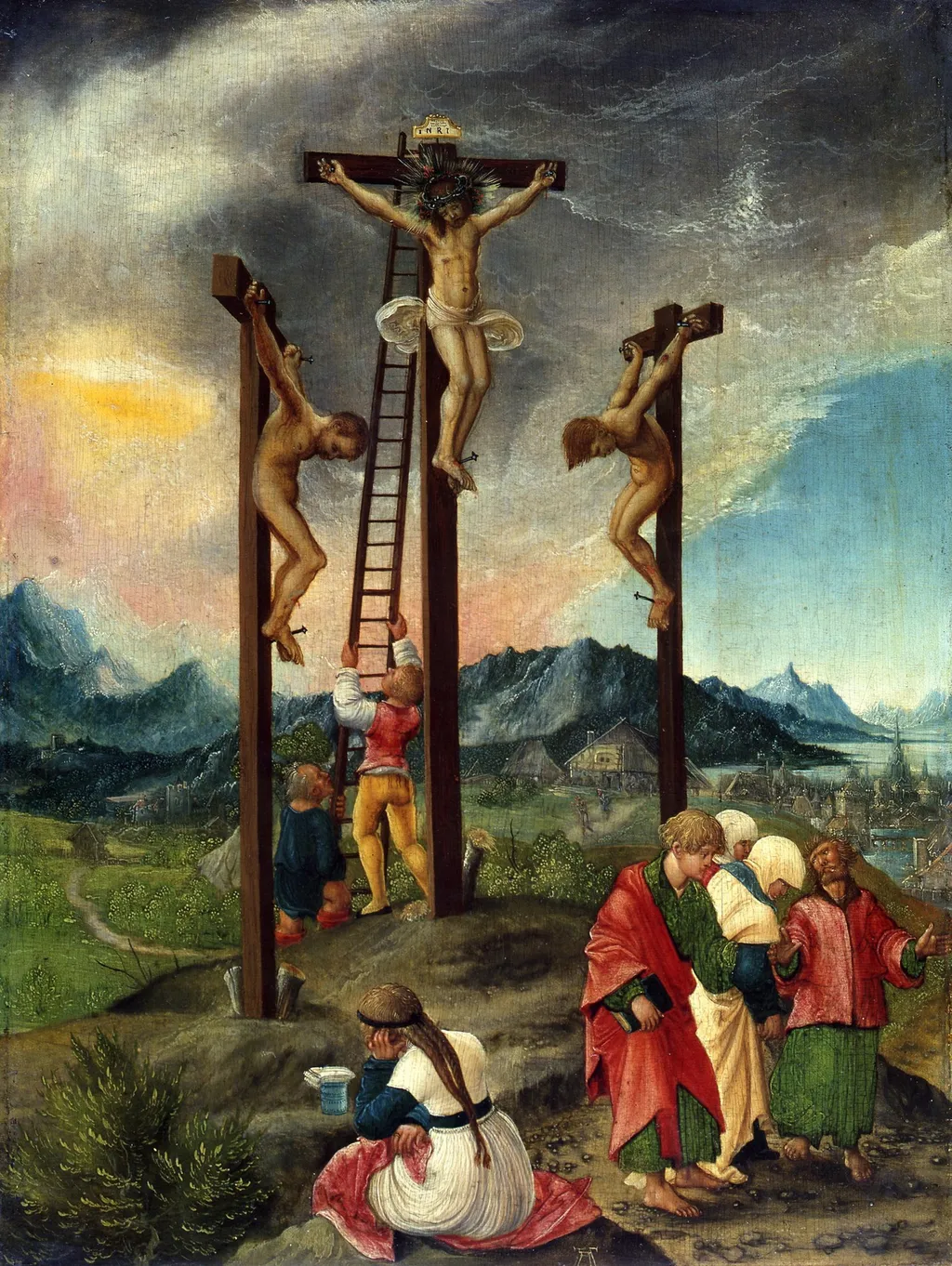
Christ on the Cross between the Two Thieves is a paint painting by the Northern Renaissance artist Albrecht Altdorfer. It dates from 1520 and is held in the collection of the Gemäldegalerie Berlin.
About this work
Overview
8 centimeters, the work is rendered in paint on lime panel and is held in the Gemäldegalerie in Berlin, where it is inventoried as 638D.
Christ on the Cross between the Two Thieves is a small panel painting by the German artist Albrecht Altdorfer, executed around 1520 and again associated with a date near 1526 in scholarly literature. Measuring 28.7 by 20.8 centimeters, the work is rendered in paint on lime panel and is held in the Gemäldegalerie in Berlin, where it is inventoried as 638D. The painting is a significant example of Altdorfer's religious art and his contribution to the Danube School, combining intimate scale with complex narrative and landscape elements. Its attribution to Altdorfer is secured by his monogram, AA, visible at the bottom of the panel.
Subject & Meaning
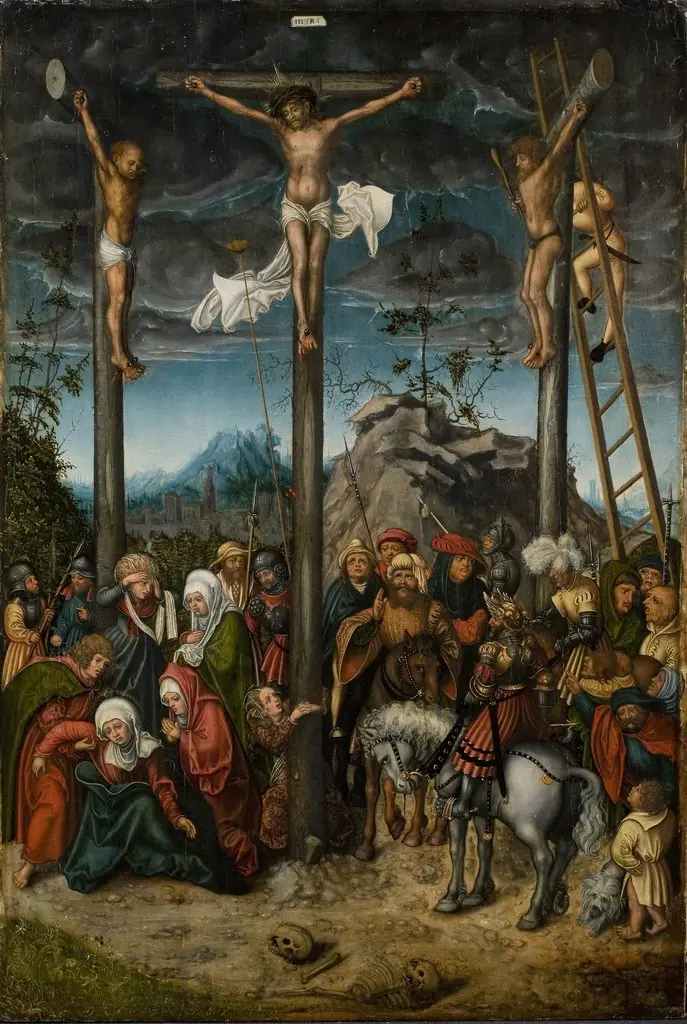
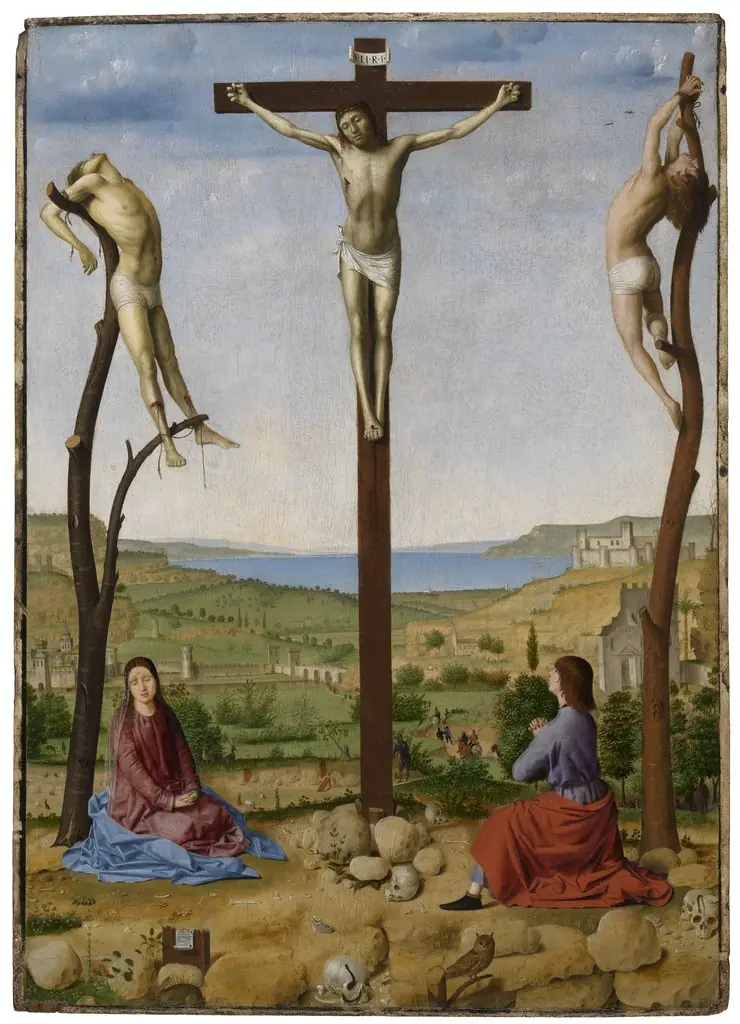
The painting depicts the Crucifixion with a distinctive narrative emphasis. Three crosses rise on a low hill, with Christ at center wearing the crown of thorns and a white loincloth, flanked by the two thieves. Unlike conventional Crucifixion scenes that capture the moment of death, Altdorfer portrays the aftermath: the execution is over, the day is ending, and the figures are dispersing. In the foreground, Mary Magdalene sits alone on an earthen mound, her back to the viewer, resting her head in her hand in a gesture of melancholy; before her lies a jar of ointment with linen bandages. Behind her, John the Evangelist leads the Virgin Mary away, accompanied by a gesticulating Joseph of Arimathea, while Nicodemus and a servant position a ladder to lower Christ's body. The dramatic sky, shifting from rose and golden light near the horizon to heavy dark clouds above, transforms the biblical darkness at the hour of death into the approaching night, making grief and mourning the devotional focus of the work.
Technique & Style
The painting is executed in oil on lime panel with a smooth finish and fine craquelure throughout. The medium allows for rich yet muted coloration, deep reds, greens, and blues set against earthy browns and greens. Altdorfer's handling shows careful attention to faces, drapery, and distant landscape elements. The symmetrical composition, with the central cross dominating and a crowd surging around it, together with the unusual golden background, lends the work what scholars have noted as a peculiarly archaic character. The painter borrowed several figures and motifs from Andrea Mantegna, a practice also seen in some of his engravings. The dramatic contrast between light and shadow, and the detailed rendering of the vast landscape with its blue mountains, town, body of water, and distant castle, demonstrate Altdorfer's innovative integration of figure and landscape.
Context
Albrecht Altdorfer, active in Regensburg on the Danube, was a painter, graphic artist, and the founder of the Danube School. Alongside Albrecht Dürer, Lucas Cranach the Elder, and Matthias Grünew [the Elder], he ranks among the most significant German artists of the sixteenth century. He was also the first landscape painter in the modern sense. The Crucifixion belongs to a series of treatments of this subject by Altdorfer, each exploring different emotional and compositional possibilities. The work's personal, melancholic approach to the Crucifixion narrative, its integration of detailed landscape with religious subject matter, and its synthesis of Italianate motifs with northern sensibilities exemplify the artistic innovations of the Danube School. Several copies of the painting exist, indicating that it found admirers and held significance for contemporary viewers.
Legacy
The painting's legacy rests on its admired status during the artist's lifetime, evidenced by the existence of multiple copies, and its continued importance as a key work in the Gemäldegalerie Berlin's collection of early German painting. As a devotional image, it shifted emphasis from the physical agony of Christ to the emotional aftermath of the Passion, influencing how subsequent artists and viewers engaged with the Crucifixion theme. The work remains a touchstone for understanding Altdorfer's development as a painter of religious subjects and his pioneering role in landscape art. Its small scale and intimate address to the viewer underscore the private devotional function for which it was originally commissioned by Peter Maurer for his chapel.
Own this work as a print
Artist & collection
Artist
Albrecht Altdorfer (c. 1480 – 12 February 1538) was a German painter, engraver and architect of the Renaissance working in Regensburg. Along with Lucas Cranach the Elder and Wolf Huber he is regarded to be the main…