Artwork
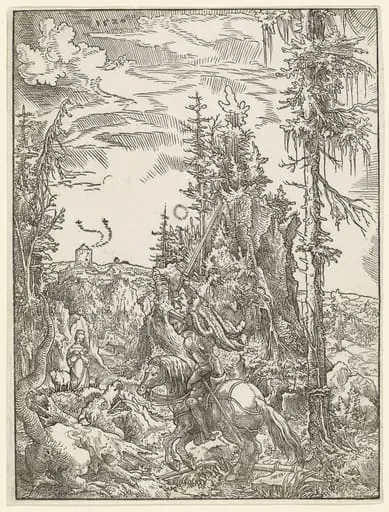
Countryside of Wood With Saint George Fighting the Dragon
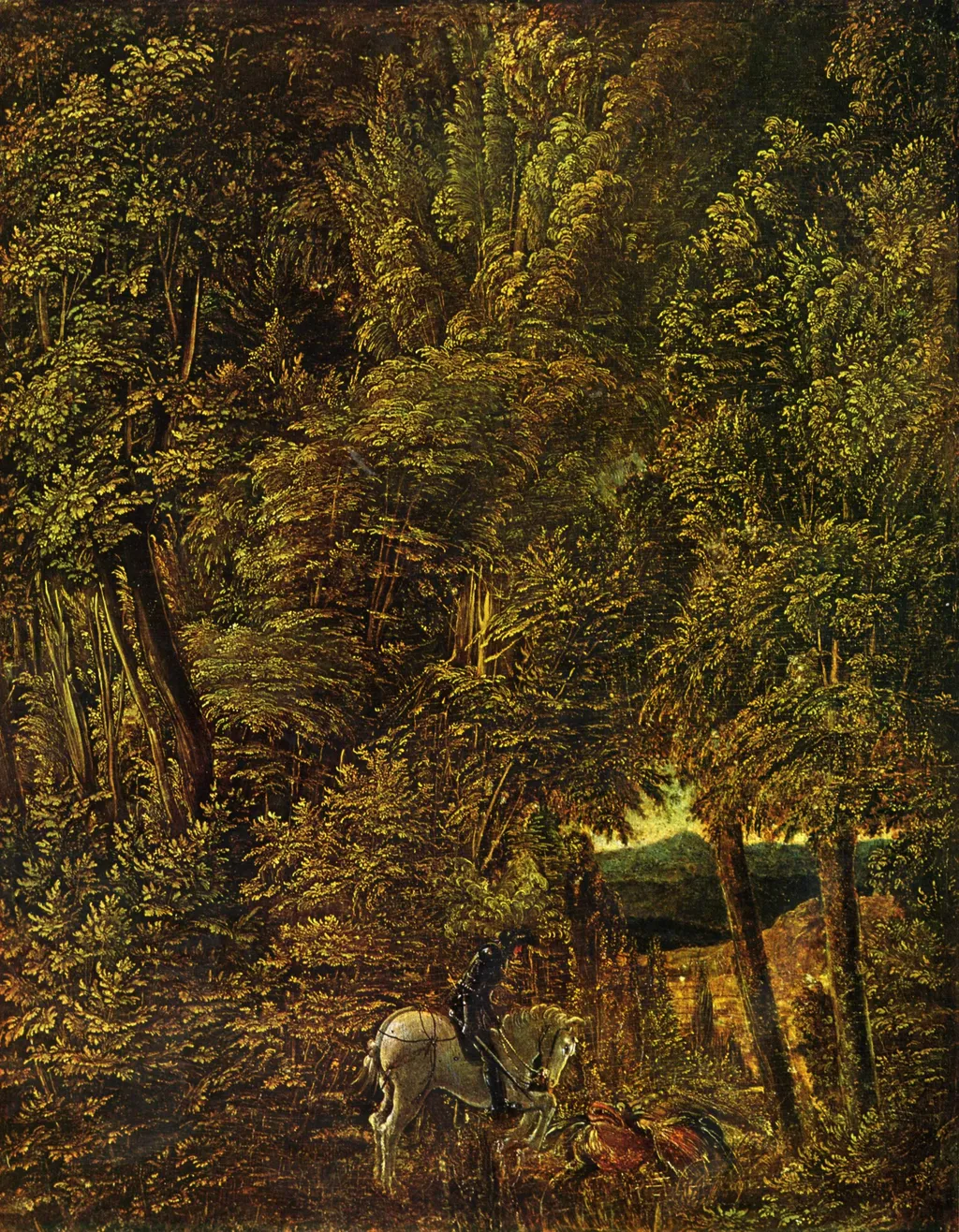
Countryside of Wood With Saint George Fighting the Dragon is an oil painting by the Northern Renaissance artist Albrecht Altdorfer. It dates from 1510 and is held in the collection of the Bavarian State Painting Collections.
About this work
A small work on parchment showing Saint George in a thick forest, locked in combat with a dragon. Altdorfer painted it around 1510, among the first to set a religious battle in dense woods rather than open fields. That choice makes the scene feel strange and familiar at once. It hangs in the Alte Pinakothek in Munich.
Subject & Meaning
Unusually, the scene omits the rescued princess Margaret and depicts George staring at the beast with a lowered lance rather than actively killing it.
Painted in 1510, this work depicts the legendary episode of Saint George fighting the dragon, a classic theme in Christian iconography derived from sources like the Golden Legend. However, Altdorfer reinterprets the traditional narrative by relegating the black-armored saint on his white horse and the small red dragon to the lower quarter of the composition. The legendary combat serves primarily as a pretext to showcase a dense, wild forest that dominates the picture plane, evoking an arcane atmosphere where human figures appear small and subordinate to natural forces.
Unusually, the scene omits the rescued princess Margaret and depicts George staring at the beast with a lowered lance rather than actively killing it. This shift reflects a broader early sixteenth-century trend where landscape representation gained prominence over religious motifs, transforming the sacred story into a study of the mysterious, overwhelming power of nature.
Technique & Style
Created in 1510, this small-format work measures 28.2 by 22.5 centimeters and employs an unusual medium combination: oil paint applied directly onto parchment, which is subsequently mounted on a linden wood panel. Albrecht Altdorfer utilized the alla prima technique, avoiding layered underpainting or glazes to achieve immediate results. The handling features yellow-green leafy scrolls painted into dark areas, with highlights heightened directly.
Stylistically, the piece exemplifies the Danube School, prioritizing a wild, arcane wooded landscape over the traditional religious narrative. The color palette is dominated by green and brown tones, while the composition subordinates the human figures and the dragon to the surrounding natural forces. A distinctive formal quality is the unexpected opening in the lower right, where the dense forest thins to reveal a distant view of fields and mountains.
History & Provenance
Created in 1510 by the German artist Albrecht Altdorfer, this small-format work was executed using oil paint on parchment, a material combination considered unusual for the period, before being mounted on linden wood. The painting employs the alla prima technique, bypassing traditional underpainting and glazing layers. Historically, the work reflects a shift in early 16th-century art where landscape elements began to supersede religious motifs, with the figure of Saint George relegated to the lower quarter of the composition.
The piece currently resides in the Alte Pinakothek in Munich as part of the Bavarian State Painting Collections, specifically held by the Wittelsbacher Ausgleichsfonds under inventory number WAF 2. While the specific original commissioner remains undocumented in the provided records, the work's inception is firmly dated to 1510.
Albrecht Altdorfer's Countryside of Wood With Saint George Fighting the Dragon (1510) is currently held in the Alte Pinakothek in Munich, Germany. The work is part of the Bavarian State Painting Collections, specifically managed under the Wittelsbacher Ausgleichsfonds. Its official inventory number is WAF 2.
The painting, an oil on parchment mounted on linden wood, measures 28.2 cm by 22.5 cm. While the provided sources confirm the artwork's current location, collection details, and accession number, they do not contain specific records regarding its past exhibition history or a chronological list of public displays prior to its current residence in Munich.
Context
Scholars identify this 1510 work as a defining example of the Danube School, with Altdorfer recognized as a primary protagonist of the movement. Art historical analysis suggests the legendary narrative serves merely as a pretext for the artist's true focus: the magical, wild, and harsh forest landscape. By relegating Saint George and the dragon to the lower quarter, Altdorfer inverts traditional iconographic hierarchies, rendering human figures small and subordinate to overwhelming natural forces.
This approach reflects a broader early sixteenth-century trend where landscape depiction gained prominence over religious or mythological motifs. The painting's unusual technique, utilizing oil on parchment with an alla prima method, further distinguishes it within the Northern Renaissance. Interpretations also connect the wooded setting to classical myths and the Legenda aurea, noting the deliberate omission of the princess and the final kill to emphasize an arcane atmosphere rather than heroic action.
Legacy
Altdorfer’s Countryside of Wood With Saint George Fighting the Dragon (1510) is widely cited as a landmark in the shift toward autonomous landscape painting in early modern Europe. Art historians note that the work subordinates the saint’s combat to a dense, atmospheric forest, signaling the rise of nature as a primary subject in Northern Renaissance art [][]. The painting’s Alla Prima technique and emphasis on wild, arcane woodland influenced the Danube School, whose members, including Wolf Huber and Augustin Hirschvogel, expanded Altdorfer’s fusion of religious narrative with landscape into a distinct stylistic idiom [][].
By the late sixteenth century, such compositions informed Venetian and Dutch landscape traditions, where human figures were increasingly marginalized in favor of sublime natural settings [][]. The work’s small scale and technical innovation also secured its place in technical art history as an early example of oil on parchment, a format later echoed in miniature traditions across Central Europe [][].
Overview
Albrecht Altdorfer's 'Countryside of Wood With Saint George Fighting the Dragon' (c. 1510) is a miniature painting executed on parchment. The composition depicts the legendary martyr Saint George engaged in close combat with a dragon within a dense, claustrophobic forest. Unlike traditional depictions that place the battle in open, pastoral landscapes, Altdorfer situates the figures amidst towering trees and thick undergrowth, creating a sense of enclosure and immediacy.
The artist utilizes the small scale to focus intensely on the interaction between the knight and the beast, with the surrounding foliage dominating the visual field. This work exemplifies Altdorfer's pioneering role in the Danube School, where he shifted the focus from the human subject to the expressive power of the natural environment. By embedding a religious narrative within a wild, untamed woodland, the painting reflects early 16th-century German interest in landscape as an independent artistic force.
The piece remains a significant example of how Altdorfer reinterpreted conventional iconography to emphasize the atmospheric and emotional weight of the setting.
Own this work as a print
Artist & collection
Artist
Albrecht Altdorfer (c. 1480 – 12 February 1538) was a German painter, engraver and architect of the Renaissance working in Regensburg. Along with Lucas Cranach the Elder and Wolf Huber he is regarded to be the main…