Artwork
Calvary
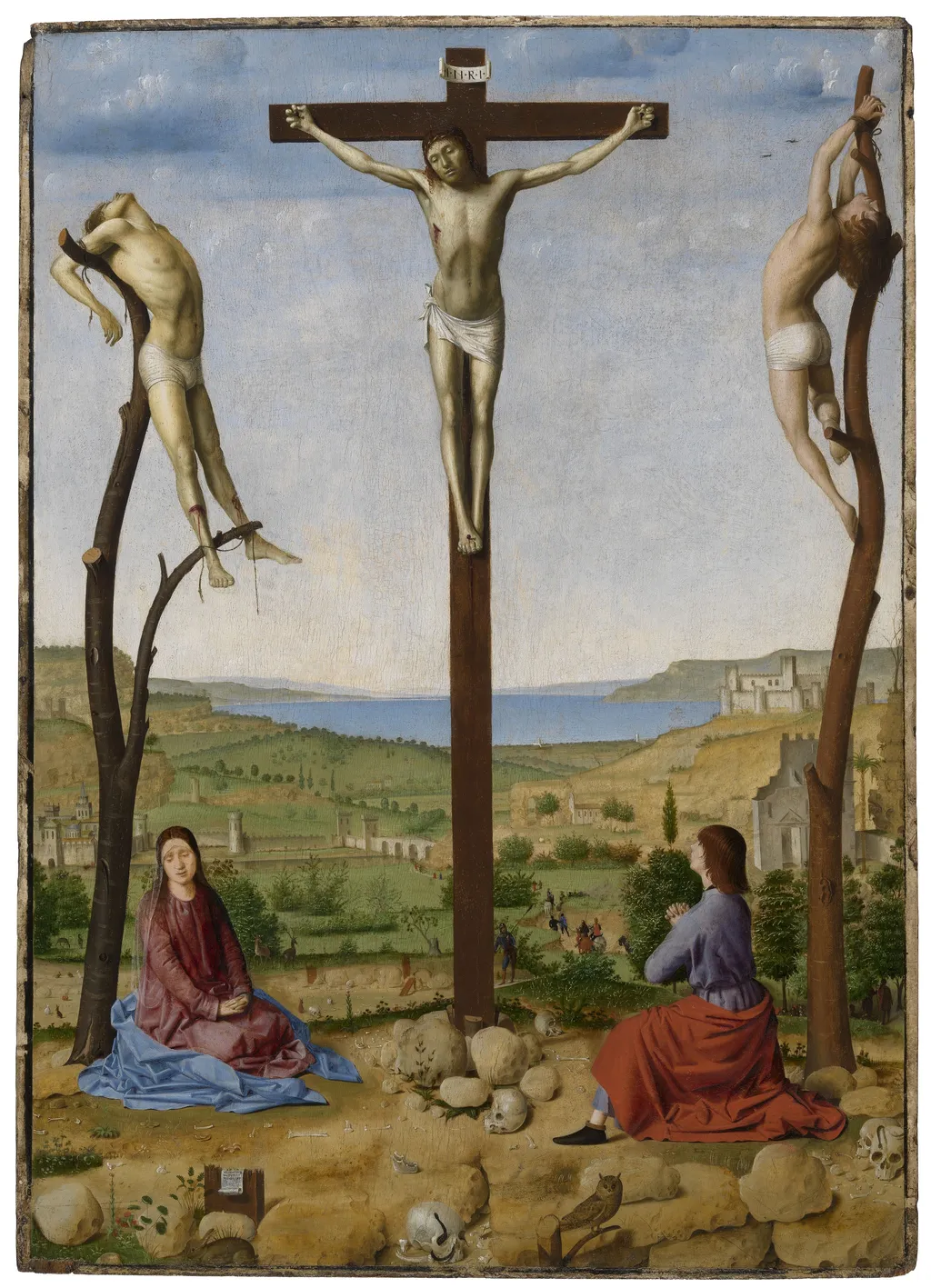
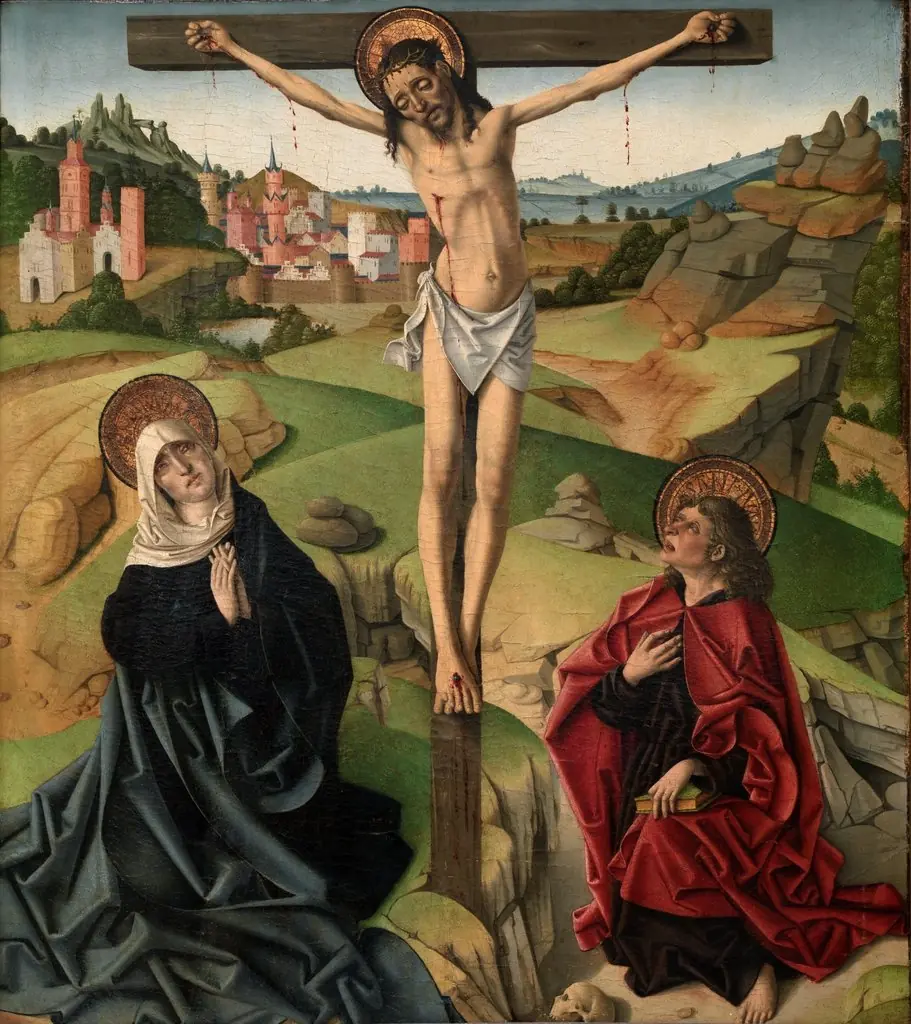
Calvary is an oil painting by the Early Renaissance artist Antonello da Messina. It dates from 1475 and is held in the collection of the Royal Museum of Fine Arts Antwerp.
About this work
Subject & Meaning
These symbols collectively convey the theological narrative of sin's entry through Adam and its overcoming through Christ's sacrifice.
The painting depicts the crucifixion of Jesus at Golgotha, with the central figure of Christ flanked by the two thieves, and mournful figures of Mary and the beloved disciple John positioned below. Symbolic elements include a skull representing Adam's burial site and a serpent referencing original sin, linking the scene to themes of redemption from the Fall. A small tree stump sprouting a new branch behind the cross symbolizes the transition from the Old to the New Covenant, while serpents winding through the skulls represent death or the devil.
An owl at the front of the composition signifies those who turn away from true faith, and the inclusion of a twig growing from a stump visually reinforces the contrast between the Old and New Covenants. These symbols collectively convey the theological narrative of sin's entry through Adam and its overcoming through Christ's sacrifice.
Technique & Style
Antonello da Messina painted Calvary in 1475 using oil paint on a limewood panel, a technique he adopted from Flemish primitives during his Venetian period. The work measures 52.5 cm in height by 42.5 cm in width and is executed in oil on wood, distinguishing it from his earlier tempera works. The composition features Christ on the cross flanked by the two thieves, with Mary and John positioned below in a triangular arrangement that emphasizes symmetry and spatial clarity characteristic of Venetian practice.
The landscape behind the figures combines an idealized setting with symbolic elements: skulls representing Adam’s burial site, a serpent referencing original sin, an owl symbolizing Jewish rejection of Christ, and a sprouting stump alluding to the New Covenant. These motifs convey a theological narrative of death and redemption, where Christ’s sacrifice atones for the Fall. The painting’s rich coloration and detailed naturalism stem from the oil technique, enabling sophisticated anatomical rendering and atmospheric depth.
Antonello’s use of symbolic objects, such as the skull with a snake and the inscribed wood stake bearing his signature in oleo, reinforces the work’s didactic purpose without resorting to vanitas tropes. Today, Calvary resides in the Royal Museum of Fine Arts Antwerp and remains the only painting by Antonello da Messina in Belgium.
History & Provenance
Executed in 1475 during Antonello da Messina's residence in Venice, Calvary is one of the few signed and dated works by the artist. The painting was created using oil paint on a panel made from wild chestnut wood, a technique the artist adopted from Flemish Primitives. The signature, inscribed on a scroll attached to a broken stake, reads "1475.
Antonellus messanes me o¯o pinxit," with the abbreviation "o¯o" explicitly denoting the use of oil. According to notes on Giorgio Vasari's Lives, the work arrived in the Netherlands early in its history. It was held for a long period by the Maelcamp family before entering the collection of a Mr. van Ertborn in Utrecht around the 1820s or 1830s. The painting is currently housed in the Royal Museum of Fine Arts Antwerp.
Calvary is held in the Royal Museum of Fine Arts Antwerp, where it is listed under the inventory of the Vlaamse Kunstcollectie. The work was acquired in the early 19th century, having previously been owned by the Maelcamp family and later by a van Ertborn in Utrecht around 1820‑30. It remains on display in the museum’s collection gallery and has been included in exhibitions focusing on Antonello da Messina’s late period and on Renaissance depictions of the Crucifixion.
The painting is accessioned as part of the museum’s permanent collection, catalogued under the Royal Museum of Fine Arts Antwerp’s holdings of Antonello da Messina works.
Context
The painting is regarded as a benchmark in Antonello da Messina's oeuvre, being one of only twelve signed and ten dated works by the artist, and it represents a late work that synthesizes South Italian, Flemish and Venetian influences. Its symbolic program links the crucifixion to the story of Adam, using motifs such as a skull with a serpent to reference original sin and an owl to signify the rejection of true faith. The work demonstrates the artist's mastery of oil technique, anatomical precision and perspective, and it reflects his engagement with Flemish Primitive practices observed in Naples and southern Italy.
The composition features a central Christ figure flanked by the two thieves, mourning Mary and the beloved disciple John, and an idealized landscape that incorporates Venetian lighting and possible references to the Sea of Galilee. Scholars note its importance as the only work by Antonello in Belgium and its role in illustrating the transition from tempera to oil in Italian art.
Legacy
The Calvary (1475) holds a significant benchmark value within Antonello da Messina's oeuvre as one of his few signed and dated works, serving as a crucial reference point for the artist's late period. The painting is historically notable for synthesizing South Italian, Flemish, and Venetian stylistic elements, particularly through its adoption of oil painting techniques derived from the Flemish Primitives. This mastery of oil allowed for a vibrancy and anatomical realism that distinguished the work from earlier tempera practices.
The influence of this approach extended beyond the canvas itself; the bright, airy lighting characteristic of the piece was a Venetian style Antonello adopted from the Bellini brothers, which was subsequently transmitted to his own important pupil, Alvise Vivarini. As the only work by the artist in Belgium, it remains a unique testament to his role in introducing Northern European oil methods to Italian art.
Overview
Created in 1475, this oil painting on wood portrays the crucifixion scene known as Calvary. Executed by the Sicilian-born Renaissance artist Antonello da Messina, the work measures roughly a modest panel size and is presently displayed in the Royal Museum of Fine Arts in Antwerp, where it remains the sole piece by the painter in the Belgian collection.
Own this work as a print
Artist & collection


![The Crucifixion with the Virgin, Saint John, Saint Jerome, and Saint Mary Magdalene [middle panel], by Pietro Perugino](https://artifactworldgallery.com/img/pietro-perugino--the-crucifixion-with-the-virgin-saint-john-saint-jerome-and--a9b4c312771e3f71-w320.webp)