Artwork
Pulcinella and Colombina
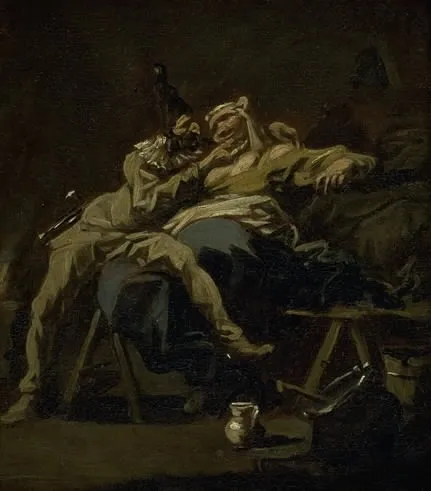
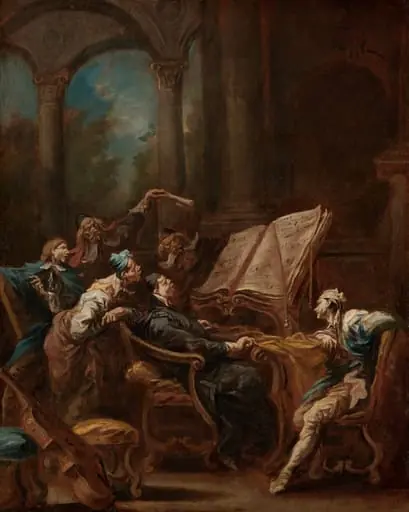
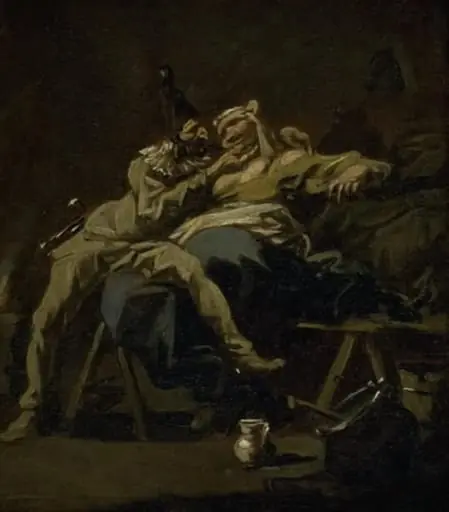
Pulcinella and Colombina is an oil painting by the Barbizon school artist Alessandro Magnasco. It dates from 1715 and is held in the collection of the Statens Museum for Kunst.
About this work
Subject & Meaning
The painting thus serves as a visual commentary on the cultural fascination with theatrical archetypes and their symbolic roles in early modern European art.
The painting shows Pulcinella, a mischievous comic figure from the commedia dell'arte, alongside Colombina, his clever female counterpart, within a lively scene that captures their playful interaction. Pulcinella is depicted with a black mask and a stick, embodying trickery, while Colombina wears a vibrant dress and holds a tambourine, symbolizing wit and flirtation, together representing the dynamic of courtship and deception in theatrical tradition.
The iconography draws directly from commedia dell'arte stock characters, with Pulcinella’s mask and stick signifying his role as a cunning servant, and Colombina’s tambourine and colorful attire reflecting her status as a witty, resourceful heroine. Their inclusion emphasizes themes of love, cunning, and social inversion common in 18th‑century theatrical imagery.
The work’s meaning lies in its celebration of the improvisational and mischievous spirit of the commedia dell'arte, using these characters to explore humor and human folly. The painting thus serves as a visual commentary on the cultural fascination with theatrical archetypes and their symbolic roles in early modern European art.
Technique & Style
Executed in oil on canvas in 1715, the work is painted in Magnasco’s characteristically rapid, sketch-like handling, with abbreviated, spirited brushwork that leaves passages thinly scumbled and others more densely loaded to define key forms. The composition is organized around the lively interplay of the two masked figures, Pulcinella and Colombina, their gestures and glances rendered with economical strokes that convey movement and theatricality rather than detailed anatomy.
The palette is subdued yet luminous, relying on earthy ochres, umbers, and chalky whites to articulate costume and flesh, with selective highlights animating the figures against a darker, loosely indicated interior setting. The canvas support measures 310 cm in width and 350 cm in height, and the painting’s condition is noted as stable with minor abrasion commensurate with its handling and age.
History & Provenance
Executed in 1715 by Alessandro Magnasco, this oil on canvas measures 350 cm by 310 cm and portrays the comic figures Pulcinella and Colombina. It entered the collection of the Statens Museum for Kunst, where it remains on view today.
The painting Pulcinella and Colombina by Alessandro Magnasco is held in the collection of the Statens Museum for Kunst, Copenhagen. The work entered the museum’s holdings as part of its permanent collection, where it remains accessible to the public.
It has not been recorded in any temporary exhibitions in the sources provided.
Overview
Alessandro Magnasco’s 1715 oil painting Pulcinella and Colombina presents a quiet interior where two figures from the Italian commedia dell’arte occupy a dimly lit space. The composition centers on a masked Pulcinella in a long coat and hat, leaning forward, and a young Colombina in a white dress, seated with her arm resting on a table. The background is largely dark, punctuated by a few scattered objects that suggest a modest domestic setting.
Context
Magnasco’s oeuvre often features fantastical, almost caricatured figures placed in ambiguous spaces, a departure from the more formal religious and historical subjects of his contemporaries. Pulcinella and Colombina exemplifies his fascination with popular culture and the theatrical world, aligning the painting with broader 18th‑century interests in everyday life and performance.
Artist & collection

Artist
Alessandro Magnasco (February 4, 1667 – March 12, 1749), also known as il Lissandrino, was an Italian late-Baroque painter active mostly in Milan and Genoa.