Artwork
New England Farm in Winter
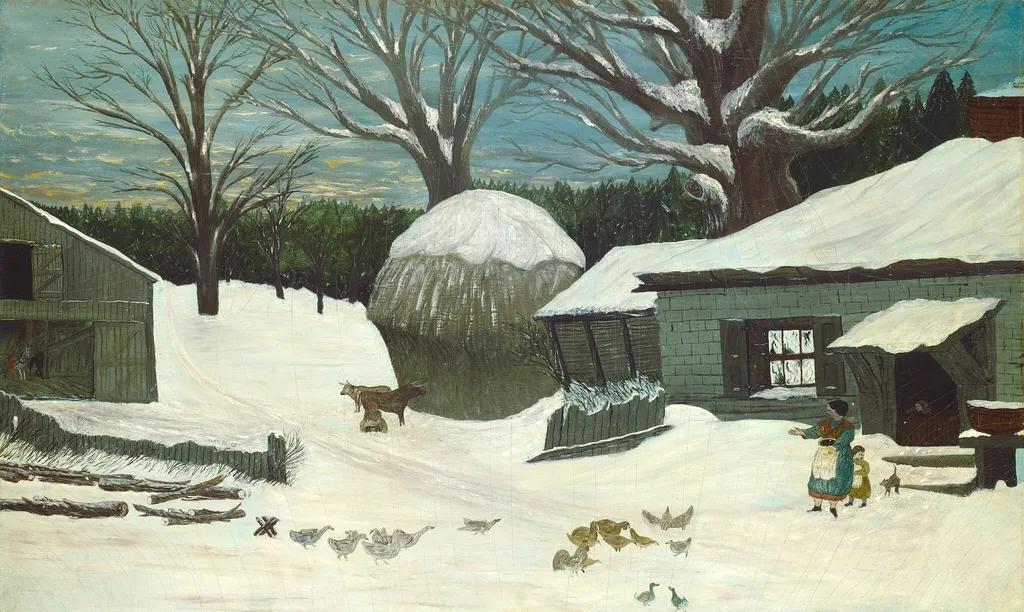
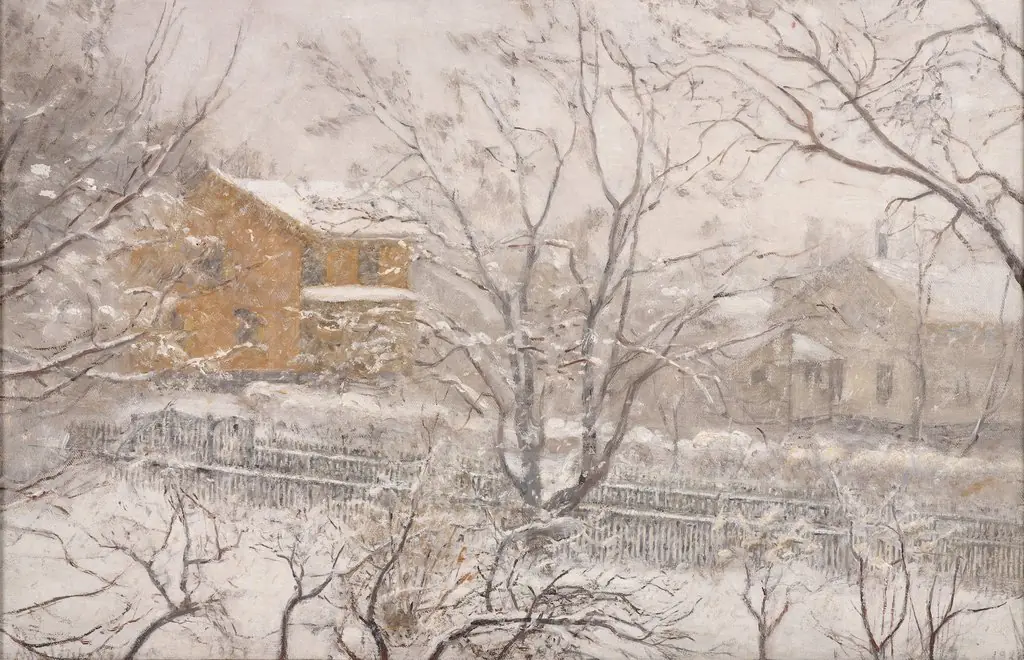
New England Farm in Winter is an oil painting. It dates from 1850 and is held in the collection of the National Gallery of Art. The work is an oil painting on canvas that depicts a winter farm landscape blanketed in snow.
About this work
Technique & Style
The composition balances documentary detail with generalized effects of light and atmosphere typical of mid-19th-century American landscape painting.
The painting is executed in oil on canvas, the support measuring 59.7 cm in height and 97.8 cm in width. The handling emphasizes broad, atmospheric recession across a snow-covered landscape, using muted tonalities to convey winter light. Brushwork is generally smooth, with subtle impasto in areas such as snow drifts and fence posts to suggest texture.
Formal qualities include a low horizon line, a central cluster of farm buildings, and a foreground of bare trees and fencing that directs the eye into the middle ground and distant hills. The composition balances documentary detail with generalized effects of light and atmosphere typical of mid-19th-century American landscape painting.
History & Provenance
Created in 1850 or later by an unidentified American nineteenth-century artist, this oil on canvas landscape originated in Hampden Highlands, Maine. Daisy C. Miller reportedly bought it from the attic of an old house in Hampden during an auction. By 1949 the painting was owned by Robert G. Hall of Dover-Foxcroft, Maine, who sold it that year to the collectors Edgar William and Bernice Chrysler Garbisch.
The Garbisches donated it to the National Gallery of Art in Washington, D.C., in 1953, where it remains. The available sources do not list a specific accession number or a detailed exhibition history.
Overview
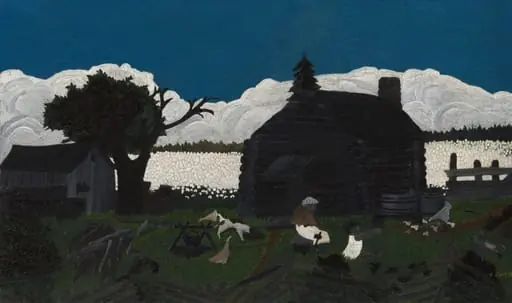
The work is an oil painting on canvas that depicts a winter farm landscape blanketed in snow. In the foreground a woman in a blue dress and white apron tends to a group of chickens alongside a child, while a barn with a horse inside occupies the left side of the composition. A second building stands behind a large tree, completing the quiet rural scene.
Subject & Meaning
The image presents everyday agricultural life during the cold season, emphasizing domestic labor and the relationship between humans and animals. The calm atmosphere, reinforced by the uniform white snow, suggests a moment of routine and stability amid winter’s harshness.
Context
The composition aligns with 19th‑century artistic interest in rural genre scenes, particularly those that document seasonal labor. By focusing on a New England farm, the painting contributes to a regional visual record of agricultural practices and domestic life during winter.
Artist & collection