Artwork
The Mounted Acrobats
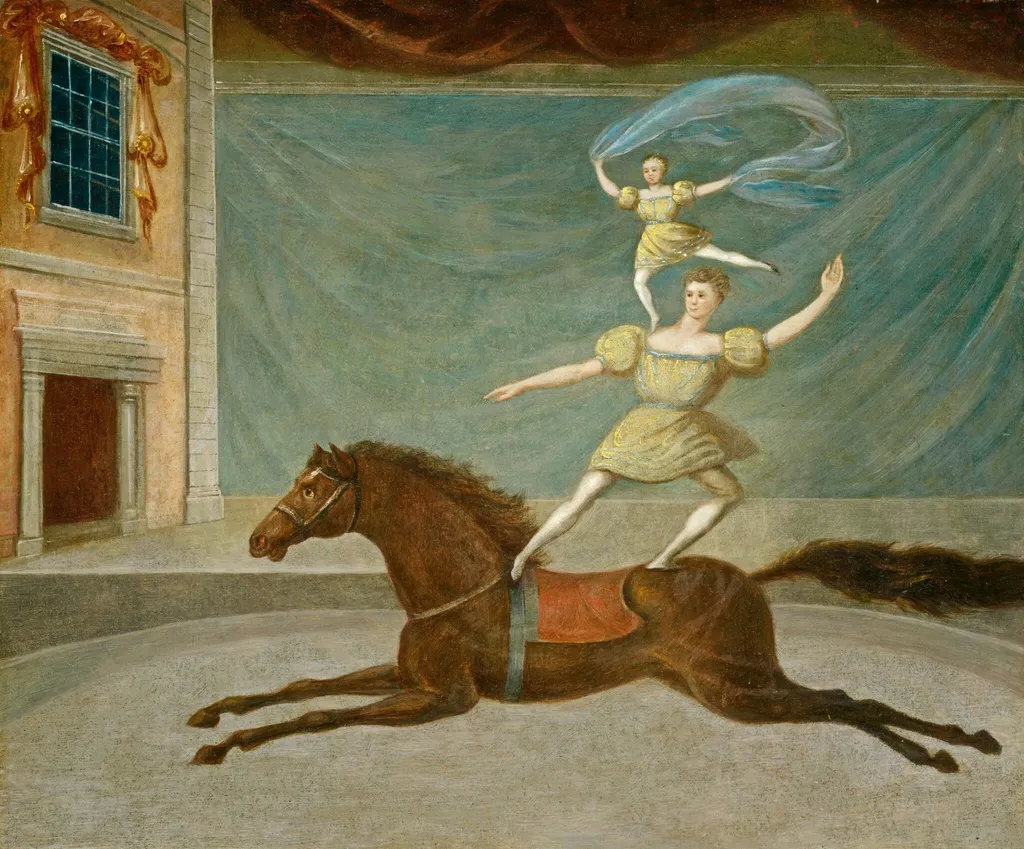
The Mounted Acrobats is an oil painting. It dates from 1825 and is held in the collection of the National Gallery of Art.
About this work
He has his arms outstretched, and a woman in a similar dress is standing on his shoulders, holding a blue cloth above her head.
This painting shows a horse lying on its side, with a man in a yellow dress balancing on its back. He has his arms outstretched, and a woman in a similar dress is standing on his shoulders, holding a blue cloth above her head. The horse is brown, and the people are wearing yellow dresses with puffy sleeves.
The background is a blue wall with a fireplace on the left side. The room is decorated with red and gold curtains and a window with a white frame.
The painting is very detailed, with lots of textures and colors. The horse's fur is rough, and the people's dresses are smooth. The background is simple, but it helps to focus attention on the acrobats.
The artist who painted this is American 19th Century.
Subject & Meaning
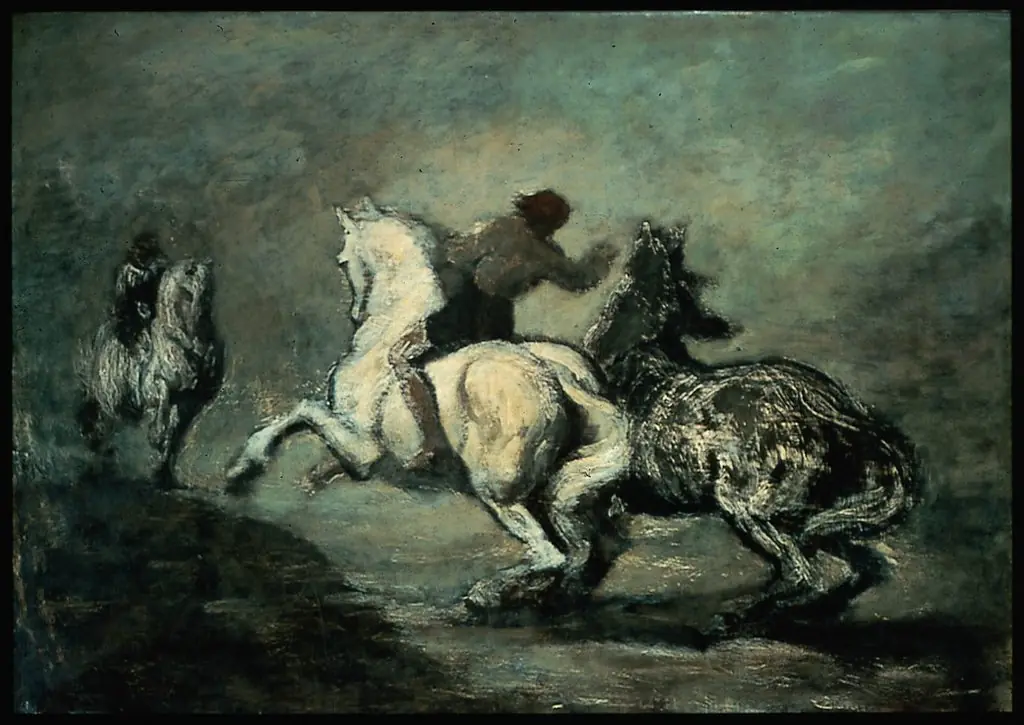
The work depicts a group of performers on horseback executing acrobatic feats, a subject drawn from popular entertainment of the early 19th century. The imagery functions as a visual record of contemporary circus acts rather than a symbolic allegory, emphasizing physical skill and the spectacle of leisure. Its composition centers on dynamic movement and the interaction between rider and mount, reflecting the era's fascination with theatrical performance and the emerging culture of public amusements.
Technique & Style
The work is executed in oil paint, though sources differ on the specific support material. One record identifies the medium as oil on wood, while another lists it as oil on canvas. The painting measures 40.3 cm in height and 47.6 cm in width.
As a genre scene from the American 19th century, the piece depicts a specific narrative moment consistent with the period's artistic output.
History & Provenance
The Mounted Acrobats was created by an American 19th-century artist in 1825 or after, executed in oil on wood as a genre scene. Its earliest recorded provenance places it in Plymouth, Massachusetts, where it was held by Robert B. Campbell of an unspecified city. Campbell sold the painting in 1952 to Edgar William and Bernice Chrysler Garbisch, who donated it to the National Gallery of Art in Washington, D.C., in 1953, where it has remained in the collection.
Note: Wikidata lists the medium as oil paint on canvas with dimensions of 40.3 by 47.6, which conflicts with the corpus record of oil on wood; the corpus provenance and dating are followed here.
The work is held by the National Gallery of Art, Washington, D.C., where it is accessioned as 1953.1.40.
It was recorded as originating in Plymouth, Massachusetts, and passed through the collection of Robert B. Campbell before being sold in 1952 to Edgar William and Bernice Chrysler Garbisch. The Garbisches subsequently gifted the painting to the National Gallery of Art in 1953.
Context
The Mounted Acrobats is an 1825 or later oil painting on wood attributed to an American 19th-century artist, currently held by the National Gallery of Art in Washington, D.C. It depicts a circus scene typical of the period's fascination with spectacle and physical prowess. The work entered the collection through a documented lineage: sold in 1952 by Robert B. Campbell of Plymouth, Massachusetts, to Edgar William and Bernice Chrysler Garbisch, who gifted it to the National Gallery of Art in 1953. Its classification as a genre scene within the broader American folk art tradition reflects 19th-century cultural interests in entertainment and national identity.
Scholarship on the piece remains limited, with most analysis focusing on its provenance and material characteristics rather than its artistic significance within the wider context of American painting.
Legacy
The work's legacy is anchored by its acquisition and preservation at the National Gallery of Art, establishing its significance within American 19th-century genre painting. Its inclusion in a major public collection has ensured continued scholarly attention to the artist's contribution to early American genre scenes.
Overview
The work, titled The Mounted Acrobats, is an oil painting executed on a wooden panel. It depicts a scene in which a brown horse lies on its side while a male figure in a yellow, puff‑sleeved costume balances atop the animal. A female figure, dressed similarly, stands on the man’s shoulders and holds a blue cloth aloft.
The interior setting includes a blue wall, a fireplace to the left, red and gold curtains, and a window framed in white.
Artist & collection