Artwork
Ichabod Crane and the Headless Horseman
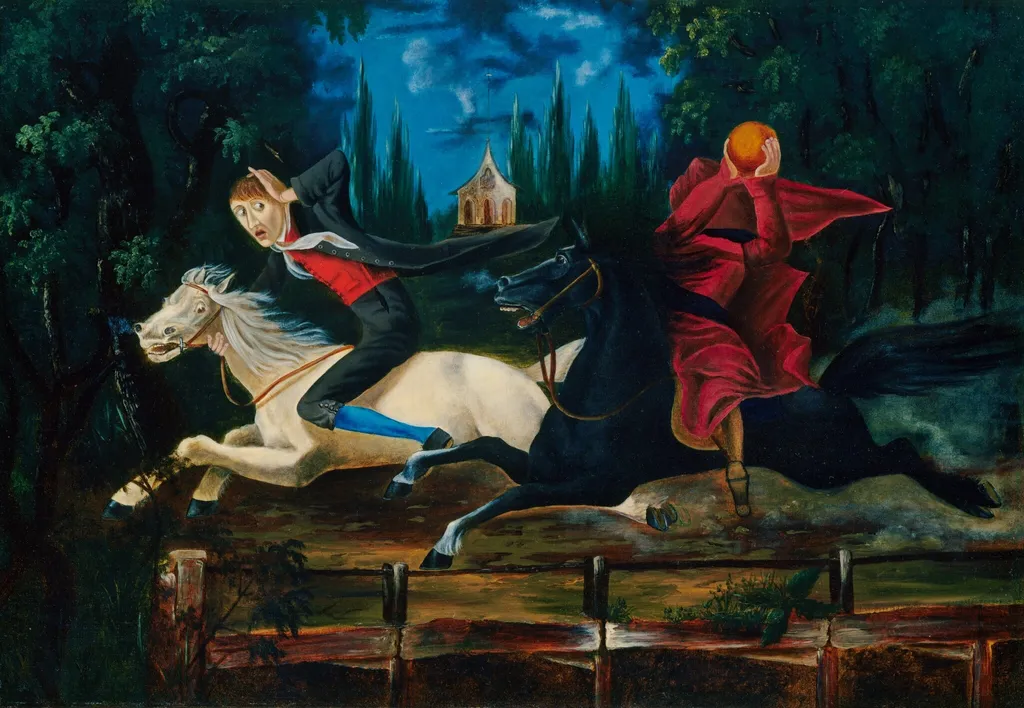
Ichabod Crane and the Headless Horseman is an oil painting by the Impressionist artist after William John Wilgus. It dates from 1855 and is held in the collection of the National Gallery of Art.
About this work
Overview
7 centimeters (20 7/8 by 30 3/16 inches) and is held in the collection of the National Gallery of Art in Washington, D.
Ichabod Crane and the Headless Horseman is an oil on canvas painting dated circa 1855, executed after William John Wilgus (1819-1853), an American artist from Troy, New York. The work measures 53 by 76.7 centimeters (20 7/8 by 30 3/16 inches) and is held in the collection of the National Gallery of Art in Washington, D.C., where it entered in 1971 as a gift from Edgar William and Bernice Chrysler Garbisch (accession number 1971.83.21). The painting occupies a notable position in American art as a mid-19th-century visual interpretation of Washington Irving's iconic 1820 tale, and it is classified within the genre of American naive painting. Its subject matter, drawn from one of the most enduring stories in American literature, has made it a frequently exhibited and widely reproduced image in the study of American folk and popular art.
Subject & Meaning
The painting depicts the climactic chase from Washington Irving's The Legend of Sleepy Hollow, in which the gangly schoolmaster Ichabod Crane flees from the spectral Headless Horseman on a darkened country road. Two mounted figures gallop from left to right across the canvas: the rider on a rearing white horse, clad in a black coat, red waistcoat, blue stockings, and white scarf, clutches his head in alarm while glancing backward; his pursuer, cloaked in flowing red, rides a black horse and holds a pale, round object where a head should be. Both horses leap over a low wooden fence, conveying urgent, breathless motion. Behind them, tall cypress trees frame a small Gothic building with arched windows beneath a deep blue, clouded night sky, while dense dark vegetation presses in from the edges of the composition. The iconography draws directly on Irving's narrative of the Hessian trooper decapitated by a cannonball during the American Revolution, who now rides nightly in search of his severed head. The pumpkin-like object the pursuer carries alludes to the story's ambiguous conclusion, in which Ichabod's abandoned hat and a shattered pumpkin are found beside the Old Dutch Church, leaving unresolved whether the horseman was supernatural or Brom Bones in disguise. The painting thus encapsulates themes of fear, the uncanny, and the vulnerability of rationality in the face of folk terror.
Technique & Style
The work is executed in oil on canvas with a palette dominated by deep greens, blues, and blacks, punctuated by sharp accents of red and the pale white of the horse and the head object. The brushwork varies across the surface: smooth and controlled in the rendering of the figures and their garments, more textured in the foliage and foreground earth. Strong chiaroscuro effects heighten the dramatic motion and nocturnal atmosphere. The composition relies on dynamic diagonal movement, with the leaping horses and backward-turned faces creating a sense of instantaneous, frozen action characteristic of narrative painting in the mid-19th century. The stylistic approach aligns with American naive painting in its direct storytelling, relatively flat spatial construction, and vivid, unmodulated color areas, even as it demonstrates competent draftsmanship in the anatomical rendering of the horses. The overall effect is theatrical and immediately legible, designed to communicate the sensational moment to a broad audience.
History & Provenance
The painting's creation history is complicated by its attribution as after William John Wilgus, who died in 1853, two years before the work's circa 1855 date. Wilgus himself had painted an earlier version of the subject in 1835, which received favorable notice when exhibited at the National Academy of Design; the National Gallery's painting appears to be based directly on this earlier composition. The provenance traces the work from New York City to an unidentified antique dealer in Lockport, New York, from whom it was sold in 1947 to Haydn Parks of Buffalo, New York. It then passed to The Old Print Shop in New York, which sold it in 1948 to Edgar William and Bernice Chrysler Garbisch, the prominent collectors of American folk art. The Garbisches gave the painting to the National Gallery of Art in 1971. The work has been extensively exhibited, beginning with The American Folk Art Tradition: Paintings from the Garbisch Collection at the National Gallery in 1978. It subsequently traveled in the American Naive Paintings from the National Gallery of Art exhibition to numerous venues including the Terra Museum of American Art (1981-1982), Telfair Academy of Arts and Sciences (1993), and institutions in Texas, Louisiana, New York, South Carolina, Florida, Idaho, North Carolina, California, Virginia, Pennsylvania, and Connecticut through 1998. The painting has also served in extended loans to federal offices, including the Department of Transportation (1976-1977), Department of Education (2000-2001), and Department of Energy (2014-2016).
Context
William John Wilgus was born in 1819 into a family connected to the book and print trade; his father, Alfred W. Wilgus, was a Buffalo bookseller and print dealer. William studied first under his uncle Nathaniel Wilgus in Buffalo, then with Samuel F.B. Morse in New York City from 1834 to 1837. He was primarily a portraitist, with secondary interests in landscape and depictions of Native Americans in western New York, and was made an honorary member of the National Academy of Design in 1840. His fragile health necessitated winters in southern climates after 1846, and he died of consumption in Buffalo in 1853. The 1835 exhibition of his Ichabod Crane and the Headless Horsemen at the National Academy of Design established his early reputation, and the subject's continued resonance led to the creation of the circa 1855 version after his death.raf The painting's classification as a work after Wilgus raises questions about studio practice and posthumous replication in American art. Scholarship has addressed this through Deborah Chotner's entry in the 1992 American Naive Paintings systematic catalogue of the National Gallery, and Chase Viele's 1978 Antiques article comparing versions of the subject. The work's consistent inclusion in exhibitions of American naive painting has reinforced its canonical status within that field.
Legacy
The painting has achieved a significant afterlife as one of the most recognizable visual representations of Irving's tale. Its reproduction history extends from scholarly catalogues to commercial print outlets, which market it on diverse merchandise including prints, canvas reproductions, home decor items, and accessories. This commercial circulation reflects the deep cultural embedding of the Sleepy Hollow narrative in American popular consciousness. Within art historical discourse, the work remains a touchstone for discussions of American naive painting, literary illustration, and the visual culture of the antebellum period. Its repeated deployment in National Gallery of Art traveling exhibitions throughout the 1990s introduced it to regional audiences across the United States, while its extended loans to federal cabinet offices suggest its function as a symbol of American cultural heritage in official contexts. The painting thus operates simultaneously as an art historical document, a popular icon, and a piece of national patrimony, its meanings shifting across these different spheres of reception.
Artist & collection
Artist

- The Mounted Acrobats
 The Race Track (Death on a Pale Horse)
 Horsemen
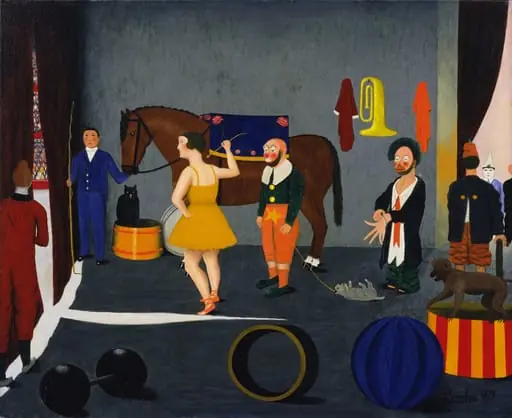 Untitled
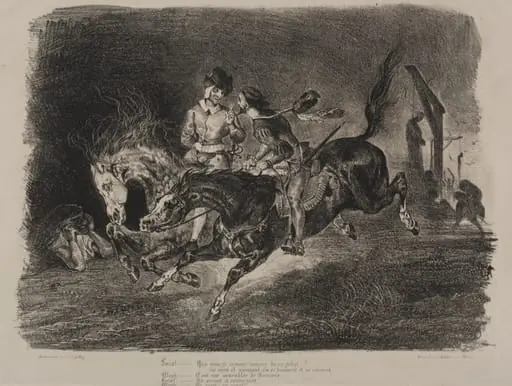 Illustrations for Faust: Faust and Méphistophélés horse riding on the Sabbath
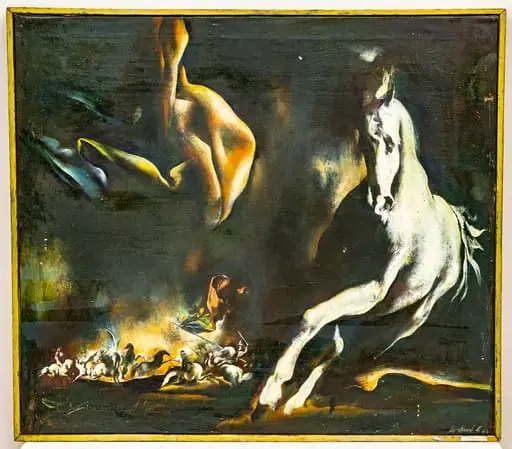 Independența
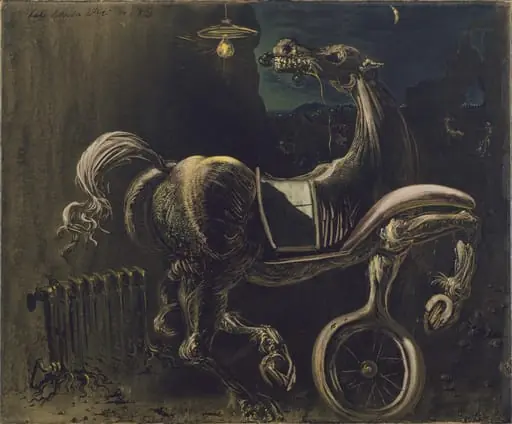 Untitled
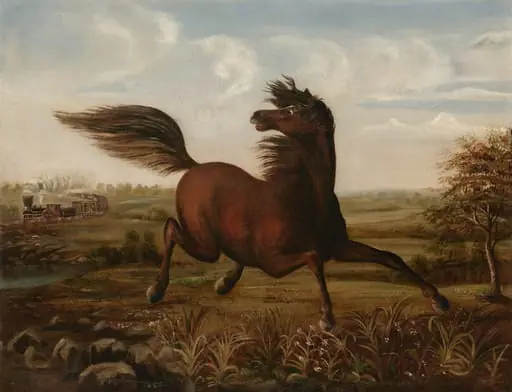 The Neigh of an Iron Horse
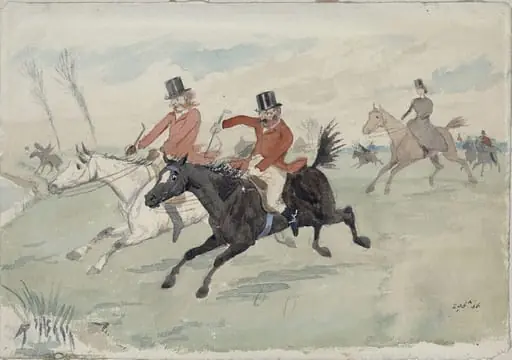 The Rivals
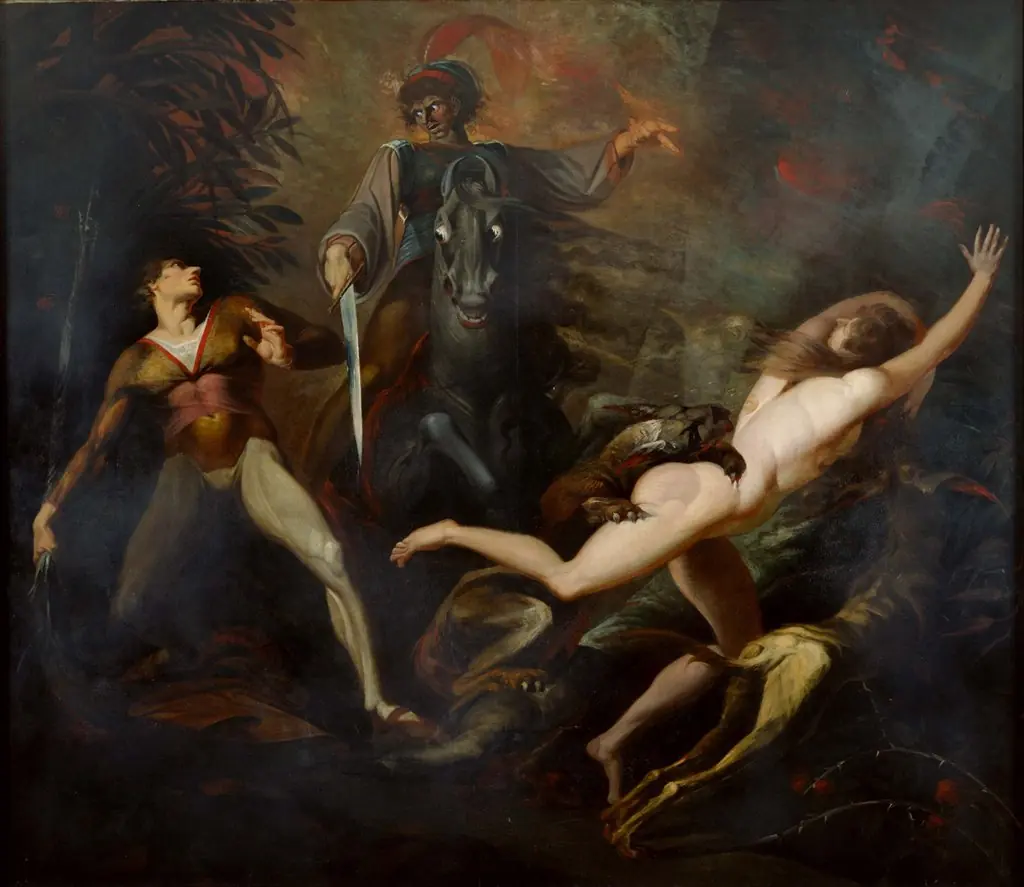 Theodore Meets in the Wood the Spectre of His Ancestor Guido Cavalcanti
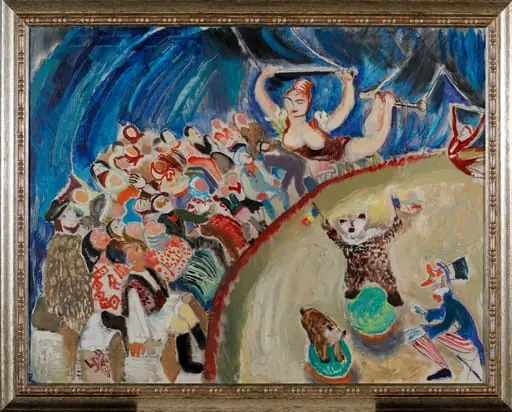 Scenă de circ
 Sf. Mucenic Gheorghe, ucingând balaurul