Artwork
Christ Appearing to the Virgin
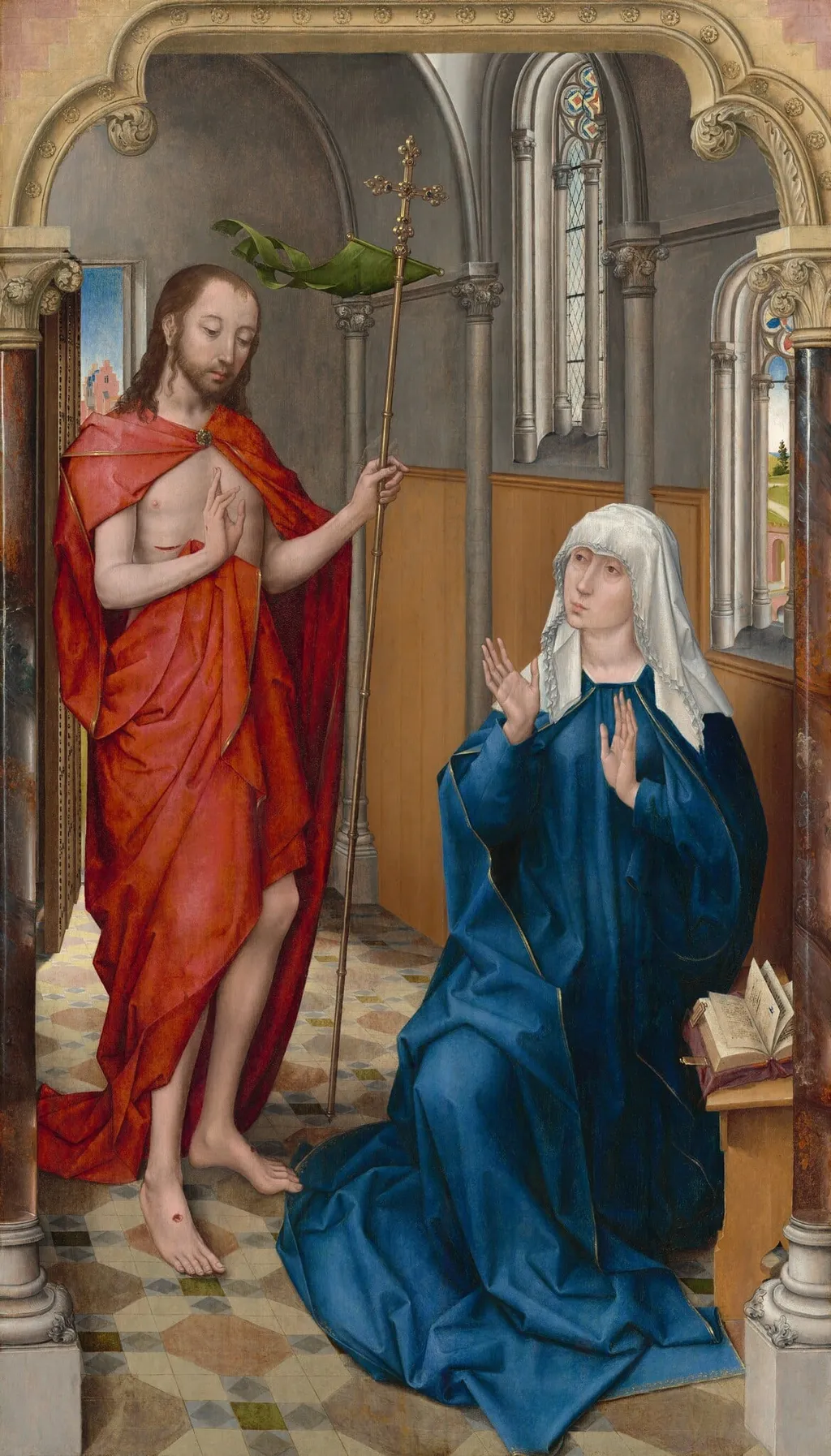
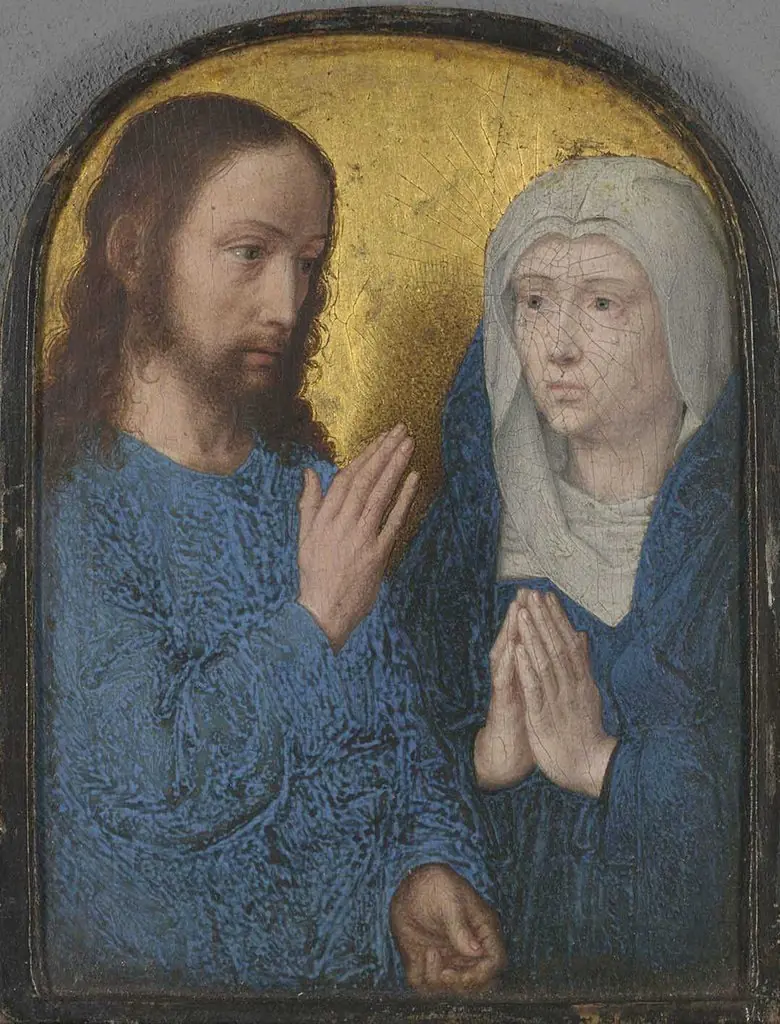
Christ Appearing to the Virgin is an oil painting by the Northern Renaissance artist Follower of Rogier van der Weyden. It dates from 1475 and is held in the collection of the National Gallery of Art.
About this work
Technique & Style
The painting is executed in oil on a wooden panel support, a common medium in Early Netherlandish painting of the late fifteenth century.
The painting is executed in oil on a wooden panel support, a common medium in Early Netherlandish painting of the late fifteenth century. The handling reveals a refined, linear precision typical of Rogier van der Weyden’s circle, with smooth transitions in modeling achieved through delicate glazing. The composition is symmetrically balanced, centered on the vertical axis of Christ’s form, and the figures are rendered with delicate, individualized features and restrained drapery folds that articulate volume without harsh modeling.
The palette relies on muted earth tones, deep blues, browns, and ochres, enlivened by selective highlights on drapery and flesh, producing a restrained yet luminous effect.
History & Provenance
Created in 1475, this oil-on-panel painting is attributed to an unknown artist, though some sources associate it with Rogier van der Weyden. The work's early ownership chain begins with Don José de Madrazo y Agudo in Madrid, where it was recorded by 1856. It subsequently passed by inheritance to his son, Don Federigo de Madrazo y Kuntz.
The painting later entered the collection of the Marqués de Salamanca, appearing in his 1865 inventory before being sold at a Paris auction in June 1867, where it was cataloged as a work by Hugo van der Goes. Following the sale, it was owned by Don Pedro de Madrazo until 1909. The piece then moved through the London and New York art markets via Durlacher, Duveen Brothers, and Kleinberger between 1909 and 1914.
Finally, the A.W. Mellon Educational and Charitable Trust purchased the work in December 1936, gifting it to the National Gallery of Art in 1937.
The painting is held by the National Gallery of Art in Washington, D.C., where it forms part of the Andrew W. Mellon collection (the sources do not specify an accession number). According to the provenance, it was purchased by the A.W. Mellon Educational and Charitable Trust in December 1936 and gifted to the National Gallery of Art in 1937. No exhibition history is recorded in the provided sources.
Context
The work known as Christ Appearing to the Virgin, dated to 1475, is classified as an Early Netherlandish religious painting executed in oil on panel. Scholarship generally identifies the anonymous master as a follower of Rogier van der Weyden, situating the piece within the broader trajectory of 15th‑century Netherlandish art. Early twentieth‑century criticism highlighted its quality, with Weale describing it as a masterpiece of the period and linking it to the attributed author.
The painting’s provenance records a chain of ownership from Spanish collectors through Parisian dealers to the Mellon family, culminating in its acquisition by the National Gallery of Art in 1937. This trajectory reflects both the work’s esteemed status and its significance within the development of early Netherlandish portraiture of divine appearances.
Legacy
The work’s later history illustrates its rising reputation in the art market and scholarship. After passing through the collections of the Marqués de Salamanca and Duveen Brothers, it entered the Andrew W. Mellon collection and was gifted to the National Gallery of Art in 1937. Its inclusion in the Mellon holdings signaled to collectors and museums that the painting was a significant example of Early Netherlandish art, a notion reinforced by catalog entries that linked it to the style of Rogier van der Weyden.
The painting’s provenance, scholarly discussion, and public display have contributed to its enduring legacy as a representative piece of 15th‑century religious art.
Overview
This oil painting, titled Christ Appearing to the Virgin, presents a sacred encounter between the resurrected Christ and the Virgin Mary. Executed on a wooden panel, the work conveys a profound sense of devotion and spiritual significance. The composition carefully arranges the two central figures within an architectural setting, inviting contemplation of this pivotal moment in Christian narrative.
Subject & Meaning
The scene depicts Christ, positioned on the left, with long hair and clad in a red robe, holding a staff. A subtle wound on his bare right foot alludes to his recent crucifixion. Opposite him, the Virgin Mary, dressed in blue with a white head covering, raises her hands in a gesture that suggests either prayerful reverence or astonished recognition. The interaction captures a moment of intimate spiritual revelation.
Artist & collection

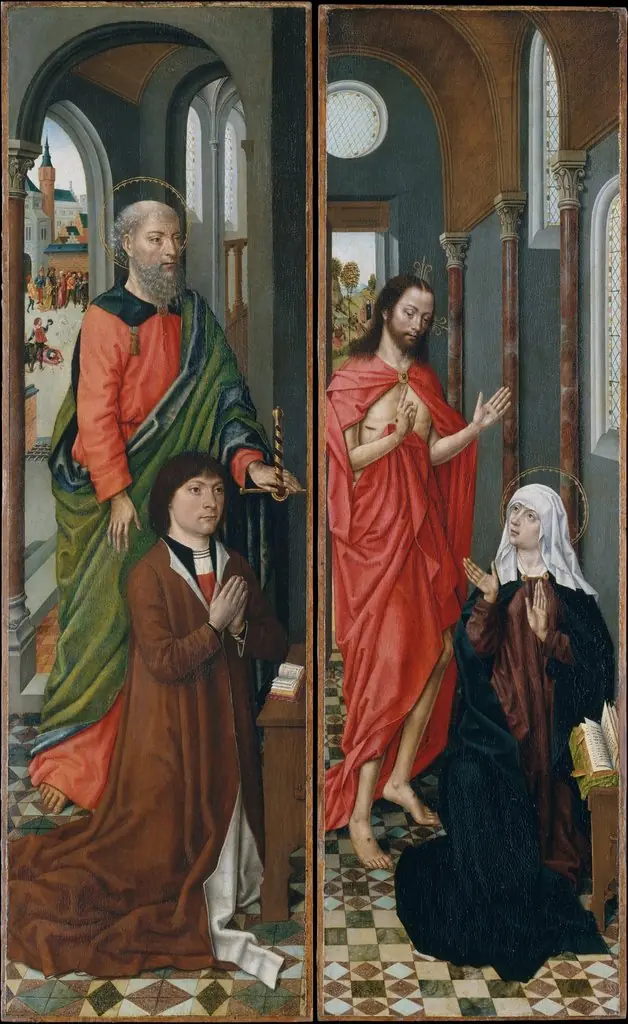 Saint Paul with Paolo Pagagnotti; Christ Appearing to His Mother
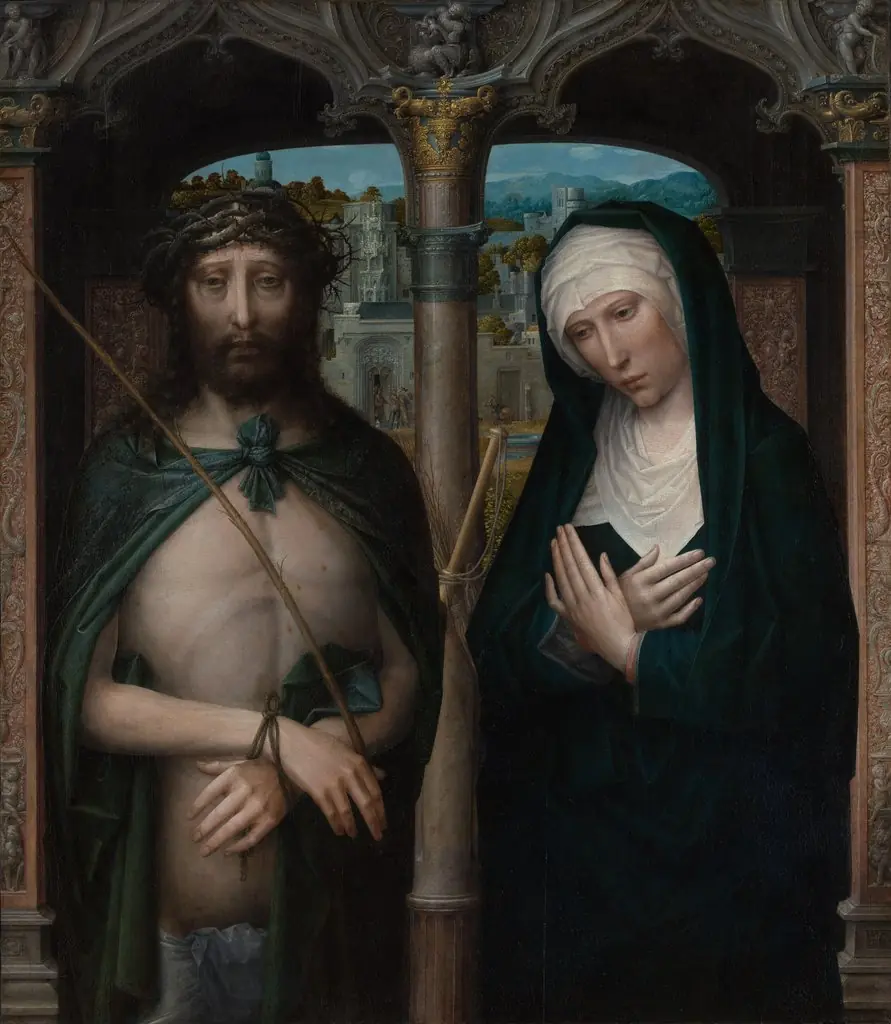 Christ Crowned with Thorns (Ecce Homo), and the Mourning Virgin
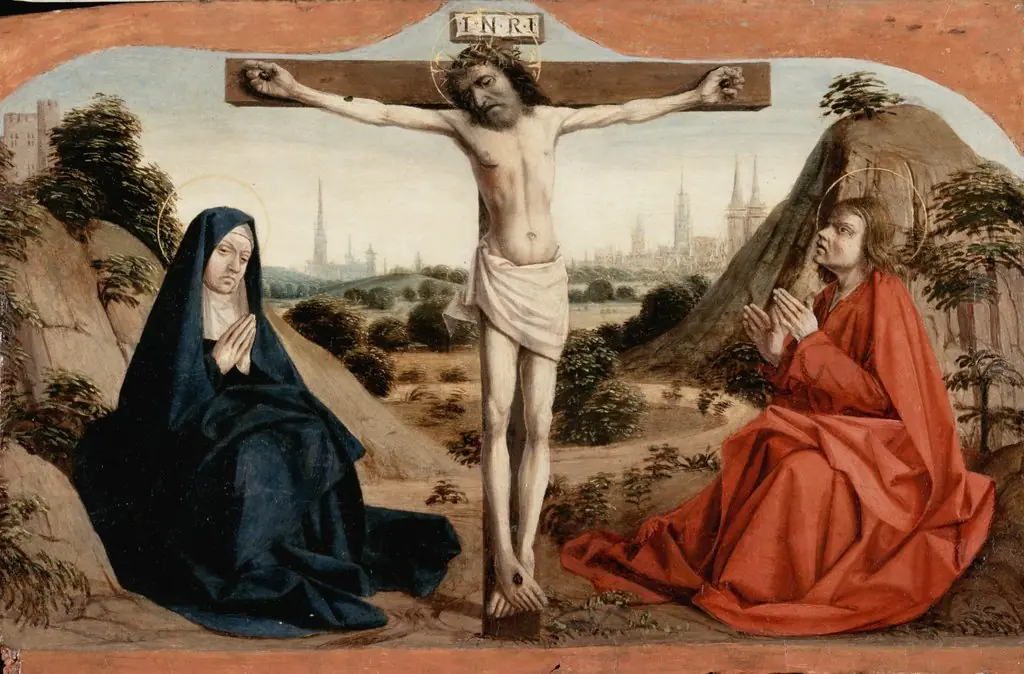 Crucifixion
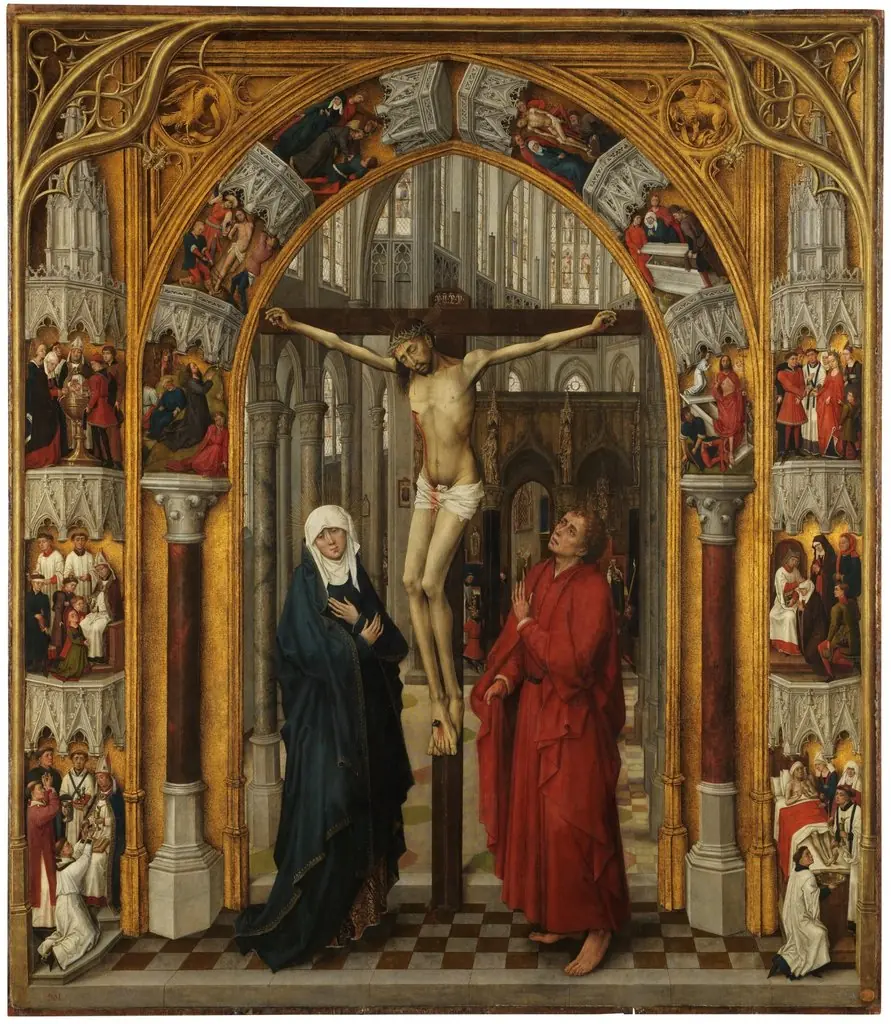 Redemption Triptych: The Crucifixion
 Teil eines Diptychons: Abschied Christi von Maria
 Apparition of Christ to Magdalen
 The Altar of St. John
 Christ's Bath
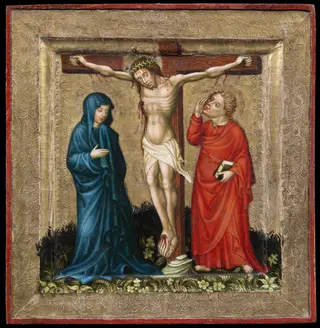 Christ on the Cross with the Virgin Mary and John