Artwork
De Rozenhoedkaai in Brugge
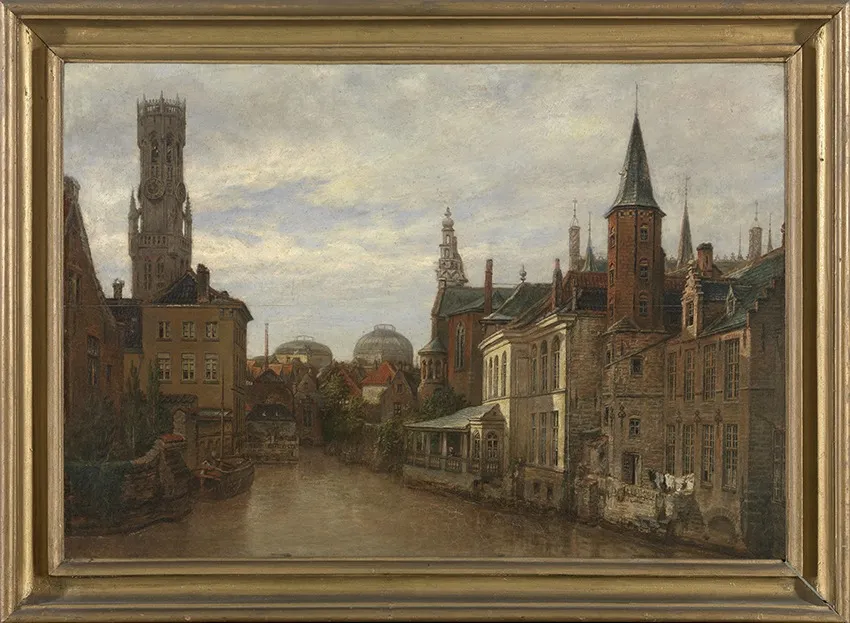
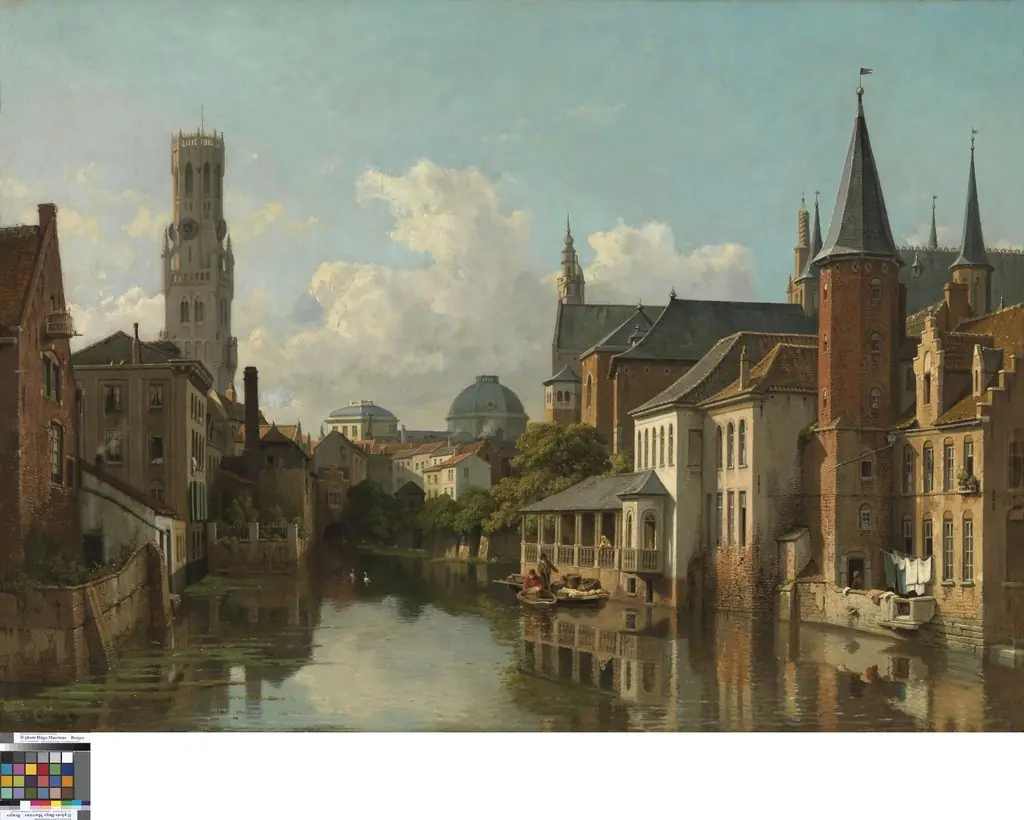
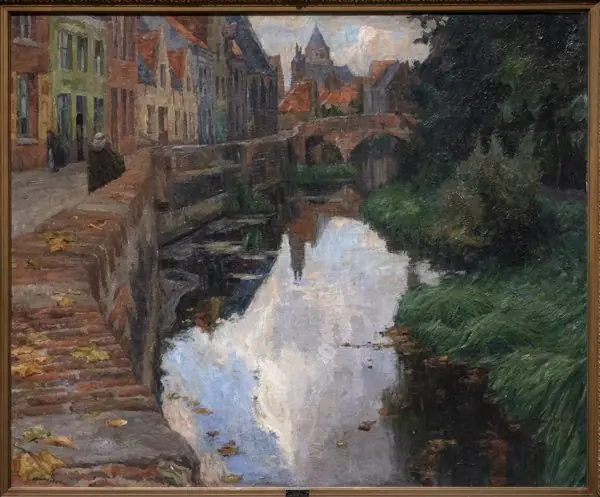
De Rozenhoedkaai in Brugge is an oil painting by the Impressionist artist Antoon Joostens. It dates from 1875 and is held in the collection of the Groeningemuseum.
About this work
Subject & Meaning
The composition centers on the waterway, where boats are visible, and is flanked by the city's most recognizable landmarks.
De Rozenhoedkaai in Brugge is a cityscape that frames the historic Rozenhoedkaai quay along the Reie canal in Bruges. The composition centers on the waterway, where boats are visible, and is flanked by the city's most recognizable landmarks. The Belfry of Bruges rises as a dominant vertical element, while the facades of the Museum van het Heilig Bloed, Bruges City Hall, and the Provinciaal Hof line the waterfront, anchoring the scene in its civic and religious setting. Trees and clouds soften the architectural ensemble, lending atmosphere to the view.
By depicting this celebrated vantage point, the painting functions as a topographical record of Bruges's medieval core, presenting the canal-side ensemble of civic, ecclesiastical, and judicial buildings as a unified heritage landscape. The inclusion of working boats on the Reie suggests the continuity of daily life within a historic urban setting, while the prominence of the Belfry emphasizes the city's enduring identity as a medieval commercial and cultural center.
Technique & Style
Antoon Joostens painted De Rozenhoedkaai in Brugge using oil paint on a wooden panel, a technique typical of 19th-century cityscapes. The work measures 45.3 cm in height by 65.3 cm in width and depicts the Rozenhoedkaai square, the Belfry of Bruges, and surrounding historic buildings. It is classified as a cityscape and is housed in the Groeningemuseum, where it remains on display.
The painting’s formal qualities reflect a realist approach, with careful rendering of architectural detail and atmospheric effects such as clouds and water. Its condition is stable, preserved as part of the museum’s permanent collection.
History & Provenance
Antoon Joostens created the oil painting De Rozenhoedkaai in Brugge in 1875. The work was executed on a panel support measuring 45.3 cm in height and 65.3 cm in width. It depicts the Rozenhoedkaai quay in Bruges, featuring landmarks such as the Belfry and the Reie river. The painting is currently held in the collection of the Groeningemuseum.
The painting De Rozenhoedkaai in Brugge is held in the collection of the Groeningemuseum in Bruges. Created by Antoon Joostens in 1875, the work is executed in oil on panel and measures 45.3 cm by 65.3 cm. While the artwork depicts prominent local landmarks such as the Belfry of Bruges and the Reie river, the available records confirm its location within the museum's holdings but do not provide a specific inventory number or details regarding its exhibition history.
Context
Antoon Joostens' 1875 oil painting De Rozenhoedkaai in Brugge depicts a bustling Bruges street scene featuring the Rozenhoedkaai square, the Belfry, and historic buildings, rendered in the cityscape genre. The work is housed in the Groeningemuseum in Bruges, where it has been part of the collection since its creation. Scholarship situates the painting within Joostens' oeuvre as an example of 19th-century Flemish urban realism, emphasizing his focus on documenting contemporary city life through precise architectural detail and atmospheric lighting.
Its composition and subject matter reflect broader 19th-century trends in European cityscape painting, particularly the move toward documenting everyday urban environments with increasing photographic precision. The painting's inclusion in the Groeningemuseum's collection has ensured its visibility within Belgian art historical narratives, though specific critical commentary from the 19th century is not documented in available sources.
Legacy
The painting's visibility in the Groeningemuseum collection has cemented its status as an early visual record of Bruges' historic market square, inspiring subsequent scholarship on 19th-century Flemish urban scenes. Art historians reference its composition when discussing the development of cityscape genre in Belgium, and the work is frequently cited in exhibition catalogues that explore the evolution of local identity through art. Its enduring reputation rests on being one of the few documented oil depictions of the Rozenhoedkaai from the 1800s, shaping modern perceptions of the site's architectural continuity.
Overview
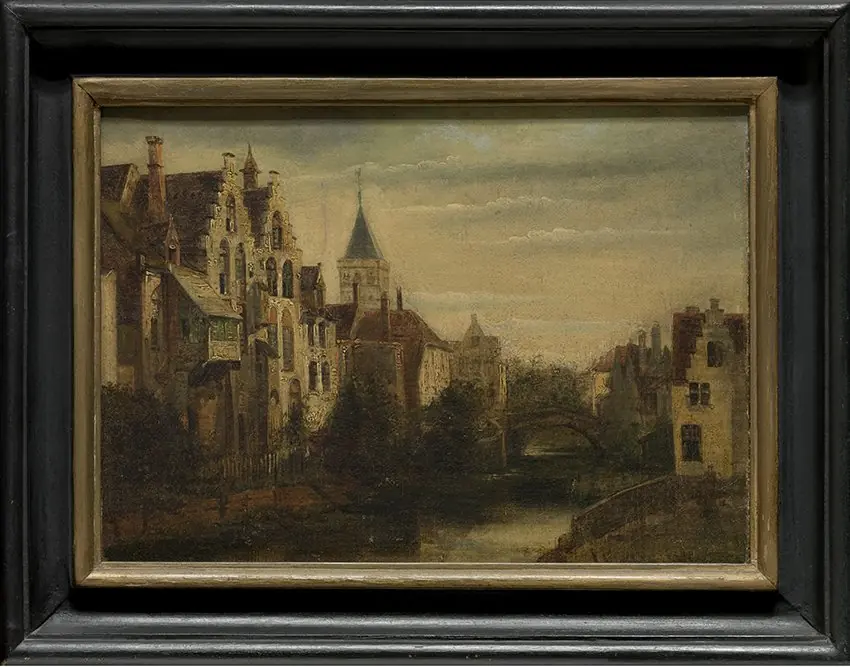
Antoon Joostens painted this oil work in 1875, presenting a tranquil canal scene in Bruges. The composition captures the city’s historic architecture, with a prominent clock tower rising among brick façades, while a small boat rests on the water’s edge.
Artist & collection

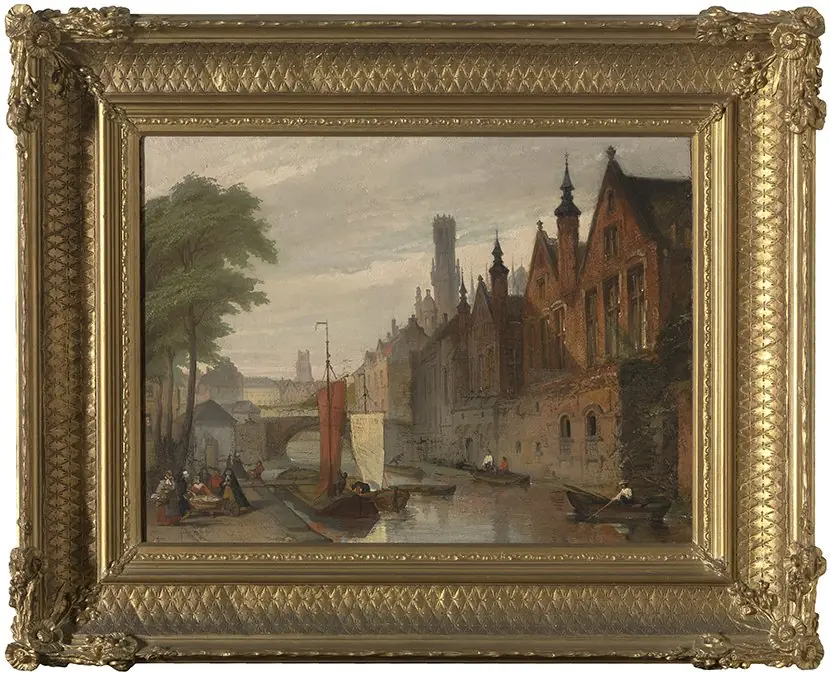 Het Brugse Vrije vanop de Steenhouwersdijk
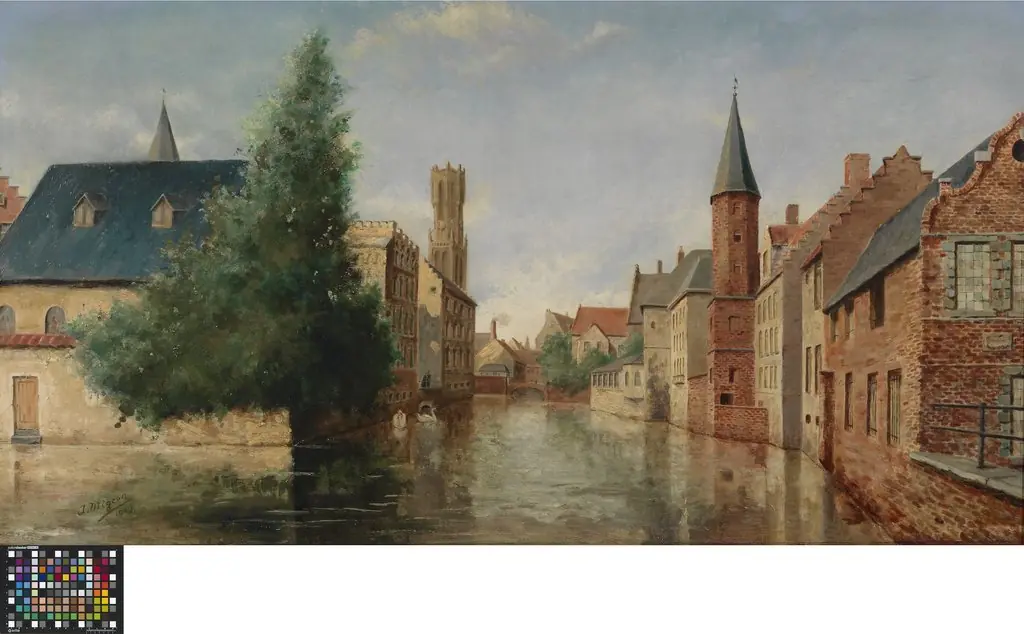 De Rozenhoedkaai in Brugge
 Facades on the Handschoenmarkt, Antwerp
 Het Jan van Eyckplein in Brugge
 Upper Lock at Steenbergen
 De Rozenhoedkaai in Brugge
 Ingang van het Begijnhof in Brugge
 A View of Temse
 The Antwerp Waterfront in 1870
 Urban Landscape
 De Speelmansrei te Brugge
- De Pottenmakersstraat in Brugge