Artwork
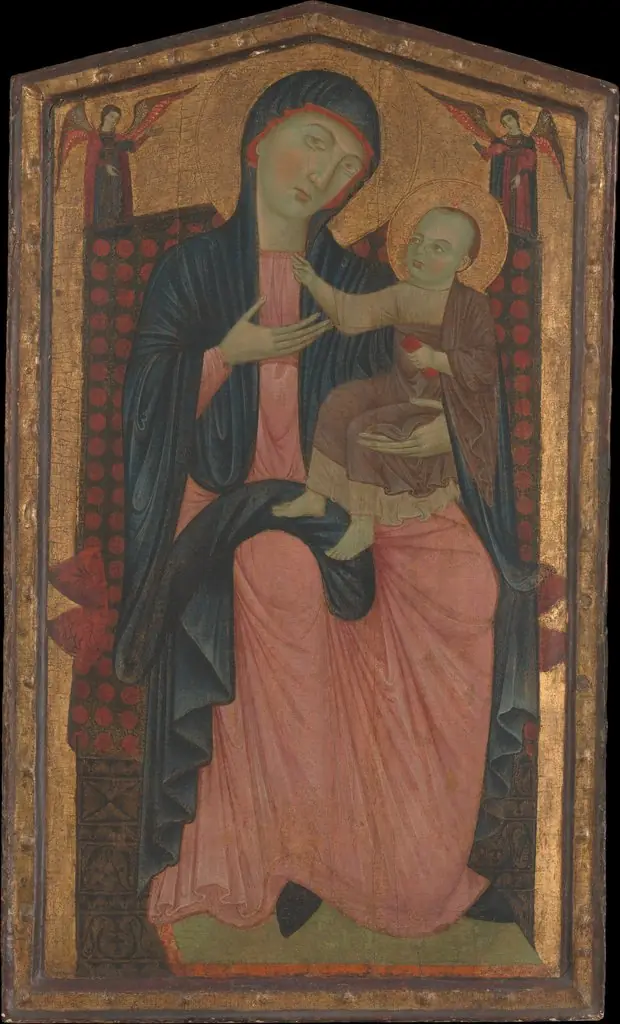
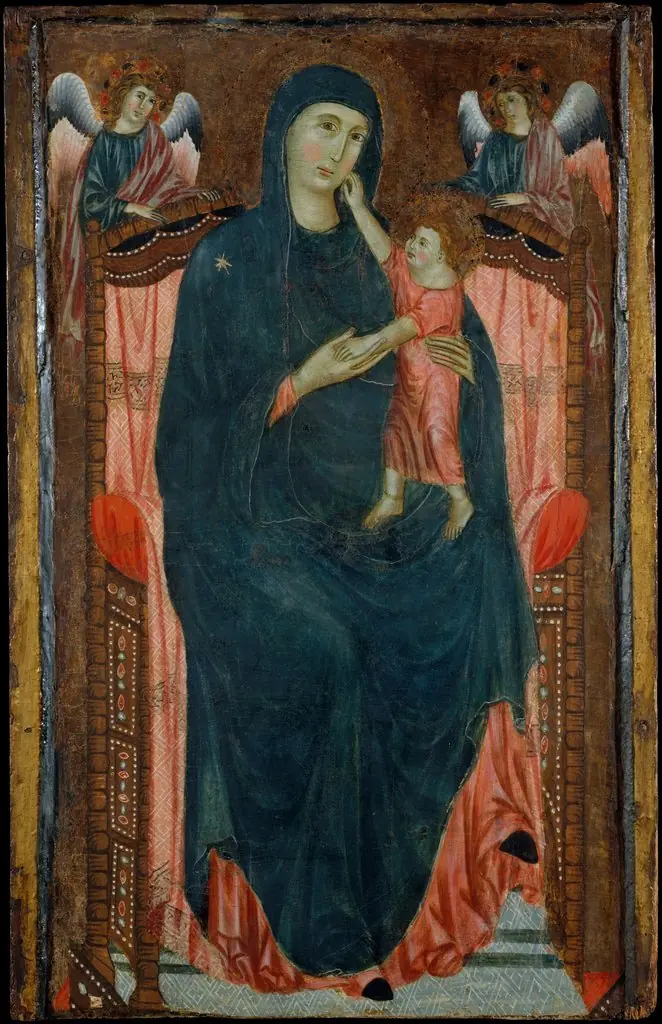
Madonna and Child with Five Angels
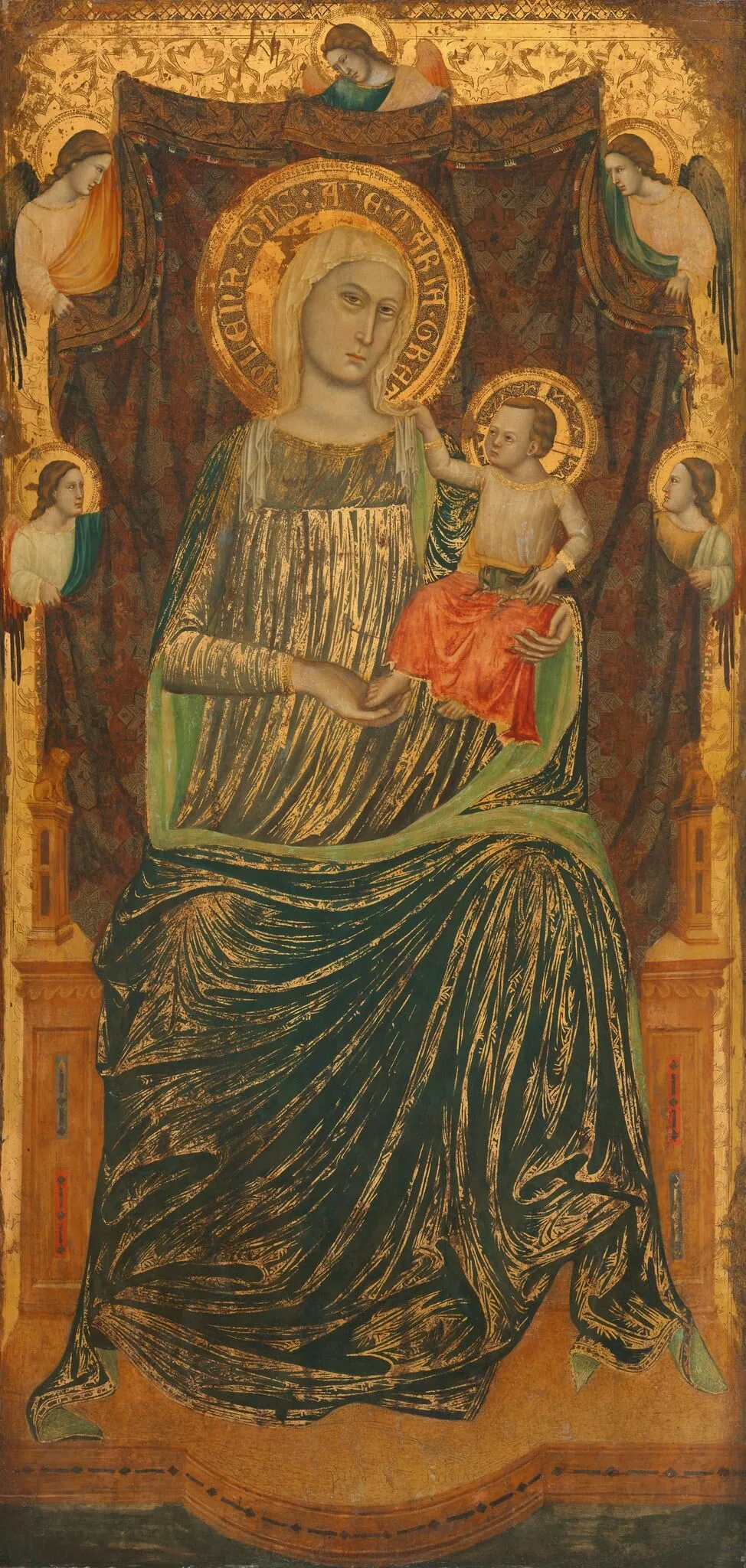
Madonna and Child with Five Angels is a tempera painting by the Byzantine icon painting artist Giovanni Baronzio. It dates from 1335 and is held in the collection of the National Gallery of Art.
- Inscription
- Inscribed:on the Madonna's halo: AVE.MARIA.GRAT[IA].PLENA.D[OMI]N[U]S: (Hail, Mary, full of grace, the Lord is with thee; from Luke 1:28)
About this work
Mary holds the Christ Child while five richly dressed angels gather around, playing music and gazing at the baby. Gold and bright color lend the scene a sense of occasion. Giovanni Baronzio, tempera on panel, 1335.
Subject & Meaning
The subject of Madonna and Child with Five Angels centers on the Virgin Mary cradling the Christ Child, flanked by five attendant angels, a composition rooted in late medieval Marian iconography. Mary, crowned and robed in blue and red, embodies maternal devotion and divine grace, while the Christ Child, often depicted with a blessing gesture or holding a scroll, symbolizes salvation and divine wisdom. The five angels, positioned symmetrically around the pair, likely represent celestial beings in service to the Holy Family, reinforcing themes of heavenly intercession and protection.
This iconography aligns with fourteenth-century Italian devotional practices, emphasizing Mary’s role as intercessor and the Christ Child’s future redemptive mission. The work’s religious genre and commissioning context, possibly for a church dedicated to Saint John the Baptist, suggest its function as an object of veneration, designed to inspire contemplation and piety among worshippers.
Technique & Style
Created in 1335, Madonna and Child with Five Angels is executed in tempera on a wooden panel support.
Created in 1335, Madonna and Child with Five Angels is executed in tempera on a wooden panel support. The work exemplifies the religious painting traditions of Giovanni Baronzio, depicting the Virgin Mary and the Christ Child within a composition that includes five angels. As a panel painting from the fourteenth century, the technique relies on the application of pigment bound with egg tempera onto the rigid wood surface, a standard medium for altarpieces of this era.
The artwork remains part of the Samuel H. Kress Collection at the National Gallery of Art in Washington, D.C., where it is classified as a significant example of religious art from the artist's hand.
History & Provenance
Dated to 1335, this tempera panel by Giovanni Baronzio was likely commissioned for the high altarpiece of a church dedicated to Saint John the Baptist in either Emilia Romagna or the Marche region. By the early twentieth century, the work belonged to Léon Ouroussoff, held in Vienna, Monte Carlo, or Cannes. Edward Fowles acquired the painting for Duveen Brothers in February 1920, subsequently selling it to Otto H. Kahn of New York by 1924.
Following Kahn's death, his widow, Addie Wolff Kahn, sold the panel back to Duveen Brothers on January 18, 1937. The firm then sold the work to the Samuel H. Kress Foundation in 1942, which gifted it to the National Gallery of Art in Washington, D.C., the following year.
The painting is held by the National Gallery of Art in Washington, D.C., where it is part of the Samuel H. Kress Collection, having been gifted to the museum in 1943. Its provenance traces from early twentieth‑century private collections through a series of sales and inheritances, culminating in its acquisition by the Kress Foundation and subsequent donation to the gallery. No exhibition history is documented in the provided sources, so the work’s exhibition record cannot be detailed here.
Overview
Giovanni Baronzio, also known as Giovanni da Rimini, created Madonna and Child with Five Angels around 1335. This tempera on panel painting depicts the Virgin Mary holding the Christ Child, surrounded by five angelic figures. The work exemplifies the artist's style within the Rimini school, active in Italy's Romagna and Marche regions. It reflects the era's artistic currents, including influences from Giotto, while adhering to established religious iconography.
Context
Giovanni Baronzio was a prominent figure in the second generation of the Rimini school, a significant artistic center in 14th-century Italy. His work, active in the Romagna and Marche regions, absorbed the artistic innovations brought by Giotto, who was present in the area during this period. This influence is evident in the developing naturalism and compositional approaches seen in Baronzio's output, even as he maintained traditional iconographic forms.
Artist & collection
Artist
Giovanni Baronzio, also known as Giovanni da Rimini, (died before 1362), was an Italian painter who was active in Romagna and the Marche region during the second quarter of the 14th century.