Artwork
Madonna of Humility
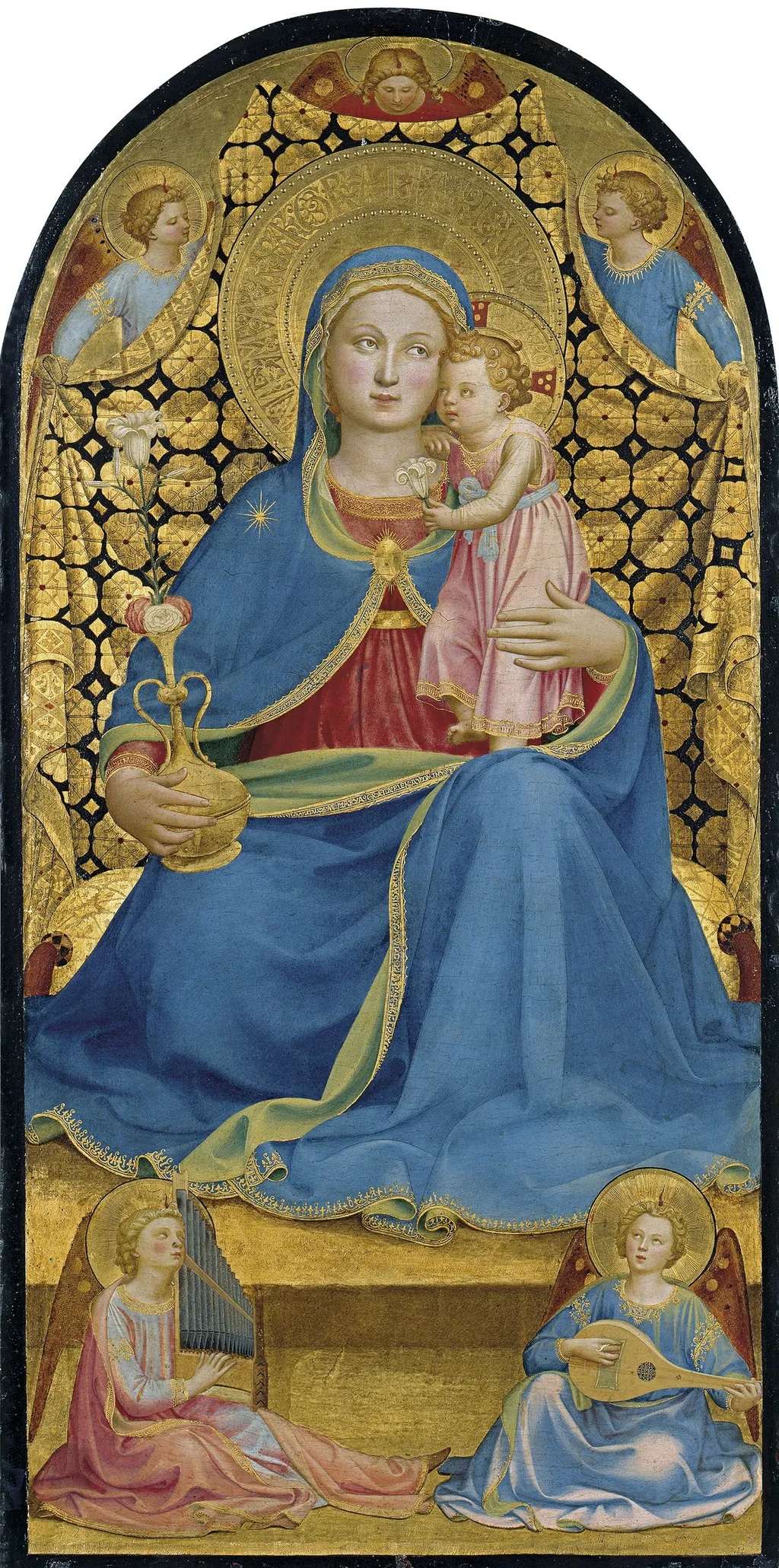
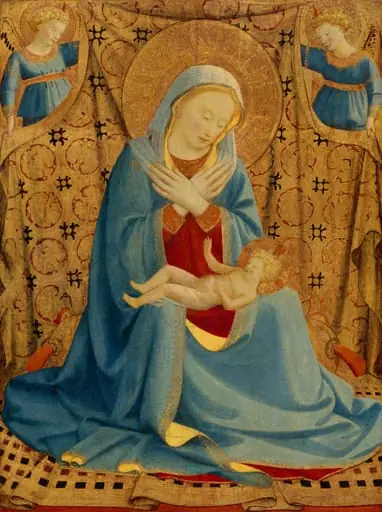
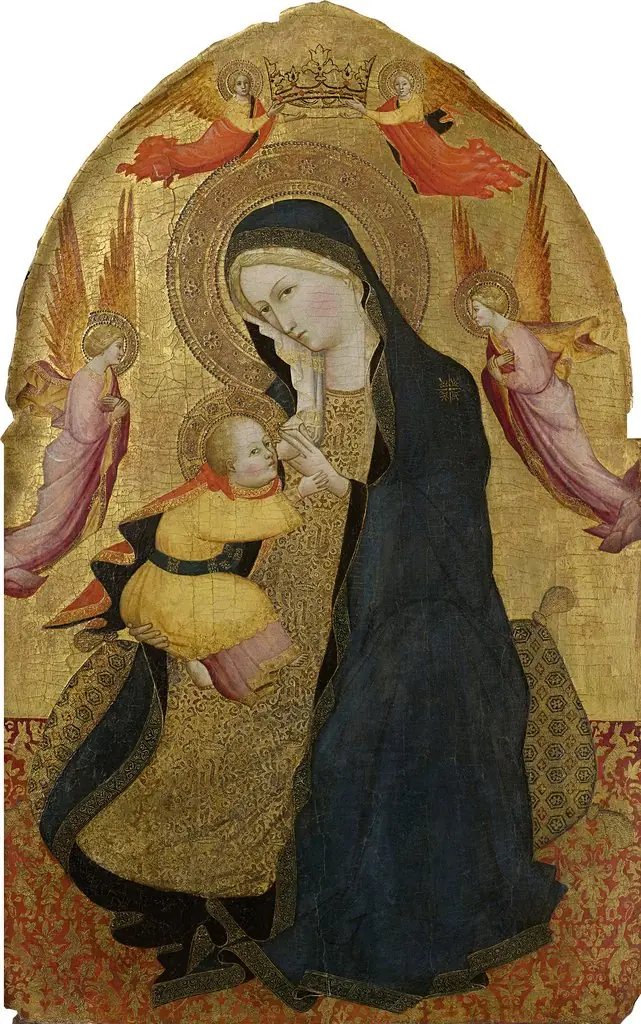
Madonna of Humility is a tempera painting by the High Renaissance artist Fra Angelico. It dates from 1433 and is held in the collection of the Museu Nacional d'Art de Catalunya.
About this work
Technique & Style
The work measures 1470 by 910 centimeters and is executed in tempera on wood, with extensive use of gold leaf enhancing its devotional character.
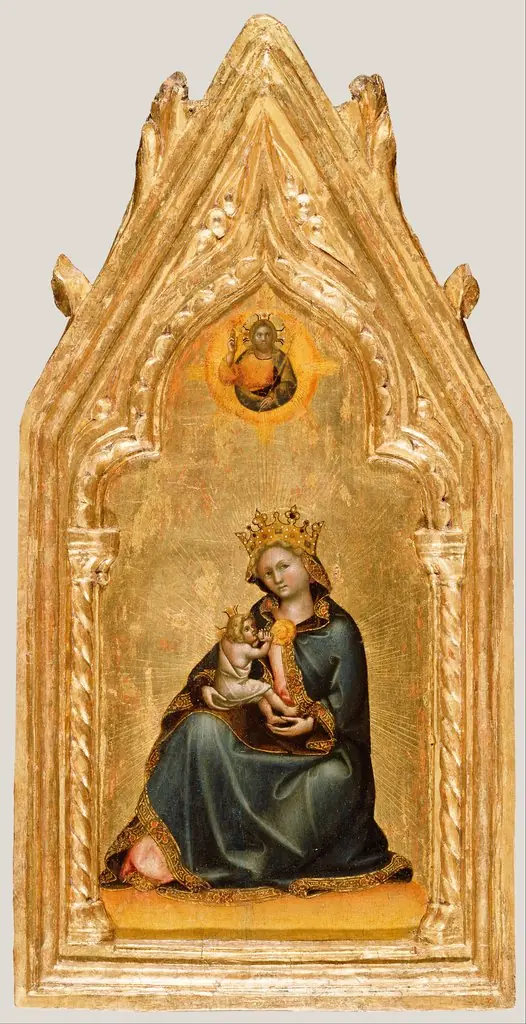
The Madonna of Humility is a tempera-on-panel painting created by Fra Angelico between 1433 and 1435. It depicts the Virgin Mary seated on a cushion on the ground, holding the Christ Child on her lap, with both figures surrounded by angels and symbolic elements such as lilies and roses representing purity and motherhood. The work features a gold-and-black brocade canopy held by three angels, while two others play musical instruments, contributing to a composition marked by monumental figures, rich drapery, modulated lighting, and a dominant use of blue and gold that aligns with Quattrocento Italian artistic conventions. The painting’s surface shows signs of past damage, including a repaired loss in the Virgin’s mouth area from the 1950s, attributed to a bullet wound, which was restored during recent conservation efforts.
The work measures 1470 by 910 centimeters and is executed in tempera on wood, with extensive use of gold leaf enhancing its devotional character. It is currently housed in the Museu Nacional d'Art de Catalunya in Barcelona, on loan from the Thyssen-Bornemisza Museum in Madrid, where it was acquired in 1935 and reintegrated into the collection in 1986 after a period in private hands.
History & Provenance
Executed between 1433 and 1435 during Fra Angelico's mature period, this tempera panel was likely the central piece of a polyptych described by Giorgio Vasari in 1568 within the Gondi family home in Florence. By the early nineteenth century, the work belonged to Prince George of England, who gifted it to his daughter Charlotte; upon her death in 1817, it passed to her husband, the future King Leopold I of Belgium, and subsequently to their son, Leopold II. The painting later entered the New York collection of J. P. Morgan Jr. before being acquired by Heinrich Thyssen-Bornemisza in 1935. Following the baron's death and the dispersal of his collection, his son repurchased the panel in 1986. It was included in the core group of works deposited in Spain, displayed at the Monastery of Pedralbes from 1993 until 2004, and has since been conserved on loan at the National Art Museum of Catalonia.
The painting belongs to the Thyssen-Bornemisza Museum in Madrid and is held on long-term loan at the Museu Nacional d'Art de Catalunya (MNAC) in Barcelona. It was acquired by the 1st Baron Thyssen-Bornemisza in 1935, passed out of the family after his 1947 death, and was repurchased by the 2nd Baron in 1986. In 1988 the panel was selected for the indivisible core of the Thyssen collection offered to Spain, and in 1993 it was placed on public display at the Monasterio de Pedralbes in Barcelona as part of a 60-work deposit. The work was moved to the MNAC in 2004, was restored at the Thyssen-Bornemisza's Madrid workshops in 2022, and was shown in Madrid in a temporary installation from December 2022 before returning to Barcelona in December 2023.
Context
Scholarship identifies this panel as the work described by Giorgio Vasari in 1568 in the Gondi family home in Florence, where it formed part of a polyptych. The painting exemplifies the purest fifteenth-century Italian style through its monumental figures, splendour of vestments, modulated light, and prominent use of blue. Art historical analysis notes that while Fra Angelico employs abundant gold leaf to confer a divine character and depicts a young, innocent Virgin, her face retains a certain hieratic quality rooted in medieval tradition. The work belongs to the Italian Renaissance movement and represents one variant within the rich Marian iconography of the Madonna of Humility, a type that became frequent from the thirteenth century onward.
Legacy
The Madonna of Humility exerted lasting influence through its impact on devotional imagery and Renaissance art theory. Giorgio Vasari recognized the panel in 1568 as part of a Gondi family polyptych, affirming its early prominence and role in documenting Florentine artistic practice. Its iconography, depicting the Virgin seated on the ground with the Christ Child, became a widely emulated model for later depictions of the Virgin and Child, particularly in its use of gold leaf, rich textiles, and attendant angels, which informed devotional painting across Italy and Spain. The work's journey through private collections, including ownership by the Thyssen-Bornemisza family, reflected broader patterns of art market circulation in the 19th and 20th centuries. Restoration efforts in the late 20th and early 21st centuries revealed original pigments and gilding techniques, contributing to scholarly understanding of 15th-century painting methods. Today, the painting is regarded as a key example of Fra Angelico’s synthesis of Dominican piety and Renaissance naturalism, frequently cited in studies of Marian imagery and Italian religious art.
Artist & collection

Artist
Fra Giovanni da Fiesole (born Guido di Pietro; c. 1395 – 18 February 1455), known posthumously as Fra Angelico ( FRAH an-JEL-ik-oh, Italian: ), was an Italian Dominican friar and painter active during the early…