Artwork
The Alchemist
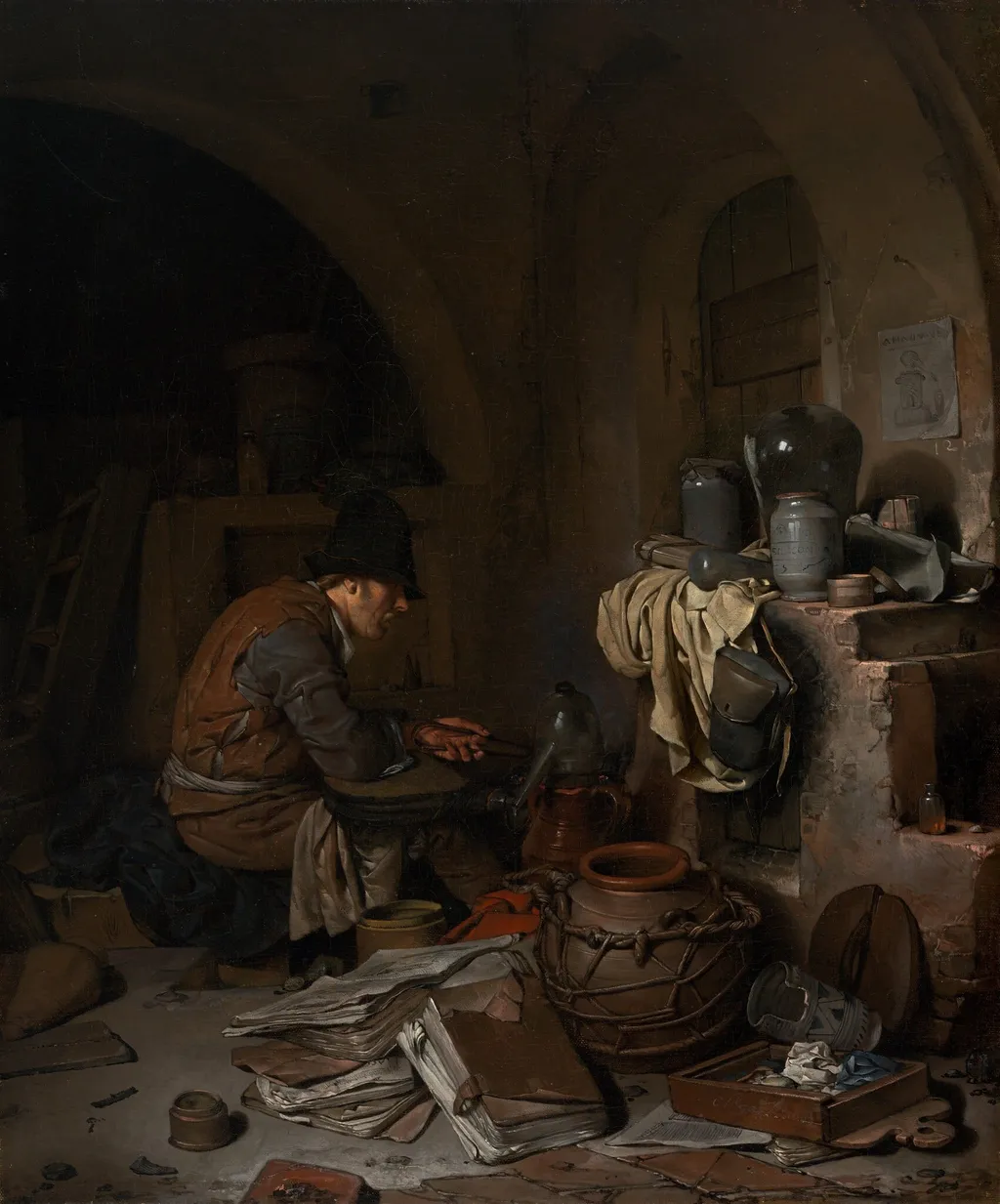
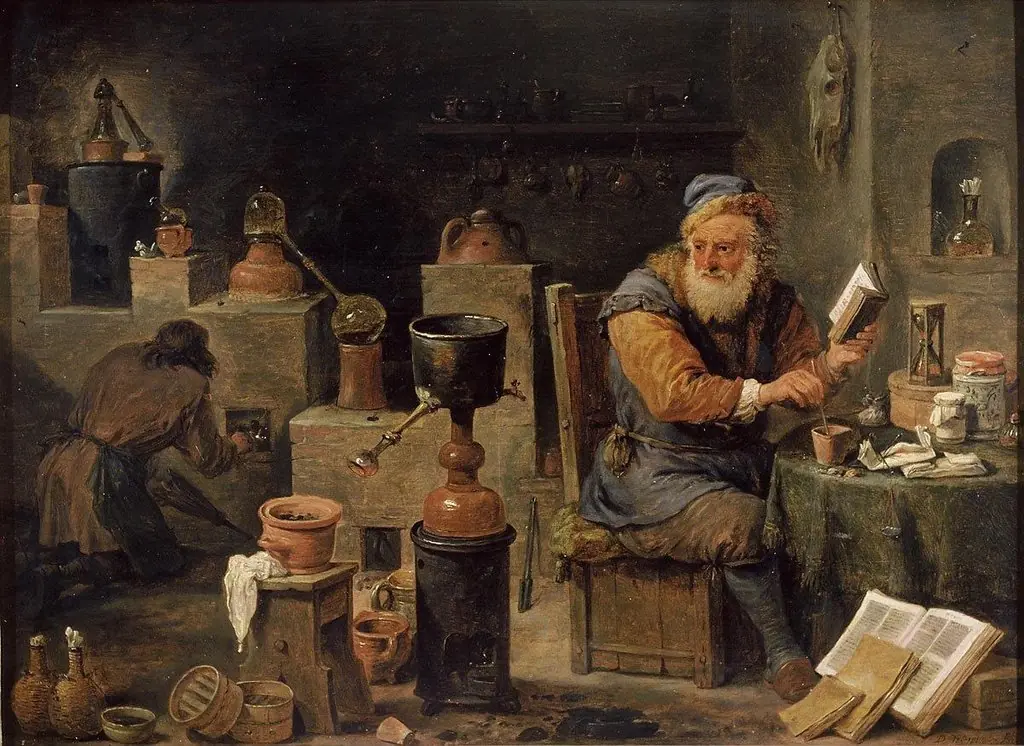
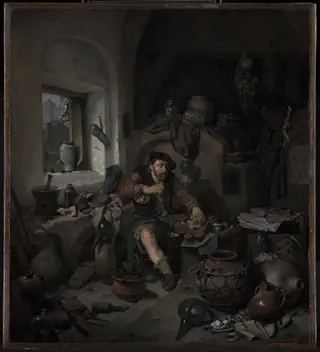
The Alchemist is an oil painting by the Baroque artist Cornelis Bega. It dates from 1663 and is held in the collection of the National Gallery of Art.
- Inscription
- Inscribed:lower right, in gray paint on box: C. Bega Ao.1663
About this work
Overview
6 centimeters, the work depicts a solitary figure engaged in a chemical experiment within a dim, sparse interior.
The Alchemist is a 1663 oil on canvas mounted on panel by the Dutch Golden Age painter Cornelis Pietersz Bega. Measuring 35 by 28.6 centimeters, the work depicts a solitary figure engaged in a chemical experiment within a dim, sparse interior. The painting is signed and dated lower right in gray paint on a box. It is currently held in the National Gallery of Art in Washington, accessioned as 2013.34.1. The work stands as a significant example of seventeenth-century Dutch genre painting, demonstrating Bega's meticulous technique and his nuanced approach to a subject that bridged early science and popular mockery.
Subject & Meaning
The painting portrays an alchemist intently hunched over his work, wearing a dark felt cap and brown vest, with blue sleeves. He squeezes bellows under his arm to heat a small furnace, grasping metal tongs that reach into the fire. Blue-grey smoke billows behind a domed alembic, a glass distillation vessel. Heated vapor from an open-topped vessel below rises into the hooded alembic, cools on its glass dome, and drips from the alembic's spout into a red cloth filter before reaching a floor receptacle. An illustration of this distillation process, bearing undecipherable alchemical text, is attached to the stone wall above the oven. Thick tomes with worn leather covers and rumpled pages lie within arm's reach. Beautifully rendered earthenware pots and various glass, wooden, leather, and metal containers signify the many ingredients used over the years. A glazed earthenware apothecary jar on the furnace appears to read "silicon", but likely depicts the end of the word "basilicon", a curative ointment used by alchemists for strengthening and healing potions. While alchemists were often mocked as fools for their futile quest to turn lead into gold using the legendary philosopher's stone, Bega depicts this humble practitioner with dignity, emphasizing the discipline's scholarly and proto-chemical components over its reputation for ruin.
Technique & Style
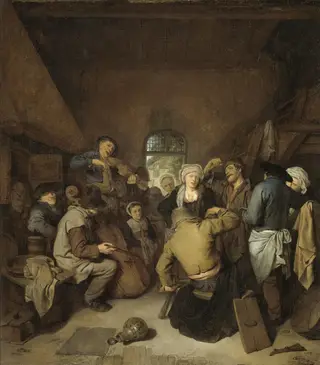
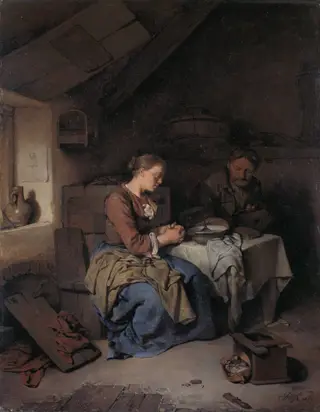
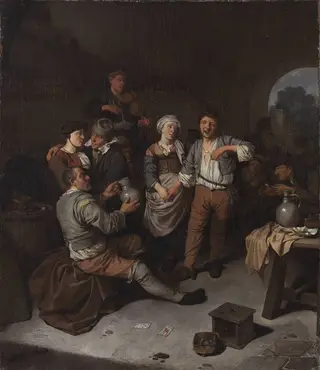
Bega employed a palette of browns, grays, muted blues, and touches of red to construct the dim interior. Strong chiaroscuro illuminates the figure and foreground objects while deep shadows engulf the background stone arches, closed wooden door, and dark arched opening. His fine brushwork and mastery of light evoke the luminous presence of inanimate objects. Visible brushwork renders the textures of fabric, ceramic, and paper with a smooth, detailed finish in the foreground and looser handling in the dark areas. Bega captures every chink, imperfection, and reflection in the scattered implements, including dust lying on discarded clay vessels. This attentive rendering of materials reflects the influence of Leiden fijnschilders like Gerrit Dou and Frans van Mieris, which Bega incorporated in the late 1650s as he shifted toward smaller paintings with fewer figures and highly detailed brushwork, moving away from the looser, rougher style of his master, Adriaen van Ostade.
History & Provenance
The painting's provenance begins with Cornelis Backer in Amsterdam, whose sale in Zoeterwoude on August 16, 1775, included the work. It passed through the hands of Abraham Delfos in Leiden and Jonkheer Menno Baron van Coehoorn in The Hague, whose estate sale took place in Amsterdam on October 19, 1801. Louis-Bernard Coders of Amsterdam and Liege then owned it before it entered a rapid series of Parisian sales between 1802 and 1804, passing through Alexandre-Joseph Paillet, Bon-Thomas Henry, Louis-Chretien Lorch, and Nodin. M. Gabory of Rouen owned it before his estate sale in Paris on April 15 to 16, 1822. The painting entered an English private collection by 1938, then belonged to Marchese San Pieri Talon in Bologna, whose sale in Venice on June 2, 1985, brought it to French and Co. in New York. Robert H. and Clarice C. Smith of Bethesda purchased it in October 1985, sold it back to French and Co. in November 1989, and it subsequently passed to Bob P. Haboldt and Co. by 1990, appearing at TEFAF in Maastricht that March. Martin and Ethel Wunsch of New York purchased it in 1992 and gifted it to the National Gallery of Art in 2013. It was exhibited in Aachen and Berlin in 2012 for the exhibition Cornelis Bega: Eleganz und raue Sitten, and in Washington and Paris in 2016 and 2017 for Drawings for Paintings in the Age of Rembrandt.
Context
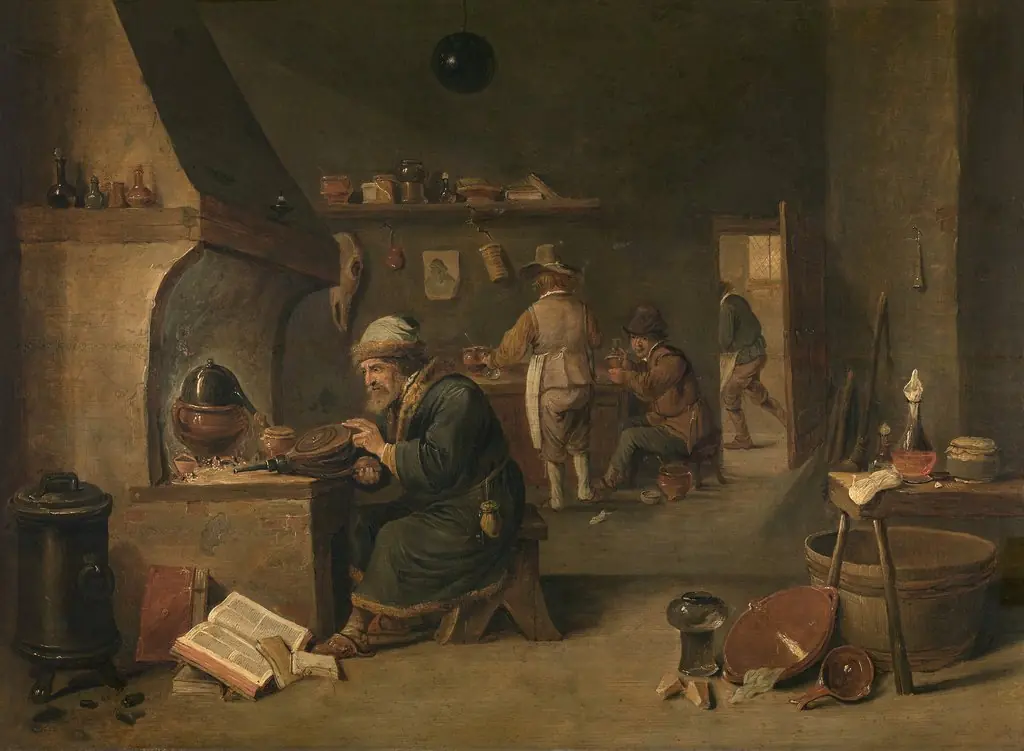
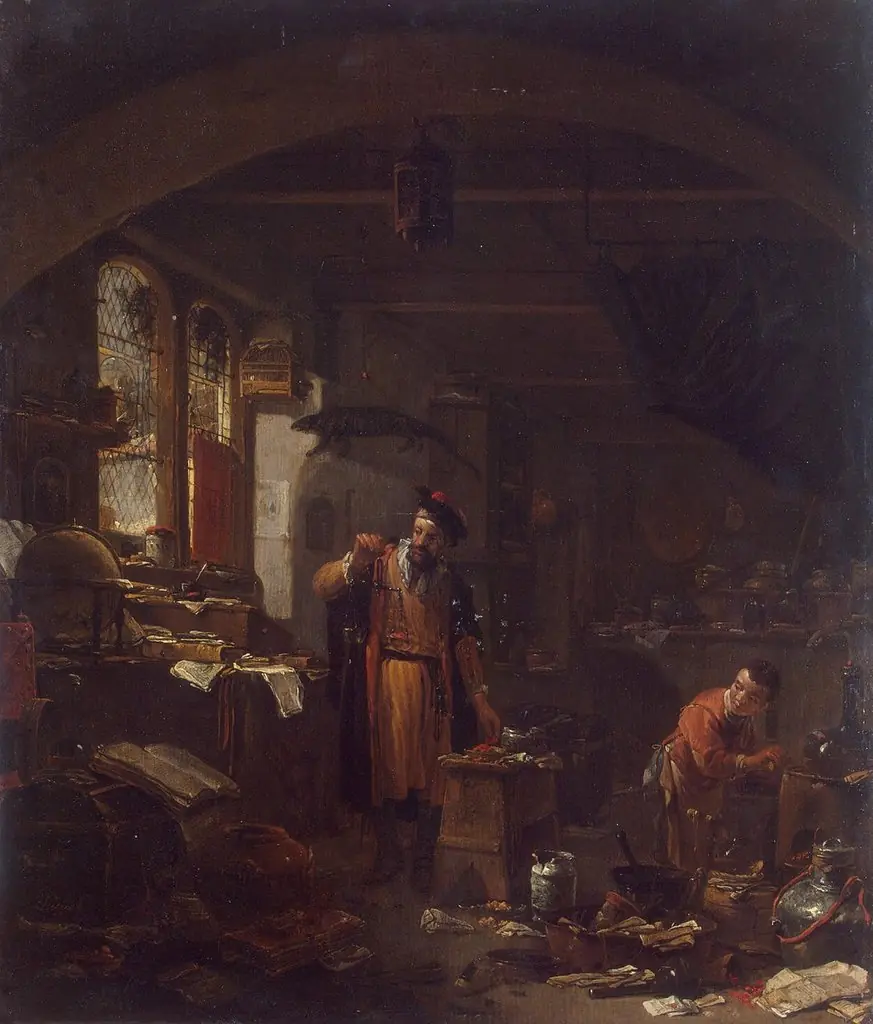
Born in Haarlem around 1631 or 1632, Cornelis Pietersz Bega was the grandson of the history painter Cornelis van Haarlem and the son of the goldsmith Pieter Jansz Begijn, with whom he likely trained before entering the workshop of Adriaen van Ostade in 1648. Bega joined the Haarlem Guild of Saint Luke in 1654 and died in 1664, likely of the plague. His family background in precious metals placed him in a world where the crafting of fine objects from noble metals was a daily concern, which presumably informed his artistic sensitivity to the idea of transforming base materials through science and imagination. Painters and alchemists shared this transformative impulse, and many ingredients for basilicon were also used in painters' workshops. Bega executed at least two other images of an alchemist at work, one in 1661 and another in 1663, and the thematic repertoire of quack scientists was a fertile market in Haarlem. While Van Ostade painted the subject only once in 1661, drawing upon negative iconography, and Thomas Wyck also approached the theme, Bega's distinctive viewpoint reflects the complex place early chemistry held in contemporary thought, treating the figure with emotional sensitivity and dignity rather than pure mockery.
Legacy
Bega's attentive rendering of materials and the emotional sensitivity he brought to his subjects influenced later genre painters, including Thomas Wyck, Jan Steen, and Cornelis Dusart. His ability to convey the basic humanity of his figures while evoking the luminous presence of inanimate objects in dark interiors established a model for sympathetic genre scenes that moved beyond mere caricature. The Alchemist itself, through its detailed depiction of proto-chemical processes and its dignified portrayal of a marginalized practitioner, offers a vital historical lens into the seventeenth-century perception of alchemy, preserving the intersection of early scientific inquiry, craftsmanship, and popular superstition. The painting's survival through centuries of prominent European collections and its eventual placement in a major public institution underscore its enduring relevance in the study of Dutch Golden Age art.
Own this work as a print
Artist & collection
Artist
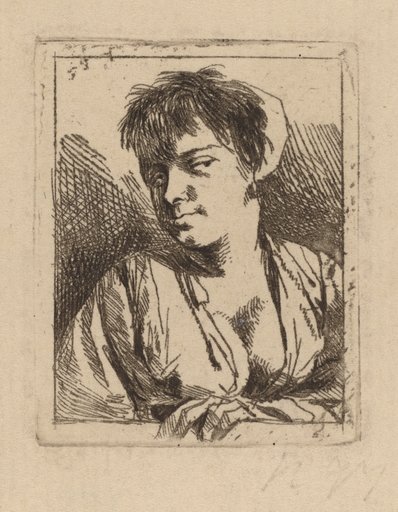
Cornelis Pietersz Bega, or Cornelis Pietersz Begijn (1631/32 – 27 August 1664) was a Dutch Golden Age painter and engraver.