Artwork
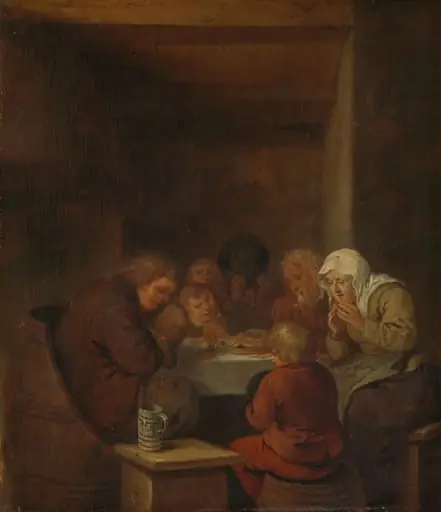
Saying Grace
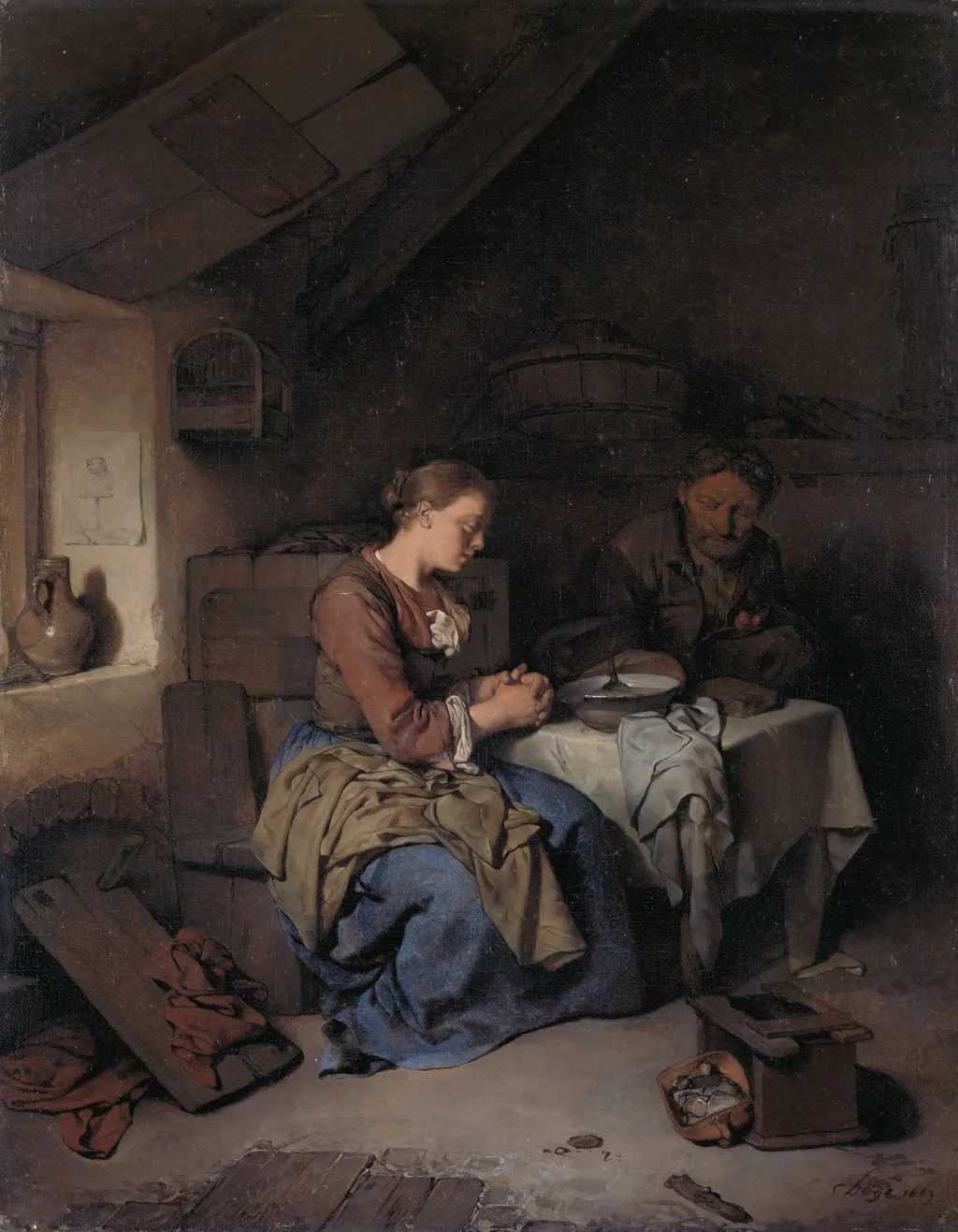
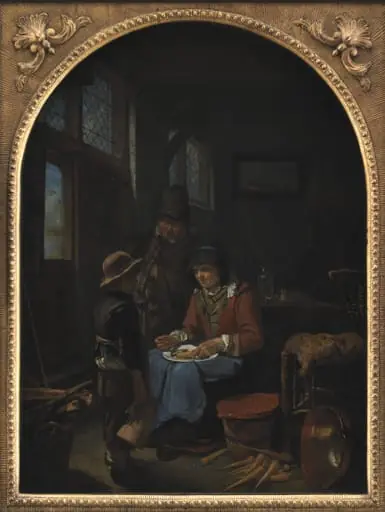
Saying Grace is an oil painting by the Dutch Golden Age artist Cornelis Bega. It dates from 1663 and is held in the collection of the Rijksmuseum.
About this work
Technique & Style
No specific condition report, restoration history, or detailed stylistic analysis is documented in the available sources.
Saying Grace is an oil painting executed on canvas, a combination of medium and support consistent with Cornelis Pietersz Bega's standard practice for small-scale genre and religious scenes of the 1660s. The work is modest in size, measuring 37.5 cm in height by 30 cm in width, an intimate format suited to private devotional viewing rather than public display.
Stylistically, the painting belongs to the religious genre tradition associated with Dutch Golden Age genre painters, employing the fine brushwork and controlled tonal handling characteristic of Bega's oil technique on canvas. The small dimensions and oil-on-canvas construction suggest a finely finished cabinet picture, executed with the careful layering and smooth surface treatment typical of mid-seventeenth-century Dutch easel painting.
No specific condition report, restoration history, or detailed stylistic analysis is documented in the available sources.
History & Provenance
The painting was created by Cornelis Pietersz. Bega in 1663, as indicated by the date inscribed on the work.
It entered the public collection through the bequest of Adriaan van der Hoop, whose name appears in the ownership history. Following his death, the collection was donated to the Rijksmuseum in Amsterdam, where the painting has been housed since.
Cornelis Pietersz Bega's 1663 painting Saying Grace is held by the Rijksmuseum in Amsterdam. The work originates from the collection of Adriaan van der Hoop, which is associated with the Amsterdam Museum. The canvas, measuring 37.5 cm in height and 30 cm in width, is classified as a religious oil painting.
The provided sources do not contain specific details regarding the work's inventory number, accession date, or a record of its exhibition history.
Overview
Cornelis Pietersz Bega’s Saying Grace is an oil painting completed in 1663, representative of the Dutch Golden Age. A Haarlem-based artist, Bega specialized in genre scenes, often portraying modest interiors populated by small groups. This work, now in the Rijksmuseum, captures a private, devotional moment within a household, reflecting the period’s interest in domestic piety and everyday life.
Subject & Meaning
The painting depicts a man and woman seated at a table, heads bowed in prayer before a meal. Their simple attire, a woman’s apron and long skirt, a man’s dark jacket, suggests a working-class or rural setting. The act of grace, a common Protestant practice, underscores themes of humility and gratitude. The subdued composition emphasizes the sincerity of the ritual over ostentation.
Context
During the Dutch Golden Age, genre painting flourished, often depicting scenes of daily life infused with moral or religious significance. Saying Grace exemplifies this trend, portraying a moment of private devotion within a secular setting. Such works resonated with a Protestant audience that valued personal piety and frugality, offering visual affirmations of virtuous conduct in ordinary circumstances.
Legacy
Bega’s Saying Grace contributes to the broader canon of Dutch genre painting, illustrating the period’s ability to elevate mundane subjects through composition and technique. While less celebrated than some contemporaries, Bega’s works endure as studies of quiet domesticity and religious observance. The painting’s preservation in the Rijksmuseum ensures its continued role in discussions of 17th-century Dutch art and cultural values.
Own this work as a print
Artist & collection
Artist
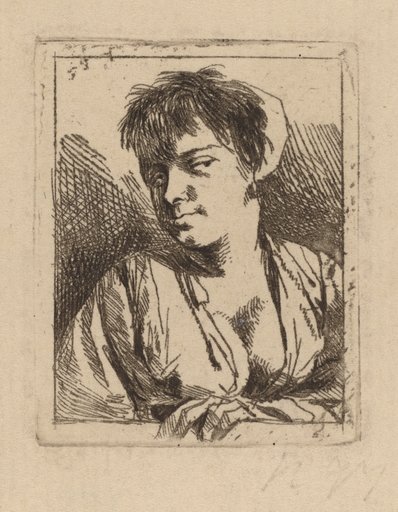
Cornelis Pietersz Bega, or Cornelis Pietersz Begijn (1631/32 – 27 August 1664) was a Dutch Golden Age painter and engraver.