Artwork
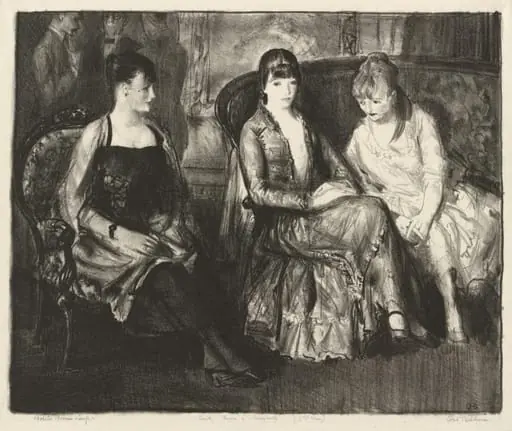
Elsie, Emma and Marjorie, second stone
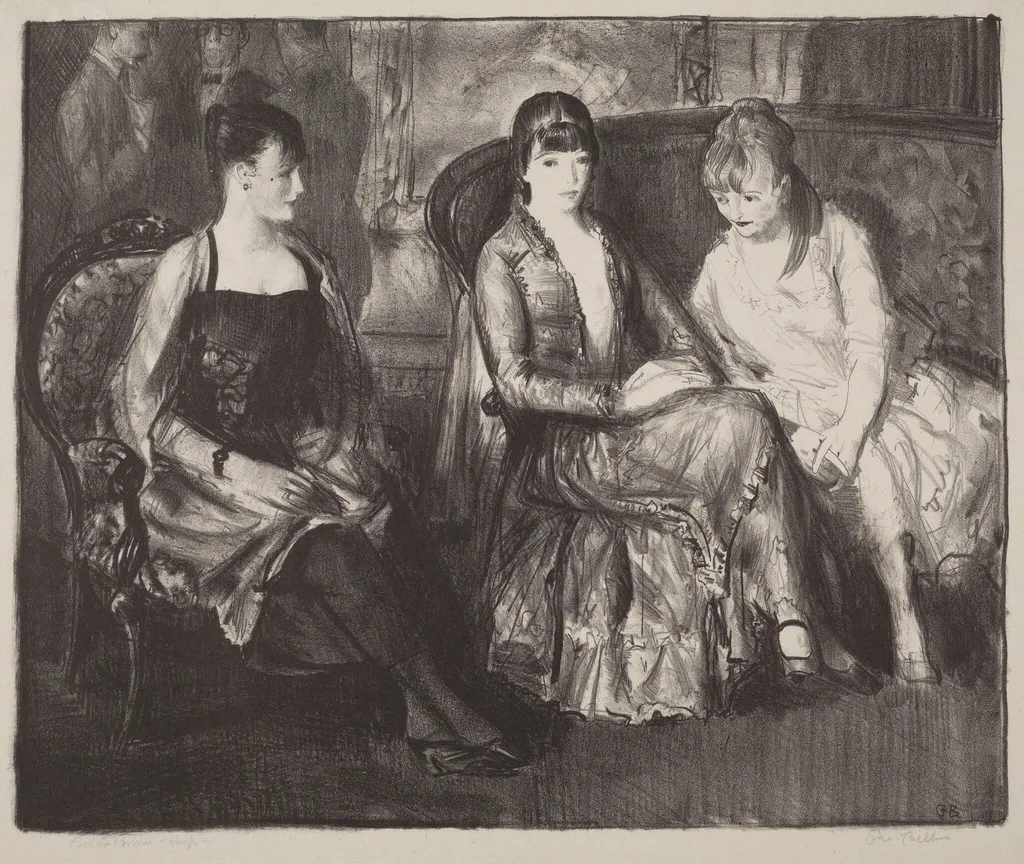
Elsie, Emma and Marjorie, second stone is an ink print by George Bellows. It dates from 1921 and is held in the collection of the National Gallery of Art.
- Inscription
- Inscribed:lower left in graphite: Bolton Brown - imp-; lower right in graphite: Geo Bellows; lower right in plate: GB
About this work
Subject & Meaning
The work’s composition and subject indicate a personal narrative, likely reflecting the artist’s own household during the early 1920s.
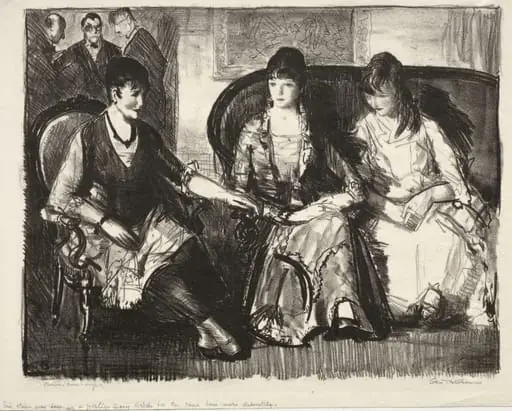
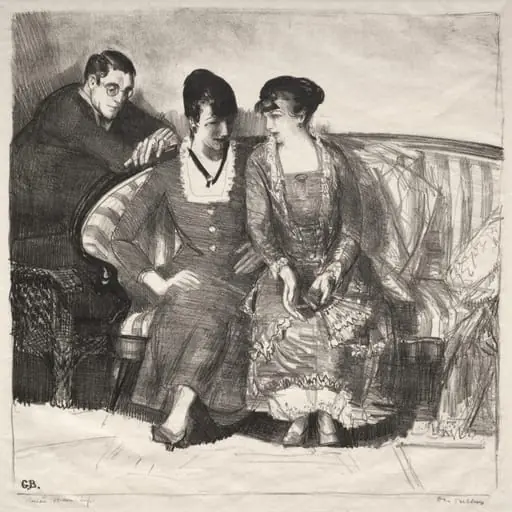
The lithograph portrays three individuals in a domestic setting, identified as Elsie Speicher, Emma S. Bellows, and Marjorie Organ. The arrangement suggests a familial or intimate relationship, with the figures positioned closely together. The work’s composition and subject indicate a personal narrative, likely reflecting the artist’s own household during the early 1920s.
The title’s reference to "second stone" points to the printmaking process, where the image was transferred from a lithographic stone, underscoring the technical and intimate nature of the depiction.
The figures’ proximity and shared space may symbolize unity or the quiet dynamics of family life in the period.
Technique & Style
The print is executed in black lithography, a medium Bellows employed to render the subjects with bold, linear definition and subtle tonal gradations. The stone matrix was used to pull a single ink layer, yielding strong contrasts between the figures’ costumes and the dark background.
The composition centers on three standing girls, their bodies and facial features delineated with confident, economical contours. The eldest’s white dress and the younger girl’s patterned garment are set against a void-like ground, focusing attention on posture and gesture. The handling emphasizes graphic clarity over textural nuance, aligning with Bellows’s approach to portrait lithography in the early 1920s.
History & Provenance
George Bellows created the lithograph Elsie, Emma and Marjorie, second stone in 1921. The work depicts Elsie Speicher, Emma S. Bellows, and Marjorie Organ. It was produced as a print in black ink, measuring 28.8 cm in height and 35.3 cm in width.
The National Gallery of Art in Washington, D.C., holds a copy of this impression, cataloged as NGA 61436. The artwork was executed during the final year of the artist's life, capturing the three women in a single composition.
The second stone state of the lithograph Elsie, Emma and Marjorie is held in the collection of the National Gallery of Art in Washington, D.C. The institution catalogs the work under the accession number 61436 within its prints department. Created in 1921, the sheet measures 28.8 cm in height and 35.3 cm in width. The provided records confirm its location and inventory details but do not list specific past exhibitions or loan history for this impression.
Overview
George Bellows’ 1921 lithograph titled Elsie, Emma and Marjorie, second stone presents a trio of women rendered in stark monochrome. The work is executed in black lithographic ink, emphasizing line and tonal contrast rather than color, and measures as a single print from Bellows’ series of portrait studies.
Context
During the early 1920s Bellows was active in the New York art world, engaging with both the Ashcan School’s realism and the emerging modernist tendencies. This lithograph reflects his interest in everyday subjects, here rendered with a quiet, observational tone that contrasts with his more dynamic, action‑filled canvases.
Legacy
While not as frequently reproduced as Bellows’ larger paintings, this lithograph exemplifies his skill in printmaking and his capacity to capture nuanced human expression in a compact format. It remains a reference point for scholars studying Bellows’ lesser‑known portrait series and the broader use of lithography in early twentieth‑century American art.
Own this work as a print
Artist & collection

Artist
George Wesley Bellows (August 12 or August 19, 1882 – January 8, 1925) was an American realist painter, known for his bold depictions of urban life in New York City.