Artwork
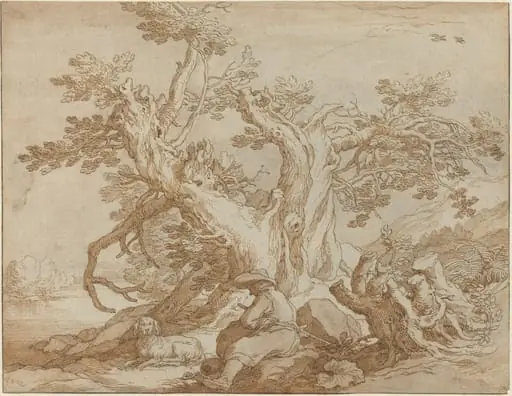
A Man and His Dog Resting by a Great Tree
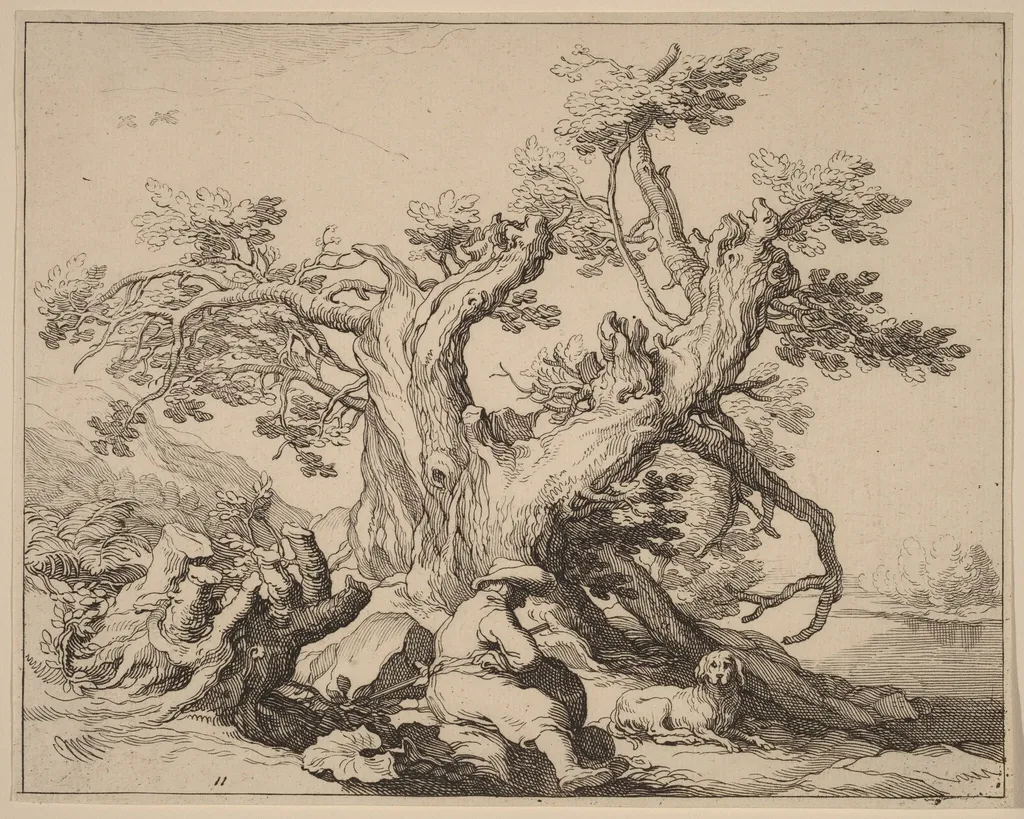
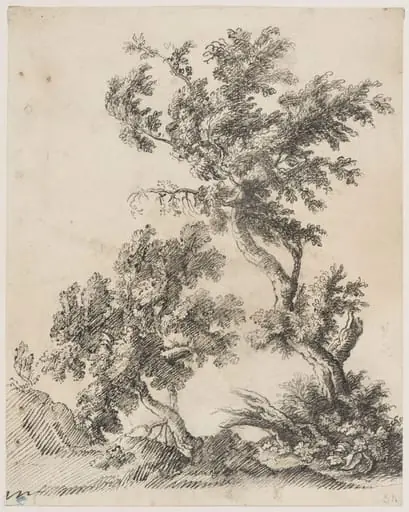
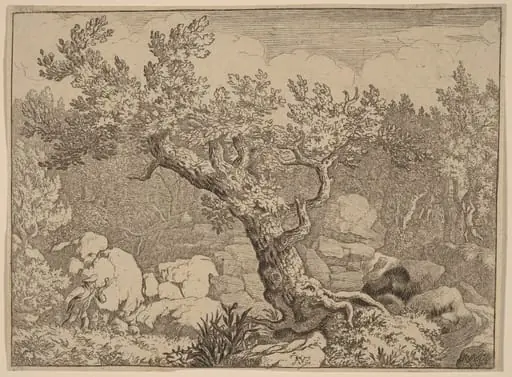
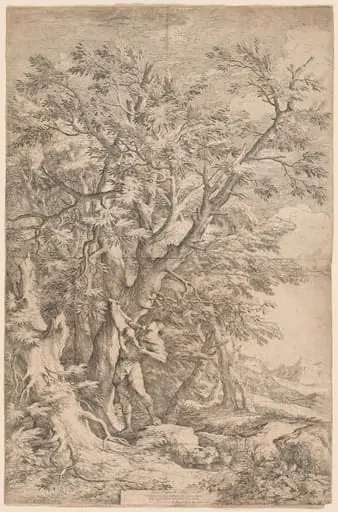
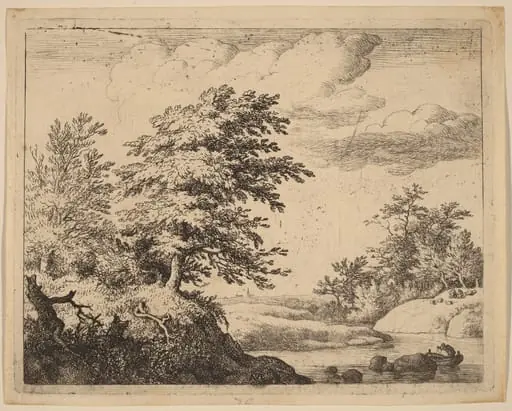
A Man and His Dog Resting by a Great Tree is an ink print by the Baroque artist Frederick Bloemaert. It dates from 1635 and is held in the collection of the National Gallery of Art.
- Inscription
- Inscribed:recto: in plate, at lower left: "11"; verso: at lower left, in graphite, in later hand: BLOEMAERT / [indecipherable number]
- Markings
- Marked:none
About this work
Overview
Bloemaert employs meticulous shading to render the textural complexity of the bark and foliage, creating a convincing sense of volume and depth.
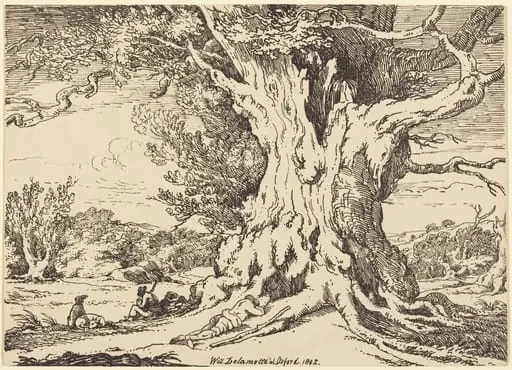
Created in 1635, 'A Man and His Dog Resting by a Great Tree' is an etching on laid paper by the Dutch artist Frederick Bloemaert. The composition centers on a monumental, sprawling tree that dominates the visual field, its twisting roots anchoring into rocky terrain while its branches extend broadly across the upper register. Beneath this arboreal canopy, a man reclines in a state of repose, accompanied by a dog resting at his side; both figures appear weary, suggesting a pause during travel or labor.
Bloemaert employs meticulous shading to render the textural complexity of the bark and foliage, creating a convincing sense of volume and depth. The interplay of light and shadow defines the solid mass of the tree against the surrounding space. This work exemplifies the artist's engagement with landscape etching during the mid-1630s, a period where he focused on naturalistic details and the atmospheric integration of human figures within a rugged environment.
The piece reflects the broader Dutch Golden Age interest in the pastoral and the observation of nature, executed with the precise line work characteristic of Bloemaert's graphic output.
Subject & Meaning
The work captures a moment of rest and contemplation, the man’s indistinct facial features suggesting introspection or a lapse into reverie. The dog’s presence reinforces themes of companionship and shared fatigue, while the enveloping tree may symbolize shelter or the passage of time.
Technique & Style
Executed as an etching on laid paper, Bloemaert employs delicate line work and nuanced shading to render the bark’s texture and the foliage’s volume. The gradations of tone give the tree a solid, three‑dimensional presence, and the soft focus on the figure’s face demonstrates a subtle handling of atmospheric effect.
History & Provenance
Created in the early seventeenth century, the print is part of Bloemaert’s broader output of narrative and genre scenes. It has survived in several impressions, circulating among collectors of Dutch printmaking, though specific ownership records prior to the nineteenth century remain sparse.
Context
Bloemaert worked within the Dutch Golden Age, a period marked by detailed realism and an interest in everyday subjects. This etching reflects contemporary tastes for pastoral tranquility and the technical experimentation with line and tone that characterized the era’s print workshops.
Legacy
The image exemplifies Bloemaert’s skill in translating complex natural forms into the linear language of etching. It continues to be referenced in studies of early modern print techniques and the representation of human‑animal relationships in Dutch art.
Own this work as a print
Artist & collection