Artwork
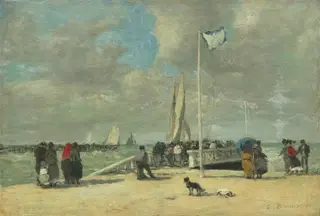
Jetty and Wharf at Trouville
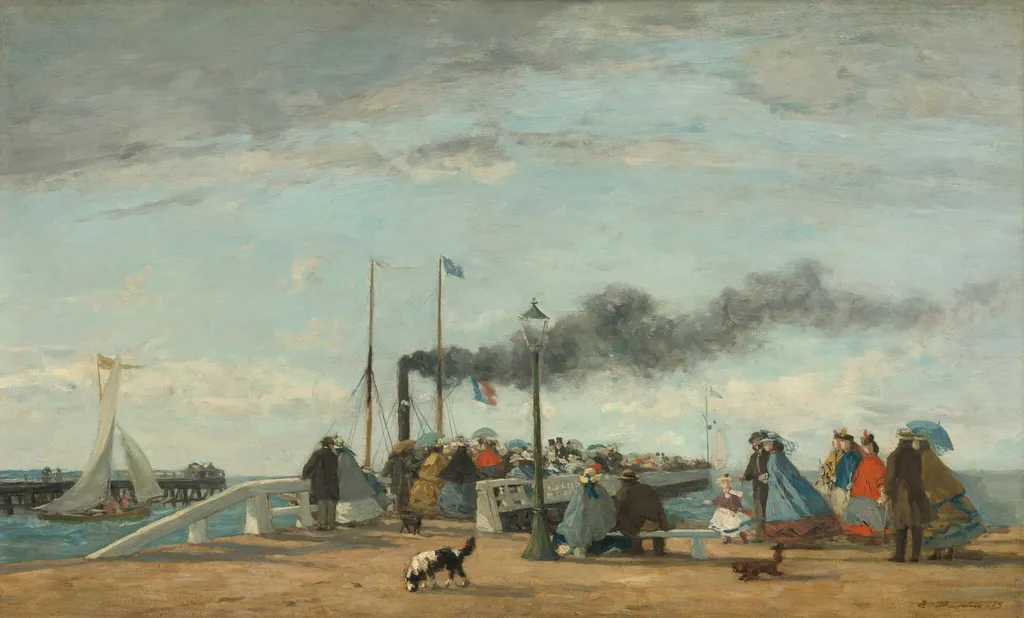
Jetty and Wharf at Trouville is an oil painting by the Impressionist artist Eugène Louis Boudin. It dates from 1863 and is held in the collection of the National Gallery of Art.
- Inscription
- Inscribed:lower right: E. Boudin. 63
About this work
Technique & Style
Eugene Boudin executed Jetty and Wharf at Trouville in 1863 using oil paint applied to a wooden panel. The support measures 34.8 cm in height and 58 cm in width. This work exemplifies the artist's practice of capturing coastal scenes on rigid panels, a common choice for plein air studies during the period. The painting remains in the collection of the National Gallery of Art in Washington, D.C.
History & Provenance
Reid of Auchterarder House, Scotland; it was sold at Christie, Manson & Woods in London on 27 March 1942, where Arthur Tooth and Sons bought it for Mrs.
Eugene Boudin painted Jetty and Wharf at Trouville in 1863, in oil on a wood panel measuring 34.8 by 58 cm. By 1937 it was recorded in the collection of Andrew T. Reid of Auchterarder House, Scotland; it was sold at Christie, Manson & Woods in London on 27 March 1942, where Arthur Tooth and Sons bought it for Mrs. Peter Pleydell-Bouverie of London. It was lent to a 1954 exhibition of the Pleydell-Bouverie collection at the Tate. Paul Mellon acquired the painting in 1963 through the Marlborough-Gerson Gallery in New York and, in 1983, gifted it to the National Gallery of Art in Washington, D.C., where it remains in the collection today.
Overview
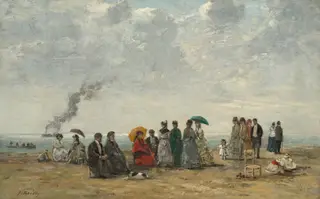
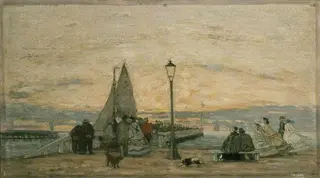
Eugène Boudin’s 1863 work Jetty and Wharf at Trouville is an oil painting on a wooden panel that captures a lively coastal harbor. The composition presents a crowded quay where figures stroll, converse, and pause beneath umbrellas, while a steamboat releases a plume of dark smoke and sailboats drift beyond the pier. The scene is set under a muted, overcast sky, with a lamppost and wandering dogs adding to the everyday atmosphere.
Subject & Meaning
The canvas portrays the everyday activity of a 19th‑century French seaside town, emphasizing the interaction between people, vessels, and the shoreline. By focusing on ordinary moments, workers, leisure seekers, and the interplay of light on water, Boudin underscores the vitality of maritime life and the transient quality of weather and human presence at the port.
Context
At the time of its execution, Boudin was among the first artists to venture beyond studio walls to capture the changing effects of light on the coast. His practice influenced younger painters, including members of the Impressionist circle, and earned commendation from critics such as Charles Baudelaire, who praised his ability to render the sea’s fleeting moods.
Own this work as a print
Artist & collection

Artist
Eugène Louis Boudin (French: ; 12 July 1824 – 8 August 1898) was one of the first French landscape painters to paint outdoors.