Artwork
Peasant Couple with Cow
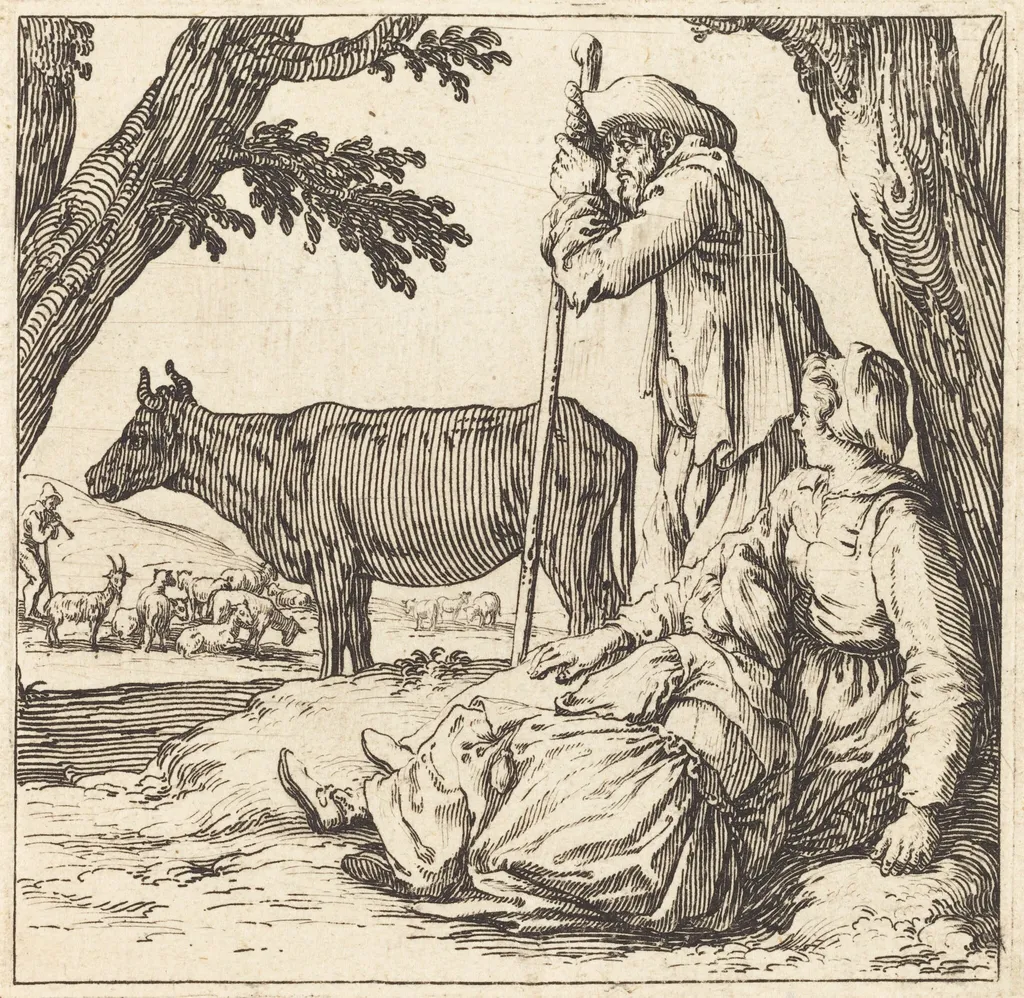
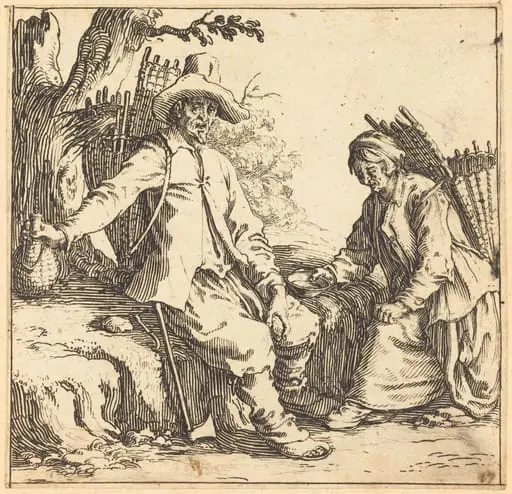
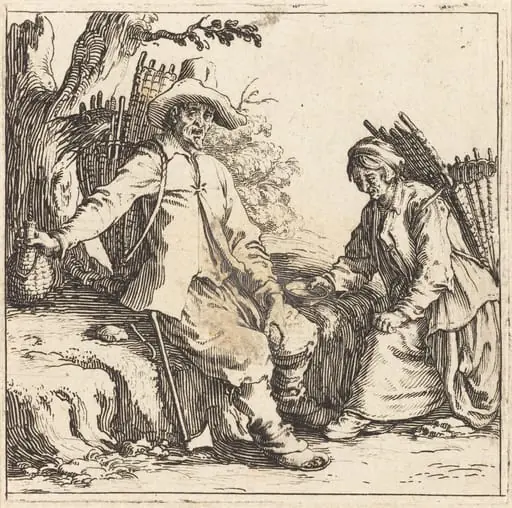
Peasant Couple with Cow is an ink print by the Baroque artist Jacques Callot. It dates from 1621 and is held in the collection of the National Gallery of Art.
About this work
Overview
The work belongs to a body of prints that prioritize observation over idealization, capturing the quiet rhythms of peasant existence with unembellished clarity.
Created around 1621, this etching on laid paper by Jacques Callot depicts a rural scene with minimal narrative but rich atmospheric detail. As one of over 1,400 prints he produced, it exemplifies his dedication to recording ordinary life in early 17th-century Europe. The work belongs to a body of prints that prioritize observation over idealization, capturing the quiet rhythms of peasant existence with unembellished clarity.
Subject & Meaning
A man stands holding a staff, his gaze lifted as if listening or watching, while a woman sits on the ground, her hands resting on a sleeping child. A cow stands nearby, and sheep graze beneath a sparse tree in the distance. The scene conveys exhaustion and stillness rather than labor or celebration.
There is no overt moral or religious message; instead, the image presents a moment of respite, grounding the figures in the physical reality of their environment.
Technique & Style
Callot employed etching to create fine, irregular lines that give the image a tactile, sketchlike quality. The inked grooves in the metal plate produce uneven textures, enhancing the roughness of clothing, soil, and foliage. His use of dense, overlapping strokes builds depth without smooth gradations, a hallmark of his approach to printmaking. The technique allows for both precision and spontaneity, mirroring the unpolished nature of the subjects.
History & Provenance
The print originates from the Duchy of Lorraine, where Callot spent much of his career, and was likely produced for a broader European audience interested in vernacular life. While its specific early ownership is unrecorded, it aligns with a circulation of prints that documented regional customs and social conditions. Its survival reflects the durability of etched plates and the growing market for such imagery in the early Baroque period.
Context
In the early 1600s, printmaking became a primary medium for depicting non-elite life across Europe. Callot’s work emerged alongside growing interest in realism and social observation, influenced by Flemish and Dutch traditions. Unlike grand historical or religious scenes, his prints focused on the overlooked, peasants, soldiers, beggars, offering a counter-narrative to the dominant artistic ideals of the time.
Legacy
Callot’s etchings, including this one, contributed to the legitimization of everyday subjects in fine art. His technical innovations in line control influenced later generations of printmakers, particularly in France and the Netherlands. While not widely celebrated in his lifetime as a social commentator, his body of work now stands as a vital visual record of rural life in early modern Europe.
Own this work as a print
Artist & collection
Artist
Jacques Callot (French: ; c. 1592 – 1635) was a baroque printmaker and draftsman from the Duchy of Lorraine. He is an important person in the development of the old master print. He made more than 1,400 etchings that…

 Holy Family at supper
 Restoration of the Aqueduct at Pisa
 Restoration of the Aqueduct at Pisa
 Square in Paris with Many Figures
 Square in Paris with Many Figures
 Horsemen Attacked by Robbers
 HOW WILL A COVERED PART BE CORRECTED?HOW WIKA A COVERED HEART DEED CORRECTED?
![Christ Walking on the Water [second plate], by Jacques Callot](https://artifactworldgallery.com/img/jacques-callot--christ-walking-on-the-water-second-plate--2069f3bfe4cb2126-w320.webp) Christ Walking on the Water [second plate]
Christ Walking on the Water [second plate]