Artwork
Pietà
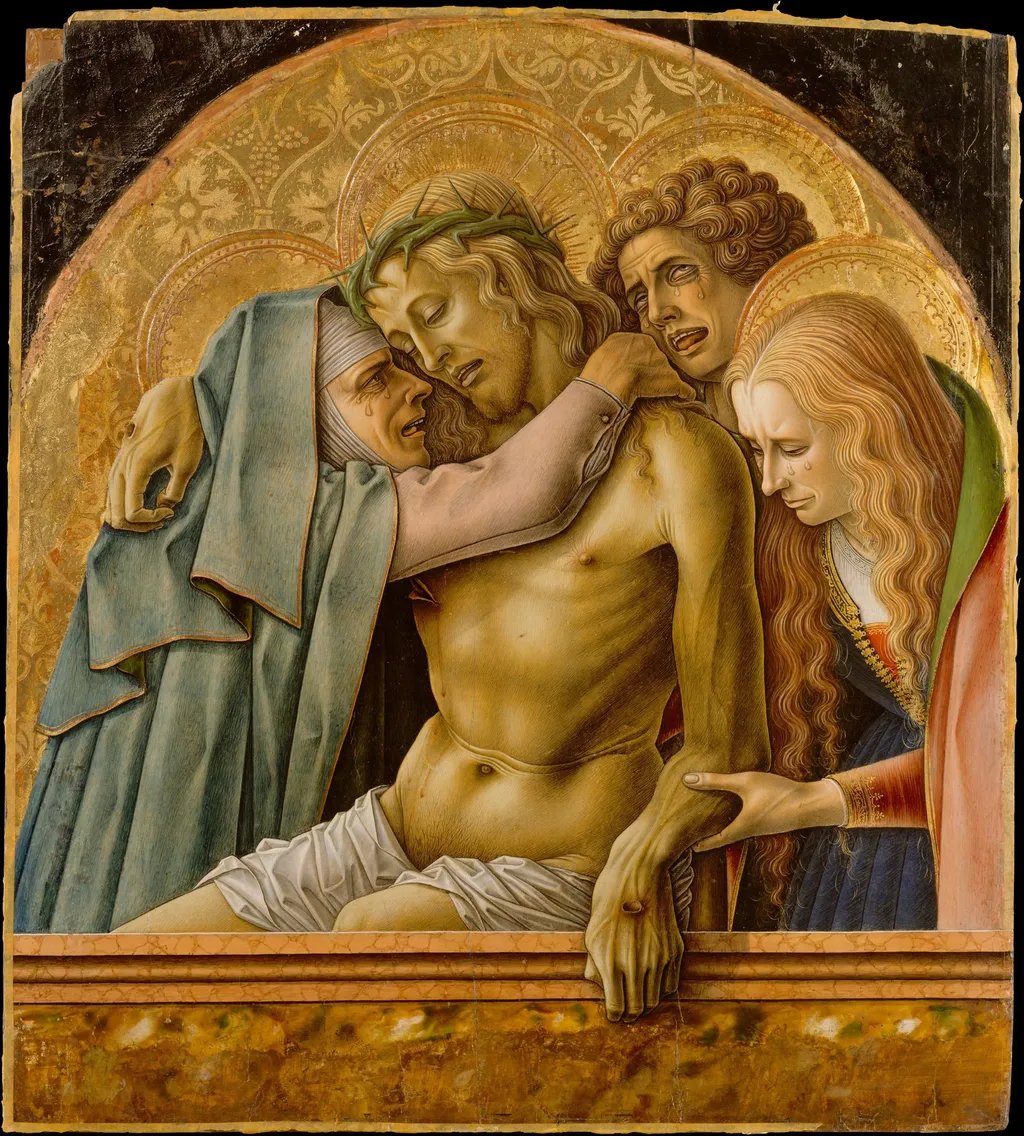
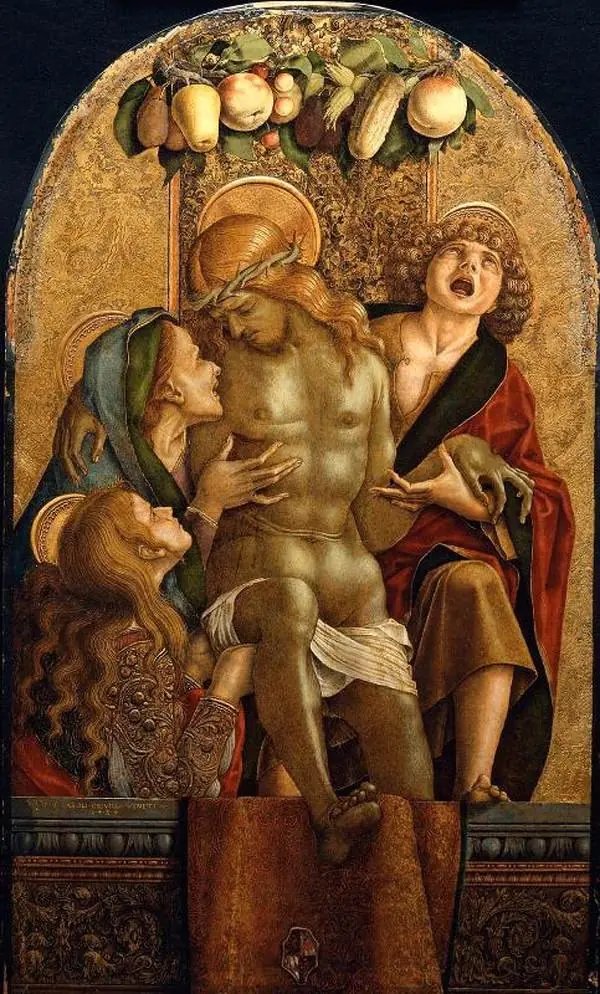
Pietà is a tempera painting by the Venetian Renaissance artist Carlo Crivelli. It dates from 1488 and is held in the collection of the Metropolitan Museum of Art.
About this work
Subject & Meaning
As documented, the work is rendered in tempera on panel and belongs to the religious art genre of the late fifteenth century.
The painting presents the Lamentation of Christ, showing the dead Christ supported by the grieving Virgin Mary and Mary Magdalene, whose expressions convey deep sorrow. This iconography emphasizes themes of mourning and compassion within the religious narrative. The composition’s focus on female figures highlighting grief underscores the human response to divine sacrifice.
As documented, the work is rendered in tempera on panel and belongs to the religious art genre of the late fifteenth century.
Technique & Style
Executed in 1476, Carlo Crivelli's Pietà is a religious painting created using tempera on a wooden panel support. The work measures approximately 71.1 centimeters in height and 63.8 centimeters in width. As a depiction of the Lamentation of Christ, the composition formally centers on the sorrowful figures of the Virgin Mary, Mary Magdalene, and the body of Jesus.
The selection of tempera as the primary medium reflects the artist's adherence to traditional techniques prevalent in late fifteenth-century Italian religious art, utilizing the material's capacity for precise detail and luminous color on the rigid panel surface.
History & Provenance
Carlo Crivelli executed the Pietà in 1476 as a tempera painting on panel, depicting the Lamentation of Christ with Mary Magdalene, the Virgin, and Christ. The work was created in the late‑15th‑century Italian context, reflecting the religious themes common in devotional art of the period. It entered the collection of the Metropolitan Museum of Art, where it has been displayed as part of the museum’s Renaissance holdings.
Documentation indicates the piece was produced under Crivelli’s hand and bears the date 1476, while its provenance is limited to its acquisition by the museum, with no further ownership records disclosed.
Carlo Crivelli’s Pietà (1476) is part of the Metropolitan Museum of Art’s collection in New York. The work is listed under the museum’s holdings without an explicit accession number provided in the available documentation. No exhibition record is noted in the sources consulted, indicating that the painting has not been publicly exhibited under the title Pietà in the contexts described.
The painting measures 71.1 cm by 63.8 cm and is classified as a religious work, reflecting its devotional function.
Overview
This tempera painting, titled Pietà, presents a poignant scene from Christian tradition. It features a central male figure, identifiable by a crown of thorns, supported by another man. A woman with a halo leans in, her hand gently touching his arm, while a fourth robed figure stands behind, observing the solemn moment. The composition is set against a dark, rounded background adorned with gold patterns and faint inscriptions.

Own this work as a print
Artist & collection
Artist
Carlo Crivelli (c. 1430 – c. 1495) was an Italian Renaissance painter of conservative Late Gothic decorative sensibility, who spent his early years in the Veneto, where he absorbed influences from the Vivarini,…