Artwork
Madonna and Child Enthroned with Donor
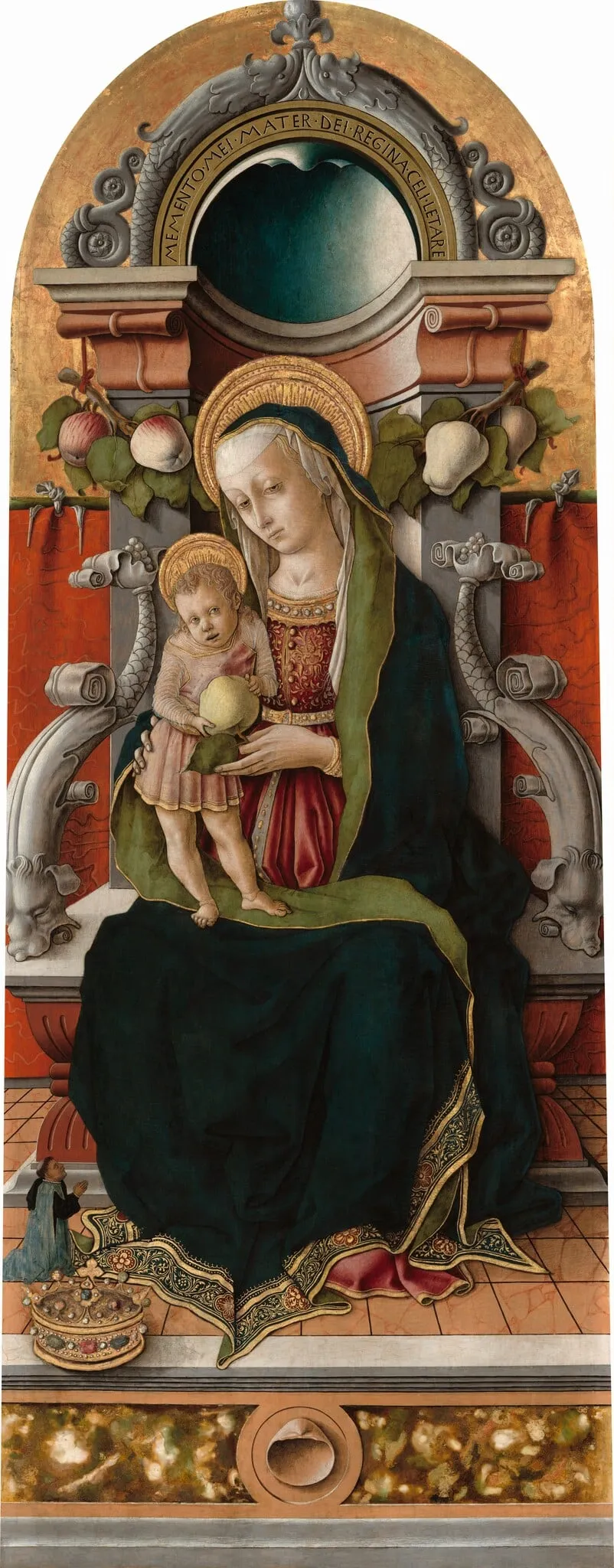
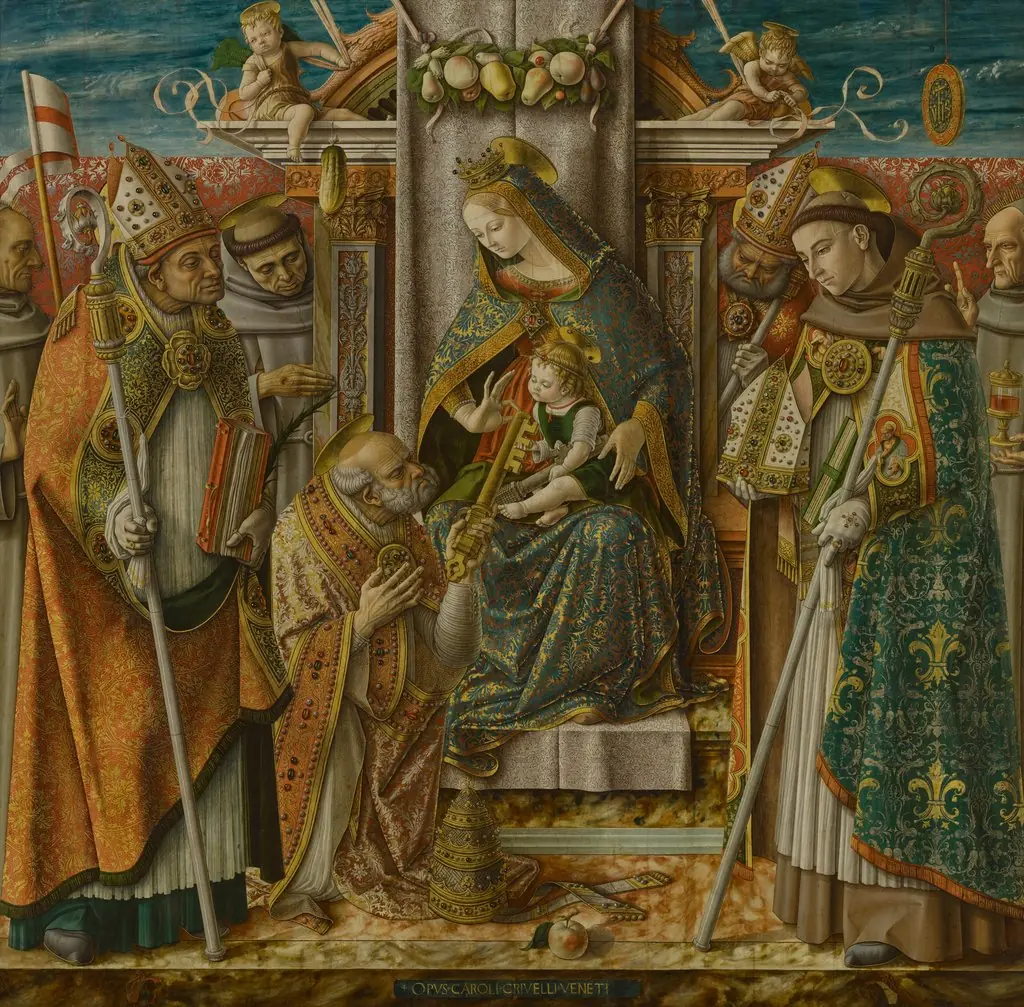
Madonna and Child Enthroned with Donor is a tempera painting by the Early Renaissance artist Carlo Crivelli. It dates from 1470 and is held in the collection of the National Gallery of Art.
- Inscription
- Inscribed:on the arch of the throne: MEMENTO.MEI.MATER.DEI.REGINA.CELI.LETARE (Remember me, O Mother of God, O Queen of Heaven rejoice!; _Regina Coeli_ from an Easter antiphon)
About this work
Subject & Meaning
The frame bears an inscription from the Easter psalm (“MEMENTO MEI · MATER DEI · REGINA CELI · LETARE”), reinforcing this sacrificial destiny.
The painting depicts the Virgin Mary enthroned with the Christ Child, a subject laden with symbolic meaning. Mary sits on a monumental stone throne, crowned as Queen of Heaven; her crown rests on the step beside a painted shell, a Marian attribute that identifies her as the “new Venus.” The Child stands on her knee, playing with an apple that alludes to the fruit of original sin, prefiguring his redemptive sacrifice.
The frame bears an inscription from the Easter psalm (“MEMENTO MEI · MATER DEI · REGINA CELI · LETARE”), reinforcing this sacrificial destiny. At the lower right, the donor appears as a small, individualized kneeling figure. The iconography thus emphasizes Mary’s role as intercessor and Christ’s salvific mission.
Technique & Style
The painting is executed in tempera and gold on a poplar panel, a typical support for Italian altarpieces. The artist employs raised gesso (pastiglia) for the Madonna's crown and pearls, creating low-relief ornament that catches light. The gold background is interrupted by a red cloth, heightening the figures' presence.
The stone throne exhibits Renaissance forms from Paduan culture, with zoomorphic armrests and a shell niche. A perspectival floor grid, inspired by Paolo Uccello, adds spatial depth. Despite the lack of atmospheric rendering, subtle chiaroscuro modeling lends a metallic splendor to the drapery and flesh.
The panel has been restored several times: by Pichetto in 1938 and 1945, and by Modestini in 1959.
History & Provenance
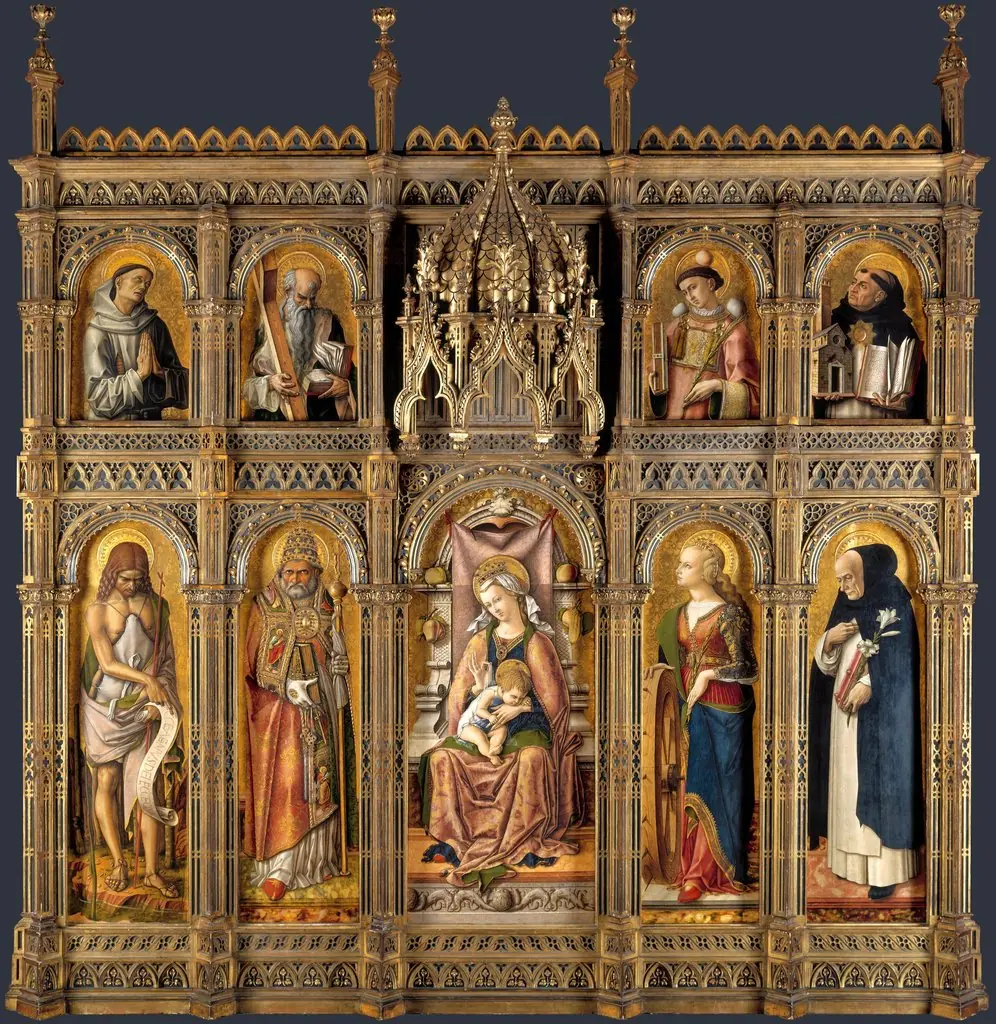
The painting dates to 1470 and served as the central panel of the Porto San Giorgio Polyptych, commissioned in 1469/1470 by Giorgio, an Albanian immigrant who founded the Salvadori family. It remained in the Church of San Giorgio, Porto San Giorgio, until the church was demolished in 1803, then was moved to the Suffragio church and later to the Salvadori residence. In 1835, Luigi Salvadori sold it to Henry Hudson for 90 scudi, a sale contested and resolved with an additional payment.
It subsequently entered the collection of William Ward, 1st Earl of Dudley, and was sold at auction in 1876 to Martin Colnaghi. The panel then entered the Cook collection in Richmond, acquiring the name “Madonna Cook.” In 1944 it was acquired by the Samuel H. Kress Foundation and gifted to the National Gallery of Art in 1952. Roberto Longhi identified it as the polyptych’s center in 1946.
The painting is held by the National Gallery of Art, Washington, D.C., as part of the Samuel H. Kress Collection, to which it was gifted in 1952. Its accession is under the Kress Collection, though a specific inventory number is not provided in the sources. Exhibition history includes display at London's Egyptian Hall while in the Dudley collection, and a temporary reunion of the entire Porto San Giorgio polyptych at a monographic exhibition on Carlo Crivelli in Venice in 1961.
Context
The work was identified as the central panel of the Porto San Giorgio Polyptych by Roberto Longhi in 1946, a key scholarly milestone. Earlier, it had been seen and described by Maggiori and Amico Ricci, and later by art historians such as Waagen, and Crowe and Cavalcaselle, who encountered it at the Egyptian Hall in London. The panel was temporarily reunited with the polyptych for a monographic exhibition on Crivelli in Venice in 1961, highlighting its art-historical significance.
Crivelli’s style, informed by the Paduan school of the Squarcioneschi and influences from Fra Filippo Lippi, situates this work within the broader currents of fifteenth-century Italian painting. The painting's history, including its contested sale, reflects shifting attitudes toward artistic patrimony.
Legacy
The painting's art-historical reputation was cemented when Roberto Longhi identified it as the central panel of the Porto San Giorgio Polyptych in 1946. Its legacy was further enhanced by its temporary reunion with other panels for a monographic exhibition on Carlo Crivelli in Venice in 1961. Housed since 1952 in the National Gallery of Art, Washington, as part of the Samuel H. Kress Collection, it remains one of the key works by Crivelli in the United States, frequently studied for its refined technique and fusion of Paduan and Florentine influences.
Overview
This painting, titled Madonna and Child Enthroned with Donor, is rendered in tempera on a poplar panel. It depicts the Virgin Mary and the infant Christ seated on a grand throne, accompanied by a standing donor figure. The composition conveys a sense of solemnity and tranquility, characteristic of religious works from the 15th century. This piece exemplifies the devotional art prevalent during that period.
Artist & collection
Artist
Carlo Crivelli (c. 1430 – c. 1495) was an Italian Renaissance painter of conservative Late Gothic decorative sensibility, who spent his early years in the Veneto, where he absorbed influences from the Vivarini,…