Artwork
Lamentation over the Dead Christ

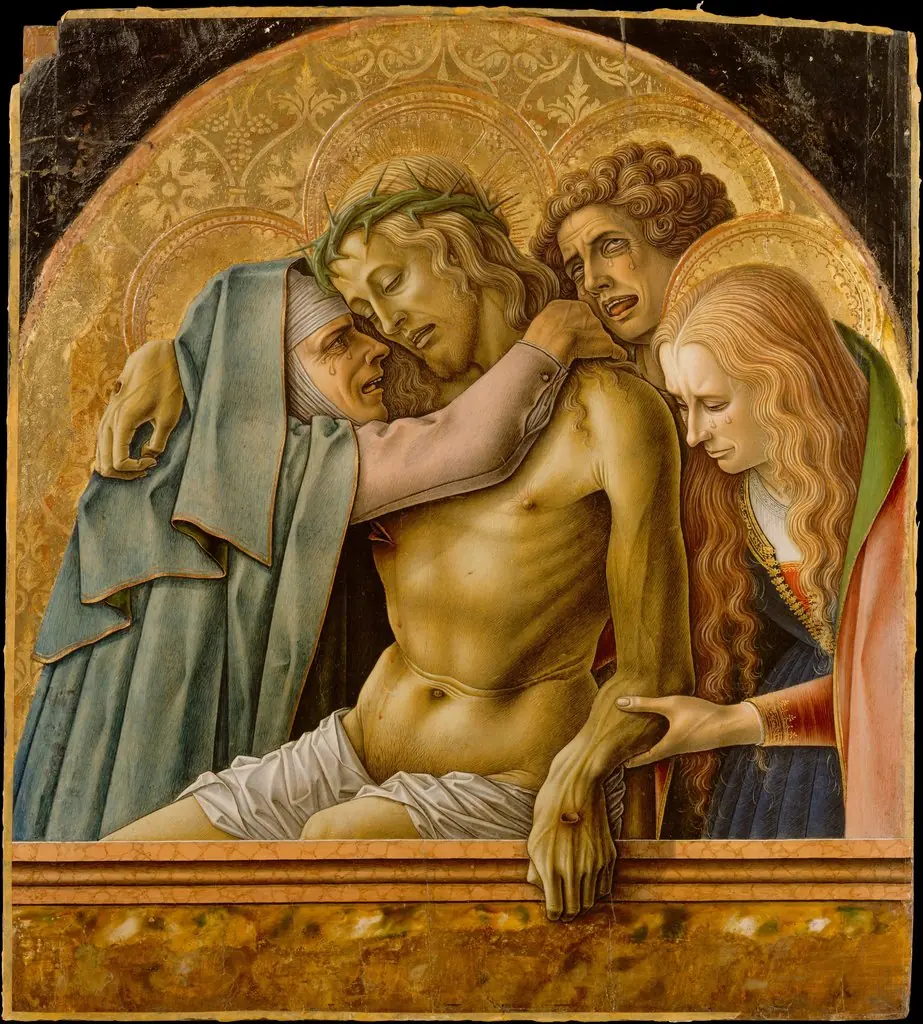
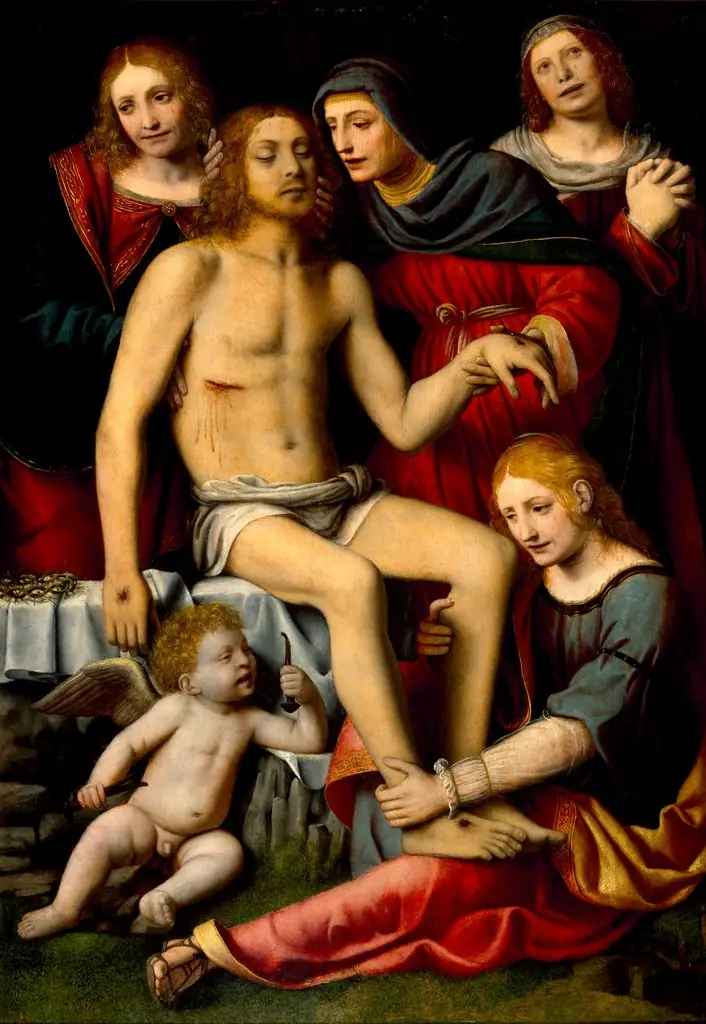
Lamentation over the Dead Christ is a tempera painting by the Early Renaissance artist Carlo Crivelli. It is held in the collection of the Museum of Fine Arts Boston.
About this work
Subject & Meaning
Christ's skin is rendered with a greenish hue indicative of decomposition, and his hands are contracted in spasms due to rigor mortis.
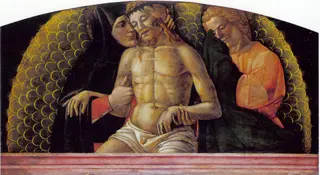
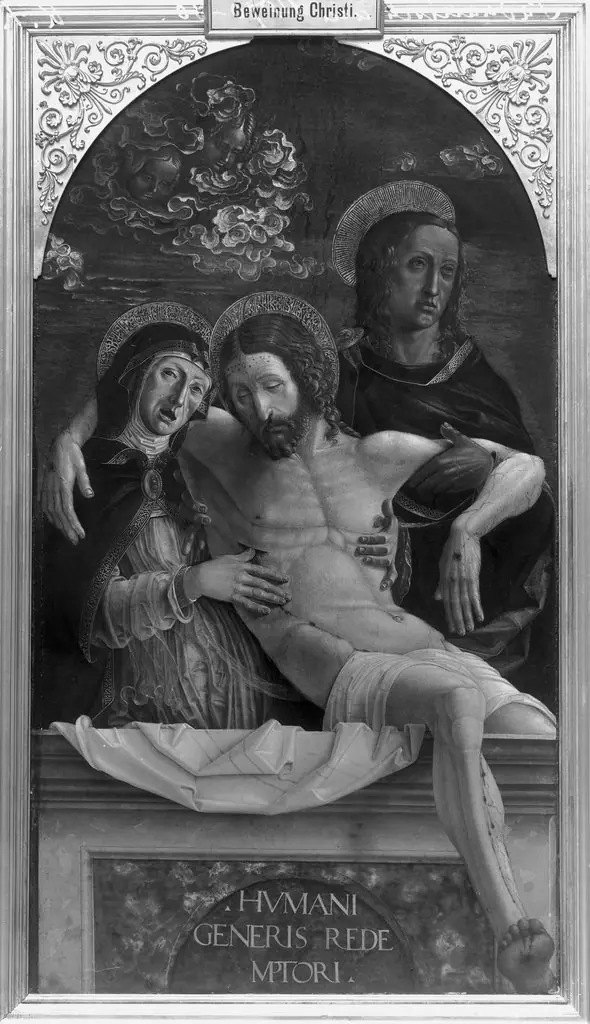
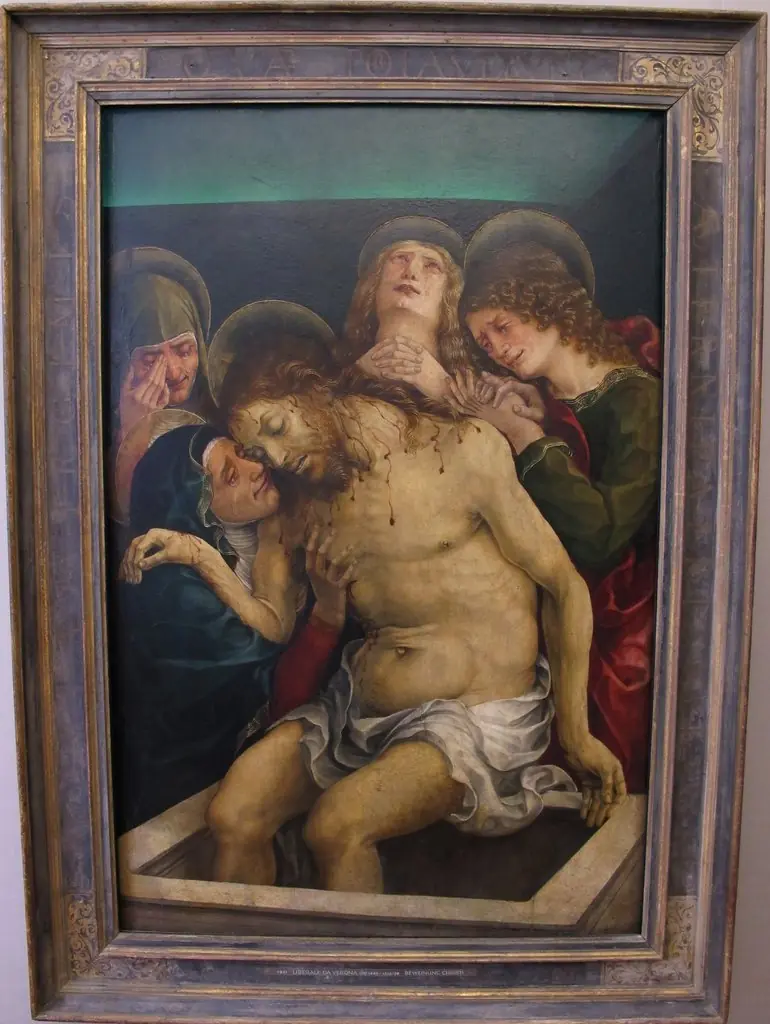
The work depicts the Lamentation of Christ, presenting the dead Jesus being lifted from his tomb. The Virgin Mary supports the body under the left arm, while Saint John stands to the right, and Mary Magdalene appears below as a half-figure in luxurious dress. The composition employs a low viewpoint, suggesting it originally served as the upper section of a dismantled polyptych.
Iconographic details emphasize the physical reality of death through macabre realism. Christ's skin is rendered with a greenish hue indicative of decomposition, and his hands are contracted in spasms due to rigor mortis. A cloth backdrop isolates the figures, adorned with an oversized garland of fruit and vegetables that carries symbolic meaning.
The scene is further defined by the projection of Christ's leg toward the viewer, creating a dramatic breach of the pictorial space.
Technique & Style
Carlo Crivelli executed the Lamentation over the Dead Christ using tempera and gold on a wooden panel measuring 88.3 by 53 centimeters. The composition is characterized by a dramatic intensity and a rich gold background. A cloth hangs behind the figures, isolating and emphasizing them, while an oversized garland of symbolic fruit and vegetables suspends from it.
Crivelli pushes the visual field forward by projecting Christ's leg out toward the viewer, a spatial illusion complemented by the painting's low "from below" vantage point, suggesting it originally served as the upper tier of a dismembered polyptych. The dead Christ displays exaggerated macabre details, including a greenish, decomposing complexion, vivid signs of martyrdom, and hands contracted in a spasm frozen by rigor mortis. Saint John's cry to heaven further amplifies the emotional fervor. The work is signed "OPVS CAROLI CRIVELLI VENETI 1485".
History & Provenance
The work titled Lamentation over the Dead Christ was executed by Carlo Crivelli in 1485 as a tempera painting on panel, originally signed “OPVS CAROLI CRIVELLI VENETI 1485”. It measures roughly 87 × 52 cm and depicts the Virgin, Saint John and Mary Magdalene surrounding the dead Christ. The panel entered the Panciatichi family collection in Florence, where it remained until it was sold in the early 20th century and acquired by the Museum of Fine Arts, Boston in 1912.
Its provenance is linked to the Bonacolsi‑Malatesta coat of arms on the surrounding drapery, suggesting a possible patronal connection, though direct commission records are absent. The date inscribed on the work aligns with the period when Crivelli divided his activity between Ascoli Piceno and Camerino, just prior to the Annunciation with Saint Emidio.
The painting is held by the Museum of Fine Arts in Boston, where it has been since 1912. Its earlier provenance is the Panciatichi collection in Florence, from which it was sold to the American museum at the beginning of the twentieth century. The work bears the signature "OPVS CAROLI CRIVELLI VENETI 1485" on the panel, and a Bonacolsi-Malatesta coat of arms appears on the cloth hanging from the sarcophagus, providing a clue to its original context.
No specific inventory or accession number, nor any detailed exhibition history beyond its acquisition by the Boston museum, is recorded in the available sources.
Context
Lamentation over the Dead Christ (c.1485) is one of several panel paintings by Carlo Crivelli depicting the Lamentation, yet it stands out for its dramatic staging and spatial audacity. The work’s scale (88.3 × 53 cm), unusual signature placement on a lateral panel, and the foreshortened leg projecting toward the viewer exemplify Crivelli’s late-period synthesis of Adriatic Gothic elegance and Renaissance illusionism.
Scholarship identifies the Boston panel as the probable uppermost section of a dismantled polyptych, a reconstruction advanced by Federico Zeri that distinguishes it from the signed Madonna of Budapest associated with the smaller San Domenico altarpiece of 1476. The painting’s provenance, from the Panciatichi collection in Florence to Boston in 1912, anchors it in the collecting circuits that dispersed Italian Renaissance works to American museums in the early twentieth century.
Overview
Carlo Crivelli's Lamentation over the Dead Christ, completed in 1493, is a tempera painting from the Italian Renaissance. This religious work portrays the somber moment after Christ's crucifixion, with several figures gathered around his lifeless body in a scene of profound grief. It exemplifies Crivelli's distinctive approach to sacred narratives, blending emotional intensity with intricate detail characteristic of his late career.
Artist & collection
Artist
Carlo Crivelli (c. 1430 – c. 1495) was an Italian Renaissance painter of conservative Late Gothic decorative sensibility, who spent his early years in the Veneto, where he absorbed influences from the Vivarini,…