Artwork
An Apostle
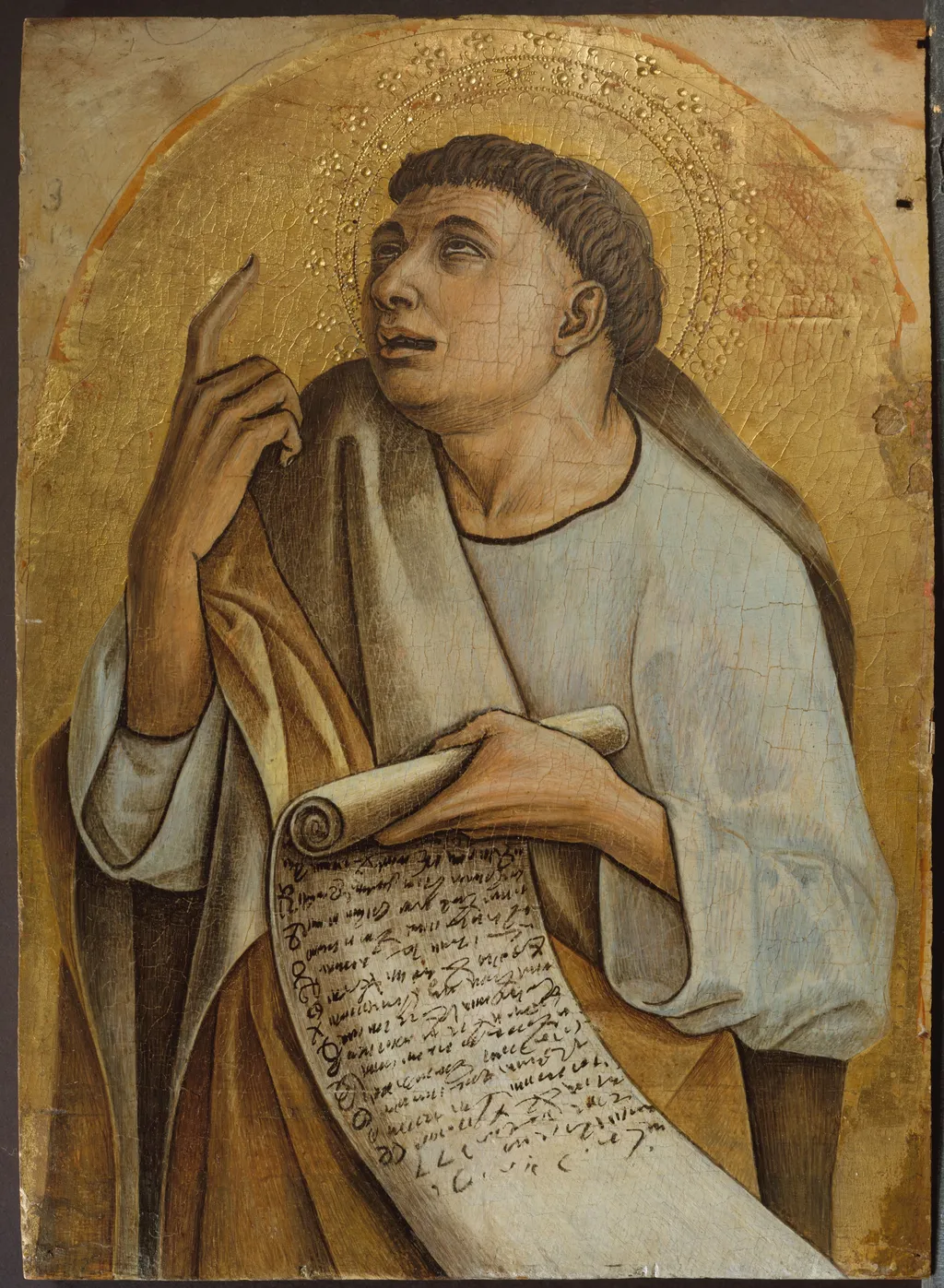
An Apostle is an unspecified painting by Carlo Crivelli. It dates from 1471 and is held in the collection of the Metropolitan Museum of Art.
About this work
Subject & Meaning
This combination of physical tension and spiritual focus emphasizes the figure's divine inspiration and emotional intensity rather than narrative specificity.
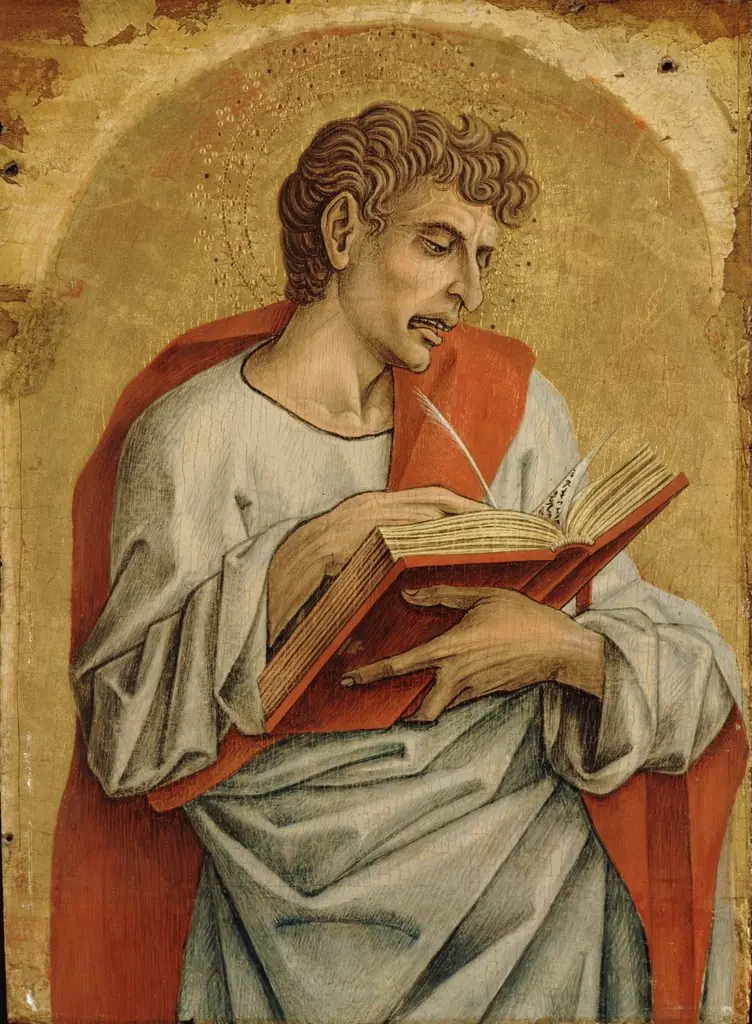
This panel depicts an apostle, though the specific identity remains unknown due to the absence of traditional distinguishing attributes. The figure is characterized by a restless, almost grotesque posture typical of Crivelli's predella works, featuring a curved spine and agitated hands. He holds a partially unrolled scroll filled with dense, decorative script in his left hand while raising his right hand to point toward heaven.
His gaze is directed upward with a contrite expression, marked by rolling eyes, furrowed brows, and a slightly open mouth. This combination of physical tension and spiritual focus emphasizes the figure's divine inspiration and emotional intensity rather than narrative specificity.
Technique & Style
An Apostle is executed in tempera and gold on a wooden panel measuring 32.1 by 23.2 cm, a small-scale format consistent with its function as a compartment of a dismembered predella. The saint is shown in a restless pose, leaning slightly backward, with the expressive emphasis concentrated in the face: upturned eyes, contracted brows, and a parted mouth give the figure an almost grotesque intensity characteristic of Crivelli's predella figures. He holds a densely inscribed scroll, partly unrolled, in his left hand while raising his right hand toward the sky.
The handling combines tempera painting with the use of gold, and the tightly written scroll and agitated gesture are typical of the artist's small devotional panels.
History & Provenance
Carlo Crivelli executed this tempera and gold panel around 1471 as a component of the predella for the Montefiore dell'Aso Altarpiece, originally housed in the church of San Francesco. Following the altarpiece's dismantling in the nineteenth century, the work passed through the hands of the Roman antiquarian Vallati in 1858 before entering various private channels. In 1927, the painting was acquired by Robert Lehman, becoming part of his distinguished collection.
The entire Lehman collection was subsequently bequeathed to the Metropolitan Museum of Art in New York, where the panel remains today.
An Apostle is held by the Metropolitan Museum of Art in New York, where it entered as part of the Robert Lehman Collection in 1975 (the Lehman bequest having been assembled earlier, with this panel joining the Lehman holdings in 1927). It is catalogued within the Robert Lehman Collection at the Met.
The panel was originally part of the predella of the dismantled Polyptych of Montefiore dell'Aso, which stood in the church of San Francesco in Montefiore dell'Aso before being dismembered in the nineteenth century. Apart from sections that remained at Montefiore (the so-called Triptych of Montefiore), the dispersed panels passed through the Roman antiquarian Vallati in 1858 before taking various paths, with this Apostle reaching the Lehman collection in 1927 and ultimately the Metropolitan Museum.
No exhibition history beyond its provenance trajectory is documented in the available sources.
Context
Carlo Crivelli's An Apostle (1471) is a small tempera-and-gold panel measuring 32.1 by 23.2 cm, originally forming part of the predella of the dismembered Polyptych of Montefiore dell'Aso. The polyptych, once housed in the church of San Francesco at Montefiore dell'Aso, was broken apart in the nineteenth century; while several sections remain at Montefiore as the so-called Triptych of Montefiore, this apostle panel passed through the Roman antiquarian Vallati in 1858 and entered the Robert Lehman collection in 1927, later being absorbed into the Metropolitan Museum of Art in New York.
The work is characteristic of Crivelli's predella figures: the unnamed saint, identifiable by no specific attribute, twists in an agitated pose, his face the focal point of emotional intensity. Holding a densely inscribed, partially unrolled scroll in his left hand, he raises his right toward heaven with upturned eyes, contracted brows, and parted lips, producing what Italian scholarship describes as an almost grotesque expression typical of the artist's small-scale figures.
The panel is documented in Pietro Zampetti's monograph Carlo Crivelli (Nardini Editore, Florence, 1986), the principal bibliographic reference for the work.
Legacy
The Apostle, a tempera and gold‑on‑panel predella fragment by Carlo Crivelli (1471), entered the Metropolitan Museum of Art through the Robert Lehman collection in 1927. Its composition, an apostle clutching a scroll, gesturing upward with an agitated pose, exemplifies the expressive intensity typical of Crivelli’s predella figures and has been highlighted in scholarship as a key example of his synthesis of Venetian and Umbrian motifs. The panel’s dimensions (32.1 × 23.2 cm) and its provenance from the dismantled polyptych of San Francesco, Montefiore dell’Aso, via the antiquarian Vallati, underscore its role in tracing the dispersal of Renaissance altarpiece components in American collections.
Overview
This painting, titled An Apostle, was created by the Italian Renaissance artist Carlo Crivelli in 1471. It depicts a solemn figure, characteristic of the religious subjects prevalent in the period. The work is currently part of the collection at The Metropolitan Museum of Art, representing Crivelli's distinctive approach to sacred imagery.
Own this work as a print
Artist & collection
Artist
Carlo Crivelli (c. 1430 – c. 1495) was an Italian Renaissance painter of conservative Late Gothic decorative sensibility, who spent his early years in the Veneto, where he absorbed influences from the Vivarini,…

![Saint James Major [right panel], by Grifo di Tancredi](https://artifactworldgallery.com/img/grifo-di-tancredi--saint-james-major-right-panel--dc190378c0cddc8f-w320.webp)