Artwork
Boy Chief - Ojibbeway
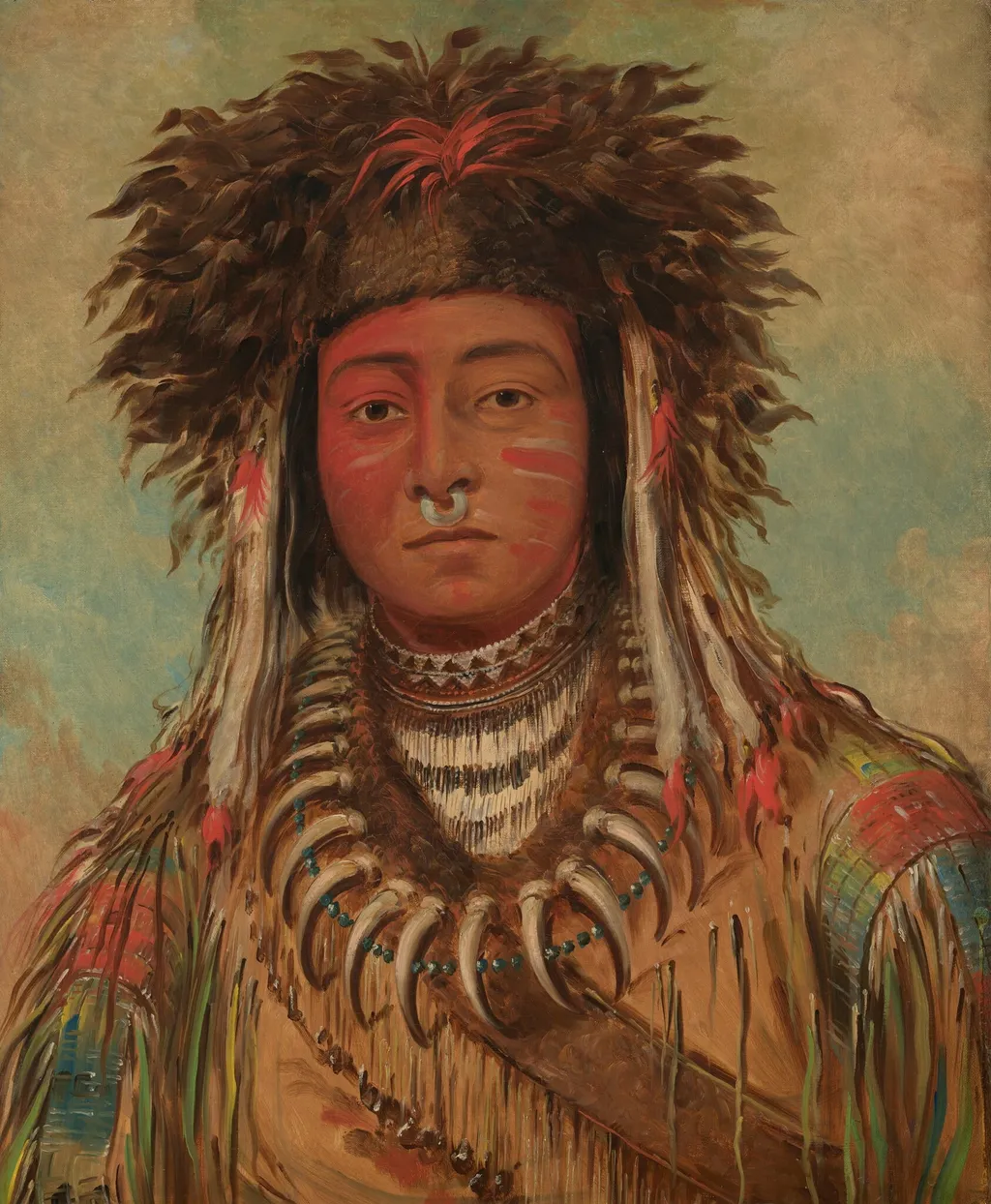
Boy Chief - Ojibbeway is an oil painting by the Romanticist artist George Catlin. It dates from 1843 and is held in the collection of the National Gallery of Art.
About this work
Overview
It was acquired by the museum in 1965 as a gift from Paul Mellon, forming part of the Paul Mellon Collection with the accession number 1965.
Boy Chief - Ojibbeway is an oil on canvas portrait painted in 1843 by George Catlin, an American artist who dedicated his career to documenting Native American peoples and cultures. The work measures 71 by 58.3 centimeters and depicts a bust-length view of a young Ojibwe man facing directly forward, adorned in elaborate ceremonial regalia. The painting is currently held in the collection of the National Gallery of Art in Washington, D.C., where it is displayed in the West Building on the main floor in Gallery 63. It was acquired by the museum in 1965 as a gift from Paul Mellon, forming part of the Paul Mellon Collection with the accession number 1965.16.349. The portrait matters as a significant example of Catlin's documentary project, undertaken from personal conviction rather than commercial commission, to preserve a visual record of Native American individuals and customs during a period of rapid cultural change and forced displacement.
Subject & Meaning
The subject is a young Ojibwe man, identified by the title as Boy Chief, presented with dignified directness and frontal gaze. His face is painted with red pigment across the cheeks and forehead, with two horizontal white stripes on each cheek, while a silver or white circular nose ring pierces the septum. The headdress is particularly elaborate, composed of numerous dark brown and black feathers with a central cluster of red feathers at the crown, from which long light-colored fur strips or hair extensions hang down both sides of the face, interspersed with smaller red and yellow feathers. Multiple necklaces encircle the neck, including strands of white beads and a prominent breastplate of long white shell or bone pendants arranged in rows. Curved white claws or horns, possibly bear claws, are strung across the chest with blue bead accents. The garment itself appears to be made of brown fur or hide with fringe details and additional colorful feather decorations at the shoulders. The iconography speaks to status and ceremonial role within Ojibwe society, with the combination of face paint, feathered headdress, and shell or bone regalia suggesting a person of standing. Catlin's approach, as noted in scholarly discussion, was driven by a desire to document what he perceived as disappearing cultures, resulting in portraits that function simultaneously as ethnographic record and as dignified individual portrayal.
Technique & Style
The work is executed in oil on canvas, with dimensions of 71 by 58.3 centimeters for the painting itself, and 80 by 67.6 centimeters when framed. The painting is not signed. Catlin's technique varies across the composition, with relatively smooth brushwork in the facial area giving way to thicker, more textured strokes in the feathers, fur, and fringe. Light falls evenly on the figure from the front, with subtle modeling to suggest three-dimensional form. The palette is dominated by earthy browns, warm reds, and touches of white, blue, and green. The background is a muted, atmospheric blend of pale blue-green and warm beige tones, loosely painted with no distinct features, which serves to isolate and emphasize the figure. This handling places the work within Catlin's broader practice of portraiture, where he sought to capture individual likeness while also attending to the details of costume and regalia that he considered culturally significant. The overall effect combines documentary attention to material detail with a formal presentation that confers dignity upon the sitter.
History & Provenance
The painting was created in 1843, during the period when Catlin was producing works based on his extensive travels and observations of Native American peoples. Following Catlin's death in 1872, the painting descended to his daughters, Clara Gregory Catlin, Louise Catlin Kinney, and Elizabeth Wing Catlin. In 1912, the American Museum of Natural History purchased the work from Elizabeth Wing Catlin. It remained there until 1959, when it was sold through Kennedy Galleries in New York to Paul Mellon of Upperville, Virginia. Mellon subsequently gave the painting to the National Gallery of Art in 1965. The work has been exhibited on several notable occasions: it was placed on extended loan to the Diplomatic Reception Rooms at the U.S. Department of State in Washington, D.C. from 1966 to November 1981, and again from March 1982 to 1990. It was featured in American Indian Life: Paintings by George Catlin at the National Gallery of Art in 1980, and in George Catlin at the Amon Carter Museum in Fort Worth from 1981 to 1982. It was also included in George Catlin and His Indian Gallery at the Renwick Gallery in Washington, D.C. from 2002 to 2003, though it was not listed in the catalogue for that exhibition. The painting has been reproduced in the National Gallery of Art's catalogues of American paintings in 1970, 1980, and 1992.
Context
George Catlin was born in 1796 in Wilkes-Barre, Pennsylvania, and after brief careers in law and as a portraitist in Philadelphia, he embarked in 1830 on the project that would define his life: traveling through Native American territories to paint and document indigenous cultures. Between 1830 and 1836 he made five major trips, visiting fifty tribes and producing more than 500 paintings. The portrait of Boy Chief belongs to the later phase of this project, painted after his return east and during the period when he was also publishing his written accounts and preparing works for reproduction. The National Gallery of Art's educational materials place this portrait in dialogue with another Catlin work, The Female Eagle - Shawano of 1830, noting that both exemplify a shift in the artist-subject relationship, as Catlin portrayed these individuals out of personal interest in documenting what he saw as disappearing cultures rather than for commercial motives. This distinguishes his practice from the portrait traditions of colonial and early republican America, where access to portraiture was limited to those who could afford this costly luxury. The French critic Charles Baudelaire, encountering Catlin's work in Europe, remarked that Catlin had brought back alive the proud and free characters of these chiefs, both their nobility and manliness. Catlin's broader project, however, was marked by financial difficulty; his attempts to sell his Indian Gallery to the U.S. government were repeatedly rejected, and in 1852 he was forced to sell the original collection of 607 paintings due to personal debts.
Legacy
The legacy of Boy Chief - Ojibbeway is intertwined with the complex afterlife of Catlin's entire documentary project. The painting exists today as part of one of the most significant collections of early Native American portraiture, held at a major national museum. Its reproduction in successive National Gallery catalogues from 1970 to 1992 indicates its established place within the museum's permanent collection and its use in scholarly and public education. The work also circulated as a hand-colored lithograph, part of the broader dissemination of Catlin's images through print media that reached audiences who could not access the original paintings. Source 6 identifies a lithograph version as part of The History of the Indian Tribes of North America, published between 1836 and 1844, though it incorrectly attributes this print to Charles Bird King rather than acknowledging Catlin as the source. This very confusion points to the complicated transmission and reception history of such images. Today, as the National Gallery's educational framework suggests, the portrait offers a complex legacy, functioning as both historical record and as a document of the romanticized view of Native cultures that characterized much 19th-century representation. The work continues to prompt questions about what truths a portrait communicates, what it reveals about the artist's perspective, and how it reflects the sitter's community, inviting viewers to approach it with cultural awareness of the period of intense upheaval and forced displacement in which it was created.
Own this work as a print
Artist & collection

Artist
George Catlin ( KAT-lin; July 26, 1796 – December 23, 1872) was an American lawyer, painter, author, and traveler, who specialized in portraits of Native Americans in the American frontier.

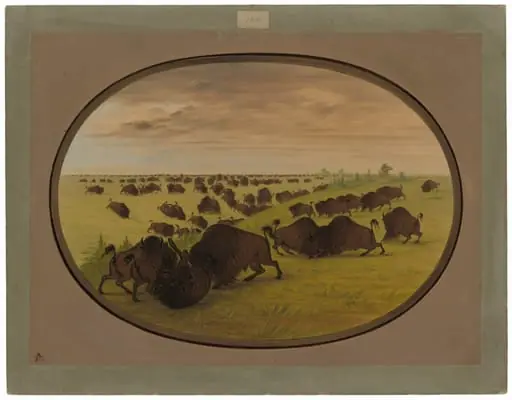 Bulls Fighting
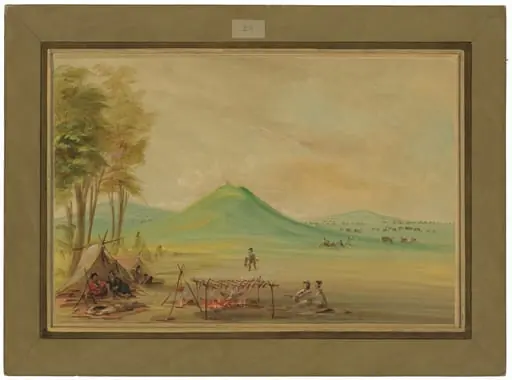 Expedition Encamped on a Texas Prairie. April 1686
 An Alligator's Nest
 Mrs. George Catlin (Clara Bartlet Gregory)
 Chief of the Taensa Indians Receiving La Salle. March 20, 1682
 A Small Village - Payaguas Indians
 Omaha Chief, His Wife, and a Warrior
 Father Hennepin Leaving the Mississippi to Join La Salle. May 8, 1680
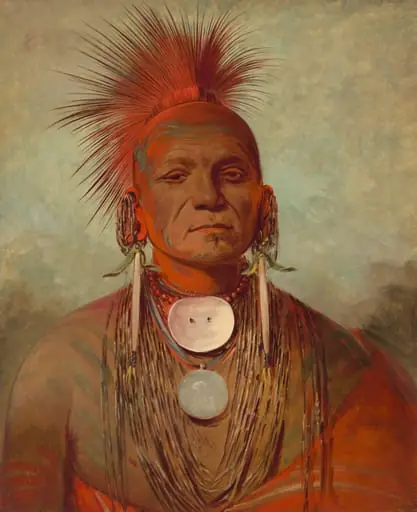
- See-non-ty-a, an Iowa Medicine Man
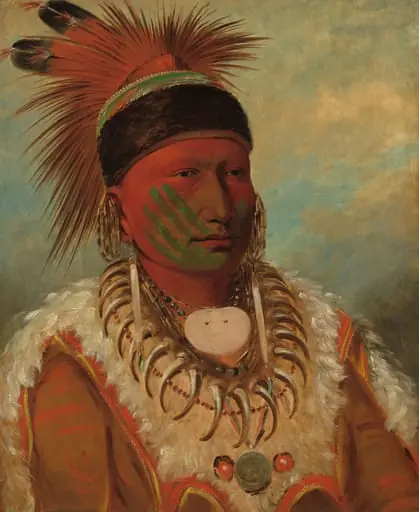 The White Cloud, Head Chief of the Iowas
 Plains Indian
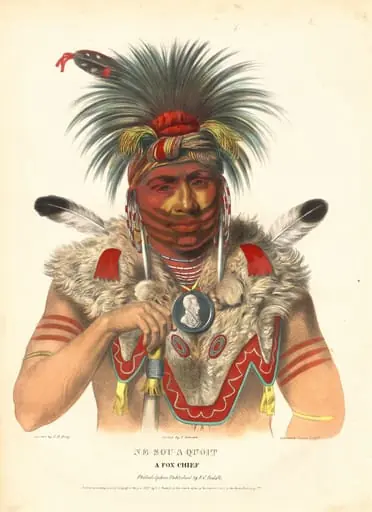 Ne-Sou-A Quoit, a Fox Chief
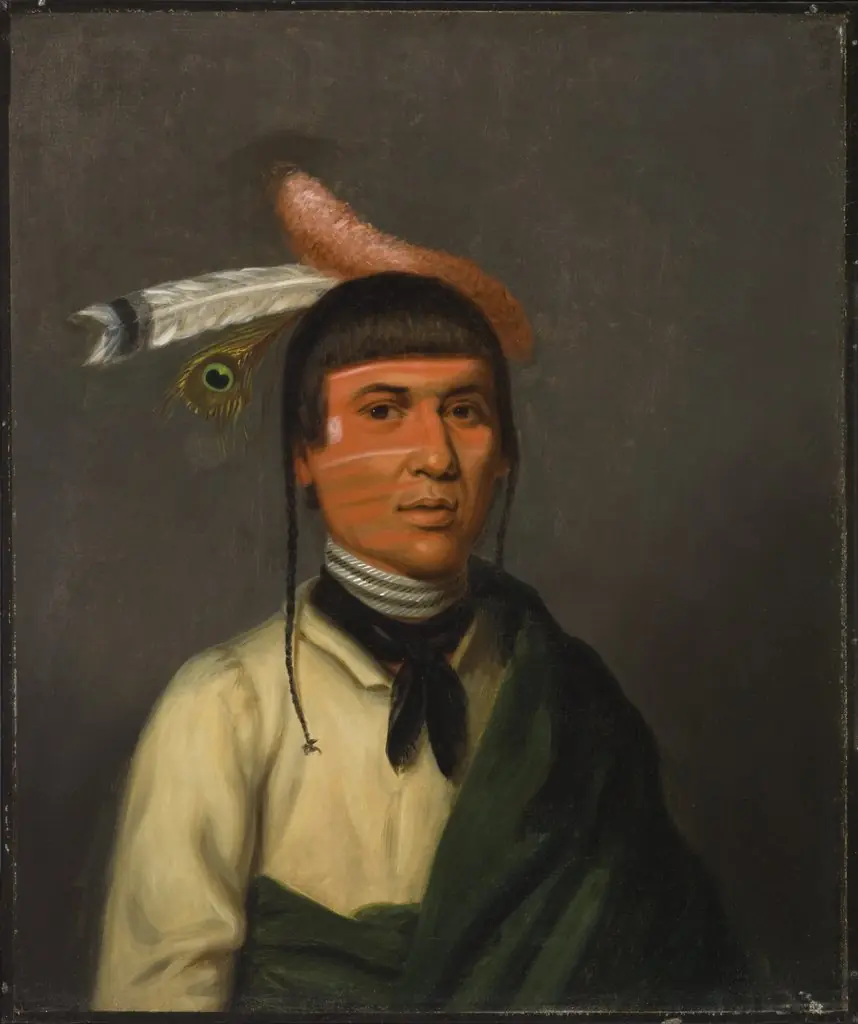 No-Tin (Wind), a Chippewa Chief
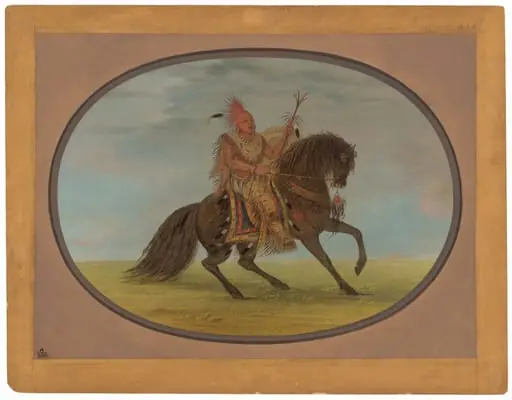 The Running Fox on a Fine Horse - Saukie
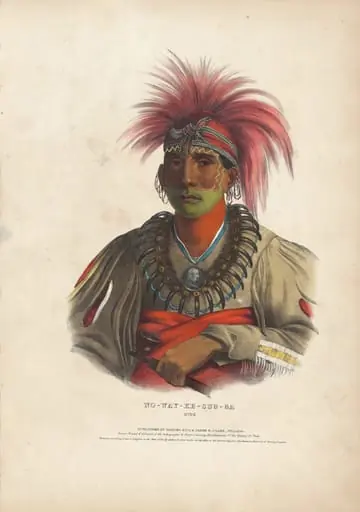 No-Way-Ke-Sug-Ga, Otoe
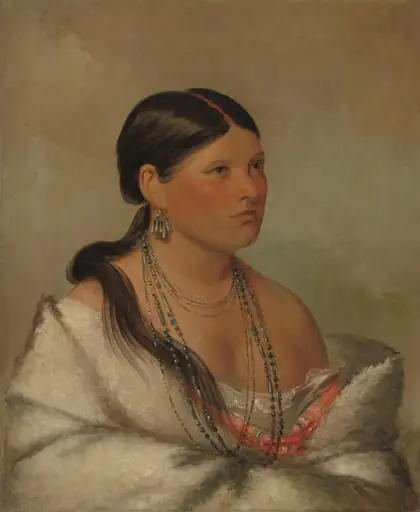 The Female Eagle - Shawano
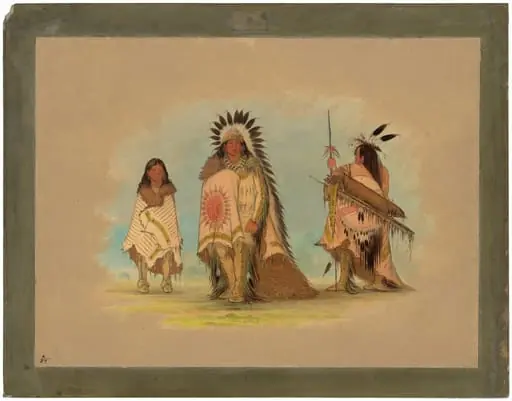 A Sioux Chief, His Daughter, and a Warrior
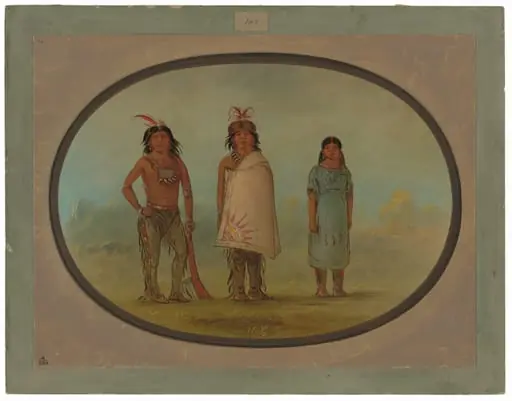 Two Chippewyan Warriors and a Woman
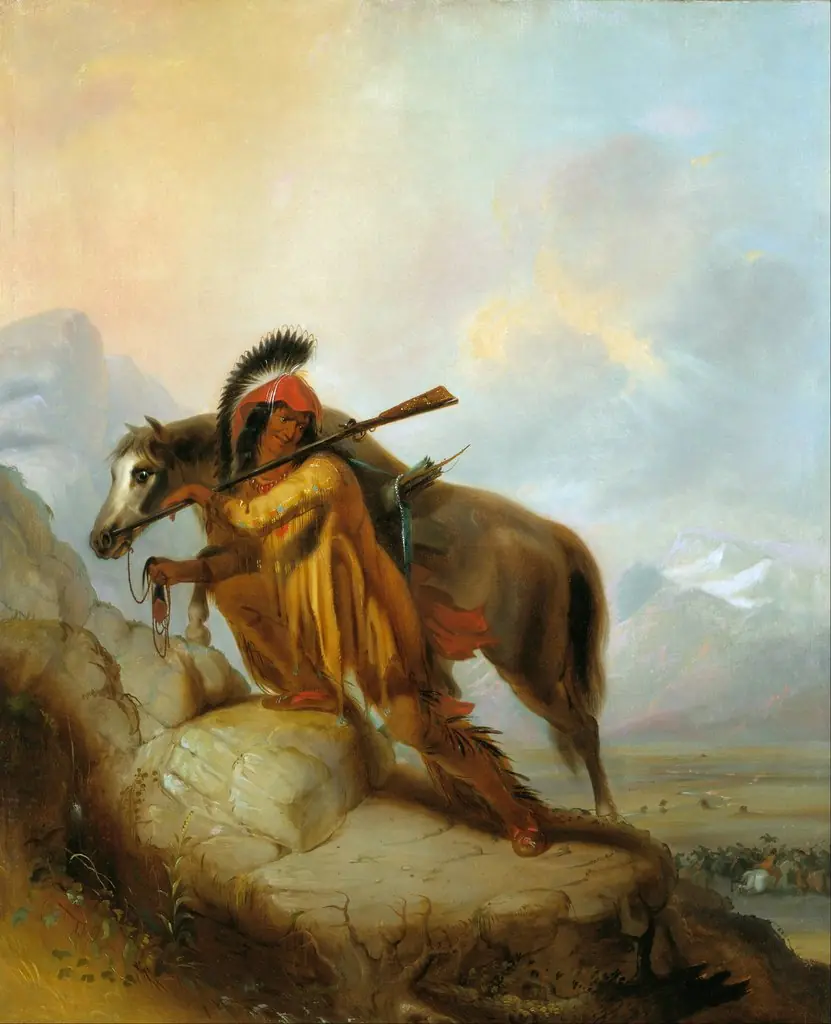 The Scalplock
 Crow Chief, His Wife, and a Warrior