Artwork
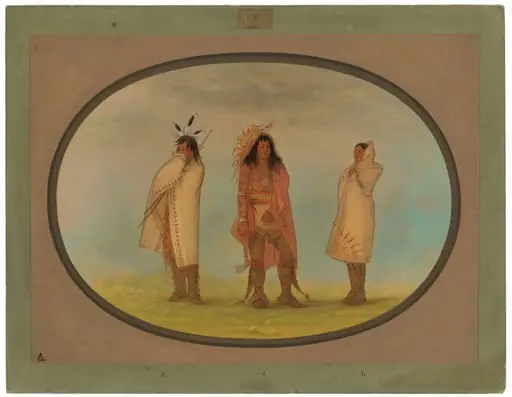
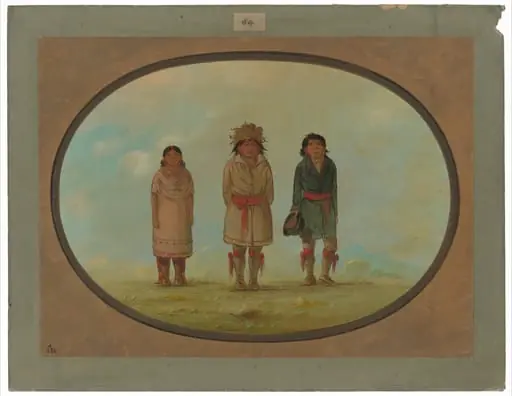
Three Delaware Indians
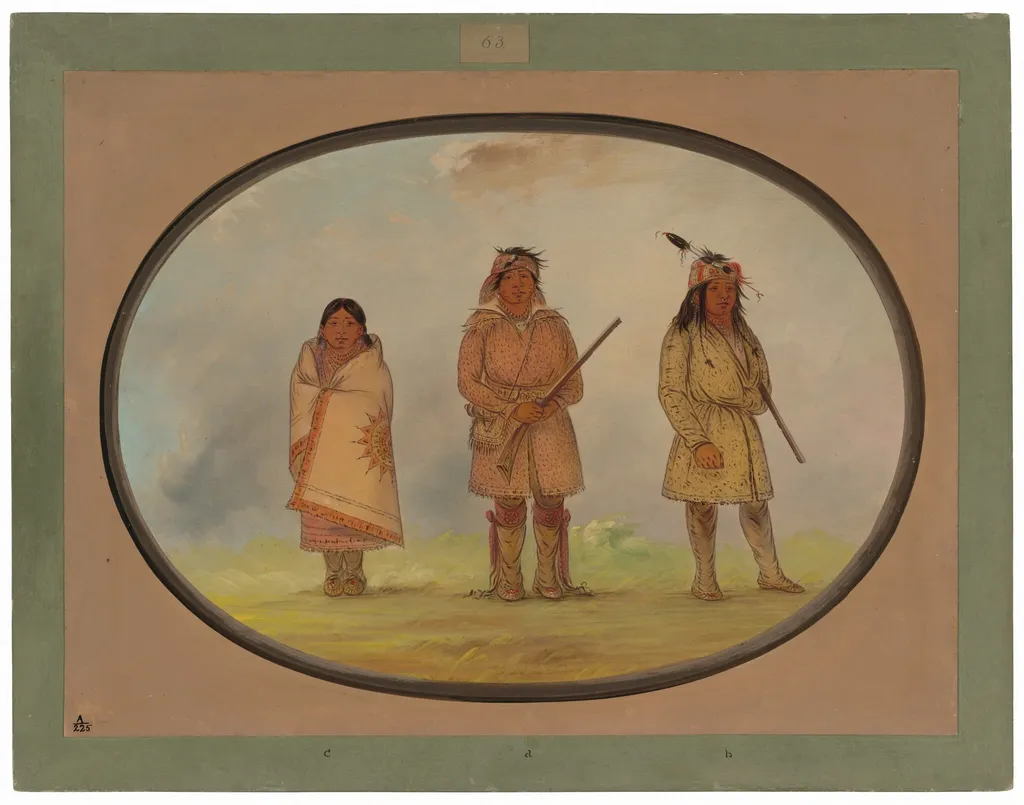
Three Delaware Indians is an oil painting by the American Folk Art artist George Catlin. It dates from 1865 and is held in the collection of the National Gallery of Art.
About this work
Subject & Meaning
The artwork is housed in the National Gallery of Art in Washington, D.
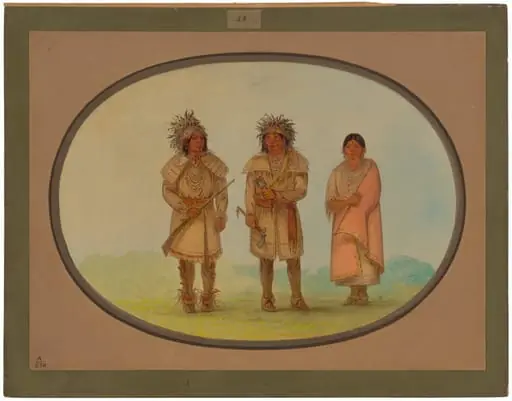
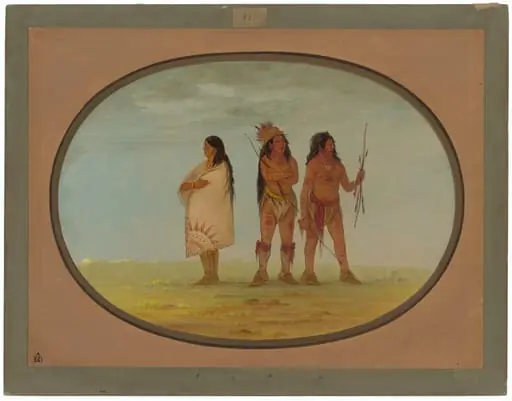
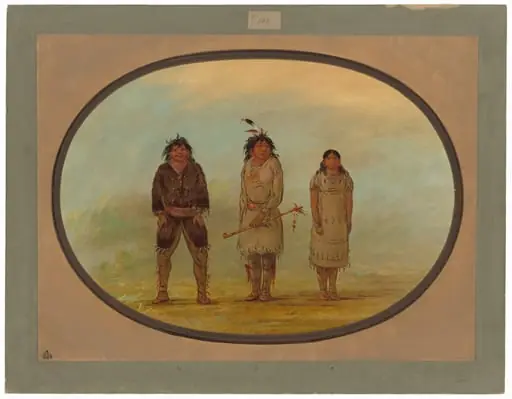
Three Delaware Indians depicts a group of Delaware people rendered in George Catlin's characteristic portrait style, emphasizing individual presence rather than ceremonial display. The composition centers on three figures, a man, woman, and child, clad in traditional dress with feathered headdresses and woven blankets, against a muted backdrop that isolates them from European settler contexts. Catlin's documentation of Indigenous subjects was driven by a mission to preserve representations he viewed as vanishing, framing the work as both ethnographic record and artistic tribute.
The painting's subject reflects 19th‑century colonial narratives that positioned Native peoples as subjects of cultural observation while simultaneously idealizing their appearance. Its meaning lies in this dual function: a visual ethnography that reinforced contemporary stereotypes yet also contributed to early conservationist impulses toward Indigenous cultures.
The artwork is housed in the National Gallery of Art in Washington, D.C., where it remains part of the permanent collection.
Technique & Style
Three Delaware Indians is an oil painting executed on card mounted on paperboard, a support arrangement characteristic of Catlin's later portable practice. The composition occupies a horizontal format measuring 47 cm in height by 63.1 cm in width. Classified as a portrait, the work is rendered in oil, a medium Catlin favored for its capacity to record the likenesses, dress, and features of his Indigenous sitters with descriptive clarity.
The painting is held in the collection of the National Gallery of Art in Washington, D.C., and dates to 1861.
The card-mounted-on-paperboard construction suggests a deliberately compact, transportable format consistent with works Catlin produced and handled outside the studio.
History & Provenance
Three Delaware Indians was painted by George Catlin in 1861 in oil on card mounted on paperboard. The work descended from the artist to his three daughters, Clara Gregory Catlin, Louise Catlin Kinney, and Elizabeth Wing Catlin. In 1912, the American Museum of Natural History purchased the painting from Elizabeth Wing Catlin.
The museum later sold it in 1959 through Kennedy Galleries in New York to Paul Mellon of Upperville, Virginia, who in 1965 gave the painting to the National Gallery of Art, where it remains in the collection.
Following its creation in 1861, this oil painting remained within the artist's family until 1912, when the American Museum of Natural History purchased it from Elizabeth Wing Catlin. The museum retained the work until 1959, at which point it was sold through Kennedy Galleries to collector Paul Mellon of Upperville, Virginia. Mellon subsequently donated the piece to the National Gallery of Art in Washington, D.C., in 1965, where it currently resides in the permanent collection.
Overview
Created in 1865, Three Delaware Indians is an oil painting executed on card that has been mounted onto paperboard. The work is part of the National Gallery of Art’s collection in Washington, D.C., and exemplifies George Catlin’s later efforts to record individual Native American subjects.
Context
By the mid‑1860s, the Delaware people had been displaced from their ancestral lands in the eastern United States and were living in various western territories. Catlin’s depiction captures a moment of cultural continuity amid forced migration, offering a visual counterpoint to contemporary narratives that often omitted Indigenous presence.
Own this work as a print
Artist & collection

Artist
George Catlin ( KAT-lin; July 26, 1796 – December 23, 1872) was an American lawyer, painter, author, and traveler, who specialized in portraits of Native Americans in the American frontier.

 Bulls Fighting
 Expedition Encamped on a Texas Prairie. April 1686
 An Alligator's Nest
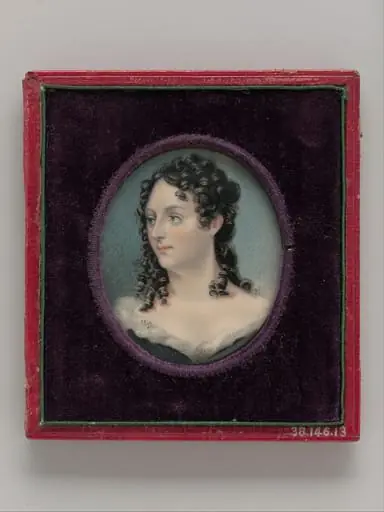 Mrs. George Catlin (Clara Bartlet Gregory)
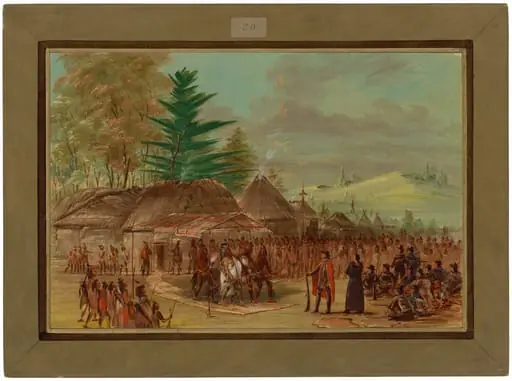 Chief of the Taensa Indians Receiving La Salle. March 20, 1682
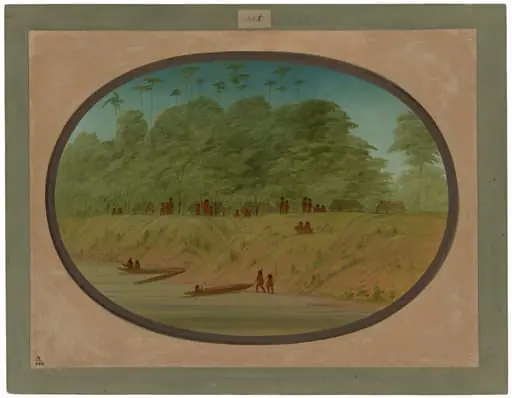 A Small Village - Payaguas Indians
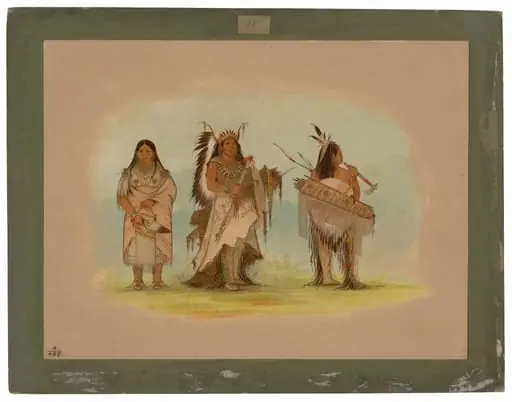 Omaha Chief, His Wife, and a Warrior
 Father Hennepin Leaving the Mississippi to Join La Salle. May 8, 1680