Artwork
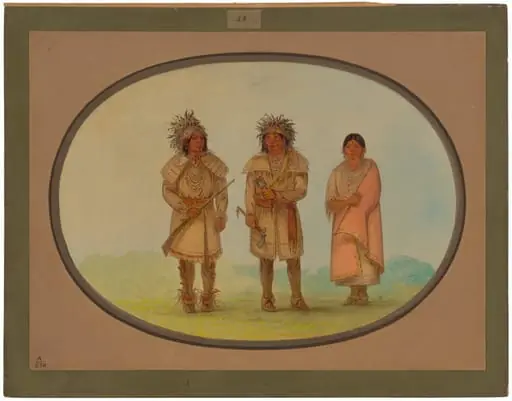
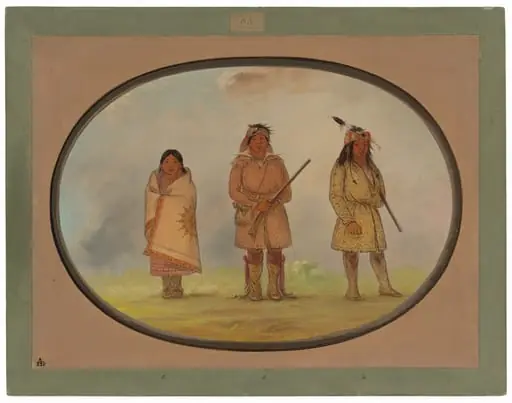
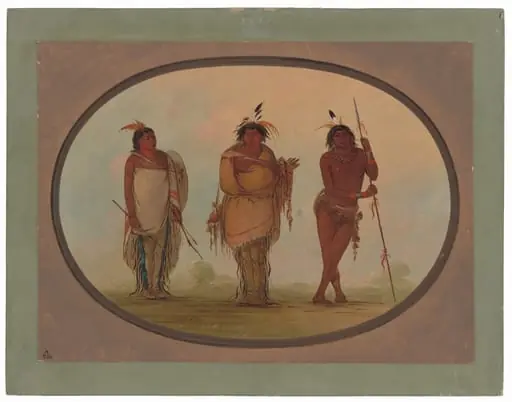
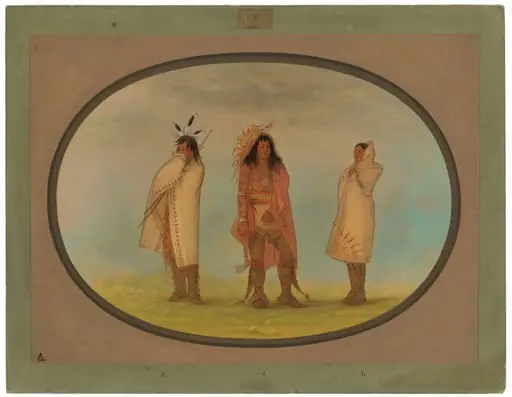
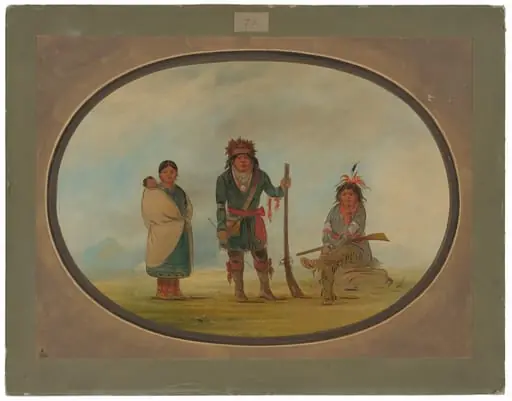
Three Potowotomie Indians
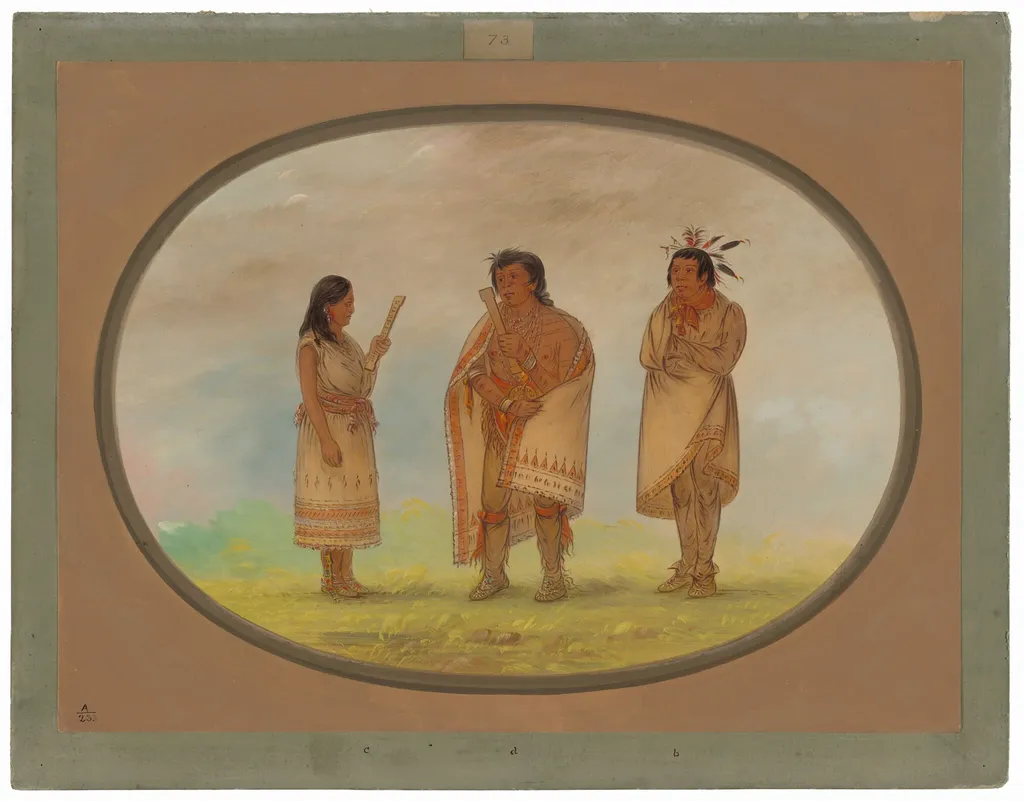
Three Potowotomie Indians is an oil painting by the American Folk Art artist George Catlin. It dates from 1865 and is held in the collection of the National Gallery of Art.
About this work
The two on the right wear similar clothing, loose shirts, leggings, and feathered headpieces, one holding a pipe, the other standing with hands crossed.
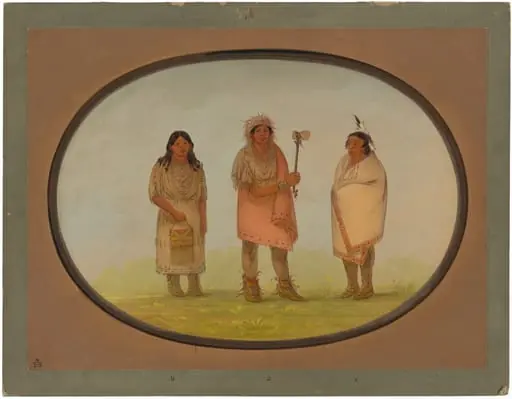
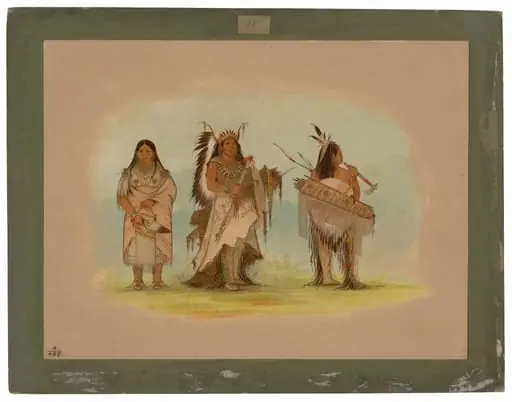
This painting shows three people standing outside in a grassy area. The person on the left is holding a small object, dressed in a long skirt with red trim. The two on the right wear similar clothing, loose shirts, leggings, and feathered headpieces, one holding a pipe, the other standing with hands crossed. The background is soft and blurry, with a faint sky and hills.
The artist painted them in a simple, direct style, focusing on their clothing and poses. This kind of straightforward painting was common in the 19th century.
If you like this style, look up Realism next.
Technique & Style
The work is executed in oil on a card support that has been mounted onto paperboard. The handling reflects Catlin’s documentary portrait style, with careful attention to physiognomic detail and costume within a restrained, naturalistic palette.
The composition arranges the three Potowotomie figures in a straightforward, standing format against a minimally described background, emphasizing clarity of form and individual likeness. Dimensions are 47.5 cm in height by 64 cm in width.
History & Provenance
Created in 1861 by George Catlin, the oil painting Three Potowotomie Indians was originally owned by the artist until his death in 1872. Upon his passing, the work passed by descent to his three daughters: Clara Gregory Catlin, Louise Catlin Kinney, and Elizabeth Wing Catlin. In 1912, the American Museum of Natural History purchased the piece directly from Elizabeth Wing Catlin.
The museum subsequently sold the painting in 1959 through Kennedy Galleries in New York to collector Paul Mellon of Upperville, Virginia. Mellon later gifted the work to the National Gallery of Art in 1965, where it remains part of the collection.
The painting is held by the National Gallery of Art, Washington, D.C., where it is accessioned as 1965.1.14.
It entered the Gallery’s collection in 1965 as a gift from Mr. Paul Mellon, Upperville, Virginia, who had acquired it in 1959 through Kennedy Galleries, New York, from Elizabeth Wing Catlin.
Overview
Created in 1865, this oil painting on card, later affixed to paperboard, depicts three members of the Potowotomie tribe standing in an open, grassy setting. The figures are rendered against a muted horizon where sky and distant hills dissolve into a soft focus, emphasizing the subjects rather than the landscape.
Subject & Meaning
The central figure on the left holds a small object, possibly a ceremonial item, and wears a long skirt trimmed in red. The two figures on the right are dressed in loose shirts, leggings, and feathered headdresses; one clutches a pipe, while the other stands with his arms crossed. The composition presents a straightforward, dignified portrayal of tribal attire and posture.
Context
The painting reflects a period when Euro‑American interest in the “vanishing” Native cultures grew, prompting artists like Catlin to create visual records. While not aligned with academic fine‑art conventions, the work contributes to the broader visual archive of 19th‑century ethnographic portraiture.
Own this work as a print
Artist & collection

Artist
George Catlin ( KAT-lin; July 26, 1796 – December 23, 1872) was an American lawyer, painter, author, and traveler, who specialized in portraits of Native Americans in the American frontier.

 Bulls Fighting
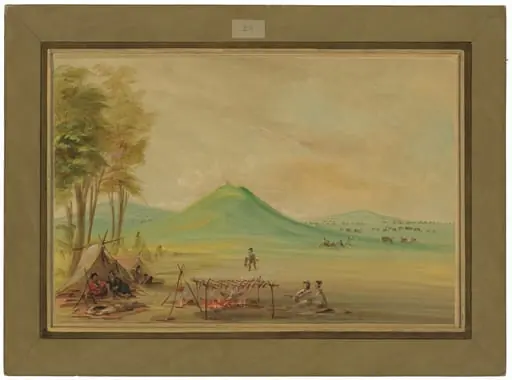 Expedition Encamped on a Texas Prairie. April 1686
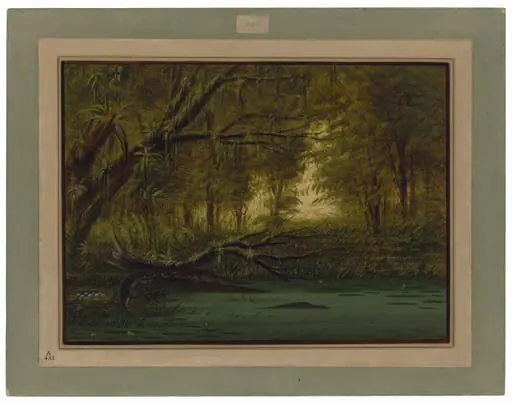 An Alligator's Nest
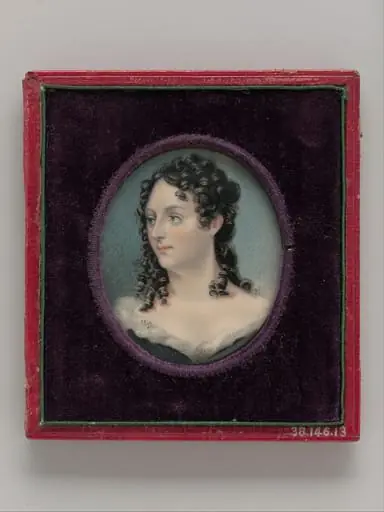 Mrs. George Catlin (Clara Bartlet Gregory)
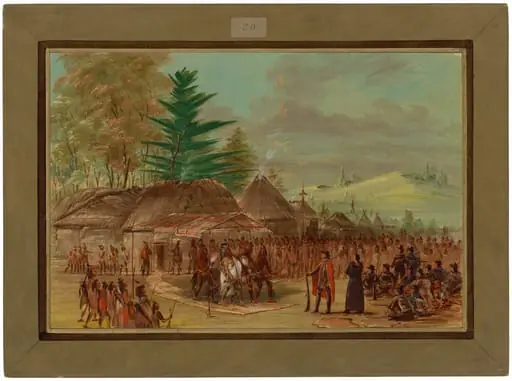 Chief of the Taensa Indians Receiving La Salle. March 20, 1682
 A Small Village - Payaguas Indians
 Omaha Chief, His Wife, and a Warrior
 Father Hennepin Leaving the Mississippi to Join La Salle. May 8, 1680