Artwork
Petite, Petite
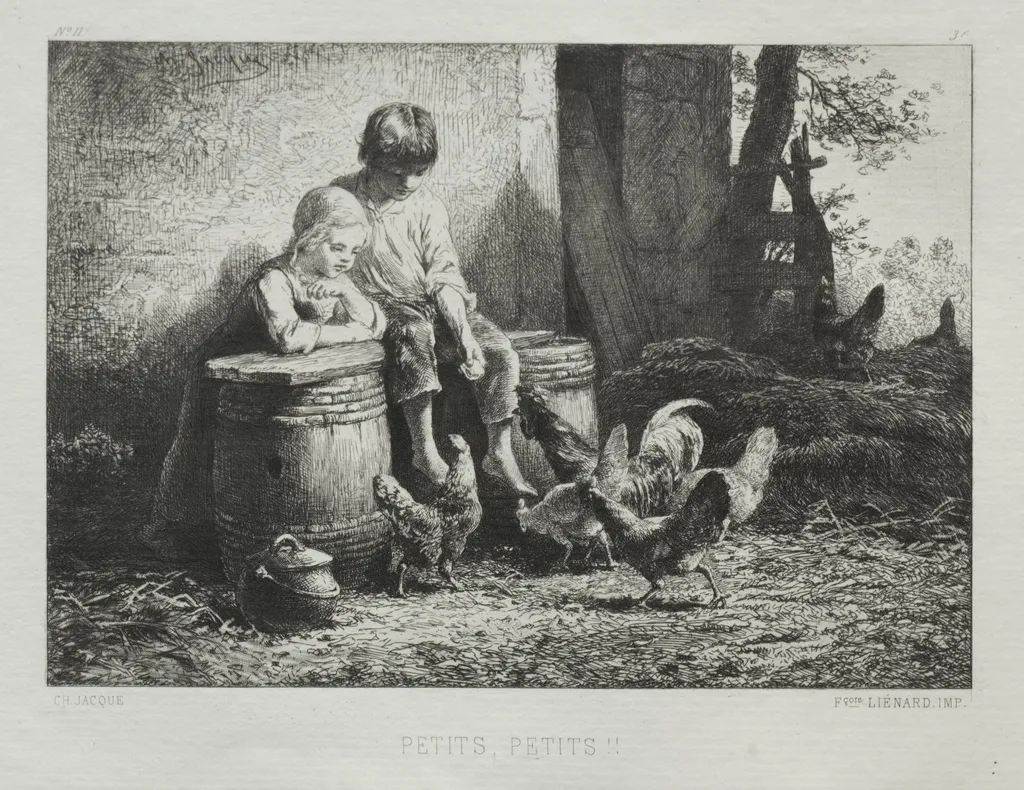
Petite, Petite is a print by the Impressionist artist Charles-Émile Jacque. It dates from 1864 and is held in the collection of the Cleveland Museum of Art.
- Accession no.
- 1921.1465
- Credit line
- Gift of Leonard C. Hanna Jr.
About this work
Overview
Charles-Émile Jacque produced Petite, Petite in 1864 as a drypoint etching, reflecting his training in engraving gained during seven years in the French Army. A member of the Barbizon School, he focused on rural subjects with quiet dignity. The work is part of The Cleveland Museum of Art’s collection and exemplifies his shift from military service to artistic expression rooted in peasant life.
Subject & Meaning
The composition emphasizes quiet domesticity, not narrative drama, honoring the rhythms of everyday rural existence.
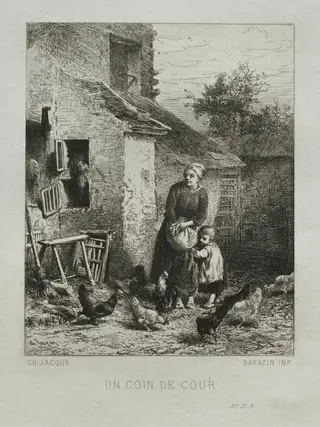
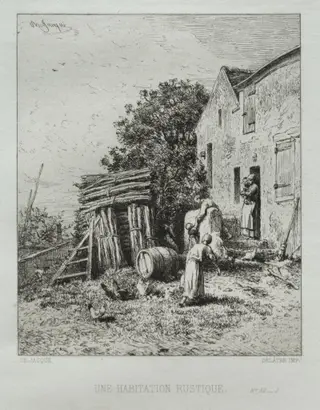
The scene depicts two women and a young child outdoors, near a wooden barrel and a woven basket. One woman holds the child, whose small hands draw attention, while chickens forage nearby. The title, Petits, Petits!, suggests a gentle, repeated call, possibly from an elder to a child. The composition emphasizes quiet domesticity, not narrative drama, honoring the rhythms of everyday rural existence.
Technique & Style
Jacque employed fine, controlled lines typical of drypoint engraving to model light and texture. The black-and-white tonal range creates depth without color, emphasizing the softness of fabric, the roughness of earth, and the delicate forms of the child and birds. His background in printmaking allowed precise rendering of detail, enhancing the scene’s intimacy and realism.
History & Provenance
Created in 1864, the print emerged during Jacque’s mature period, when he was deeply engaged with the Barbizon artists’ ideals. It entered The Cleveland Museum of Art’s collection through documented acquisition, though earlier ownership details remain unrecorded. Its preservation reflects early 20th-century interest in French graphic arts tied to social realism.
Context
Jacque worked alongside Jean-François Millet and other Barbizon painters who rejected academic idealism in favor of observing rural labor and leisure. Petite, Petite aligns with this movement’s emphasis on authenticity, capturing unposed moments in the countryside. The print’s modest scale and subject matter contrast with grand historical paintings dominant in Parisian salons at the time.
Legacy
Though less widely known than his contemporaries, Jacque’s prints contributed to the legitimization of rural life as worthy artistic subject matter. His technical precision in etching influenced later generations of printmakers interested in naturalism. Petite, Petite remains a quiet testament to the dignity found in ordinary, overlooked moments of peasant life.
Own this work as a print
Artist & collection

Artist
Charles-Émile Jacque (23 May 1813 – 7 May 1894) was a French painter of Pastoralism and engraver who was, with Jean-François Millet, part of the Barbizon School. He first learned to engrave maps when he spent seven years in the French Army.