Artwork
Hunting from a Chariot, Tomb of Userhat
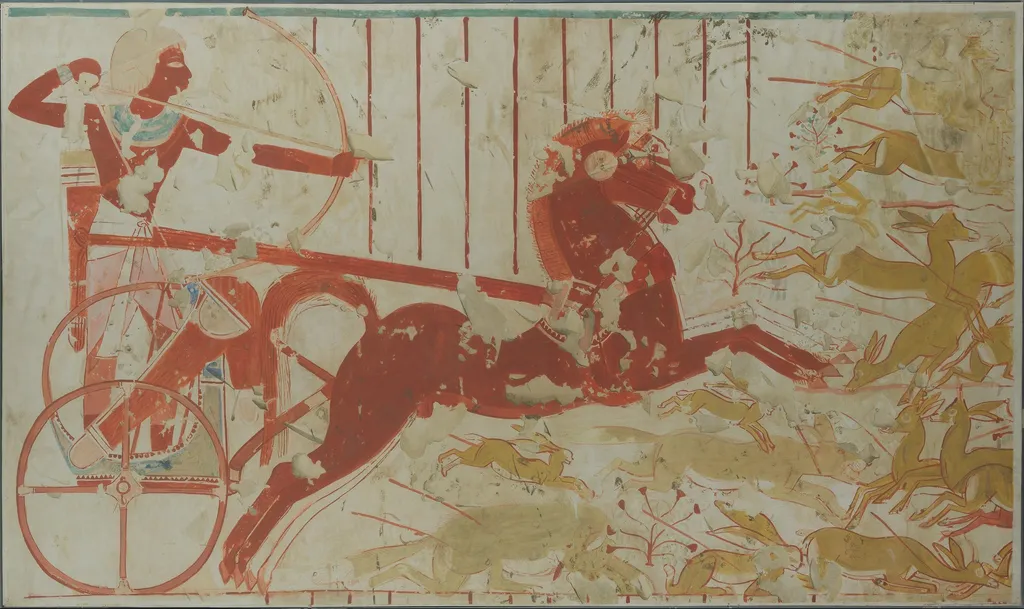
Hunting from a Chariot, Tomb of Userhat is an unspecified painting by Charles Wilkinson. It is held in the collection of the Metropolitan Museum of Art. This painting from the Tomb of Userhat depicts a dynamic hunting scene, characterized by its energetic composition.
About this work
Subject & Meaning
The scene functions as a visual assertion of the tomb owner's authority and active role, capturing a moment of controlled action against nature.
The artwork depicts a dynamic hunting scene centered on a man driving a chariot pulled by horses. In this composition, the figure is shown wielding a bow and arrow while pursuing deer. As a representation of hunting from a chariot within the context of the Tomb of Userhat, the imagery illustrates the deceased's engagement in high-status activities traditionally associated with elite power and royal virtue.
The inclusion of specific elements such as the chariot, horses, and prey serves to emphasize the subject's capability and status during life, projecting these qualities into the afterlife. The scene functions as a visual assertion of the tomb owner's authority and active role, capturing a moment of controlled action against nature.
History & Provenance
The tomb painting Hunting from a Chariot in the Tomb of Userhat (TT 56) was recorded as a facsimile by Charles Wilkinson. The work entered the Metropolitan Museum of Art as accession 30.4.42, where it has been maintained within the museum's Egyptian collection. Dating aligns with the late Eighteenth Dynasty context of Userhat's burial at Thebes.
Wilkinson's facsimile preserves the original scene's chariot-hunting motif without altering the tomb's provenance, which remains tied to the Theban necropolis.
Overview
This painting from the Tomb of Userhat depicts a dynamic hunting scene, characterized by its energetic composition. Two chariots race across the landscape, their occupants actively engaged in the pursuit of deer. The palette is dominated by vivid reds and earthy browns, contributing to the overall intensity.
Scattered deer, some already fallen, convey the swift and decisive nature of the chase, set against a backdrop of tall reeds and a few flying birds.
Technique & Style
The artistic approach employs a striking contrast of bright red and earthy brown tones to define the forms. Chariots are rendered with a bold simplicity, characterized by thick outlines and areas of flat color. While the animals convey a sense of rapid movement through their scattering forms, their individual shapes retain a certain stiffness and angularity, a characteristic stylistic choice that combines vitality with formal structure in ancient Egyptian art.
Context
This painting originates from the Tomb of Userhat, an ancient Egyptian burial site. Tomb paintings like this typically served a specific purpose, often depicting scenes from daily life, religious rituals, or activities such as hunting that were believed to ensure the deceased's well-being and continued existence in the afterlife. Its presence in a tomb suggests its function as a commemorative or ritualistic image for the tomb owner.
Artist & collection
Artist
Egyptian artists carved lively scenes on tomb walls to keep the dead company. Wilkinson's group gathers five such reliefs, from a falcon guarding a pharaoh to wine presses and chariots for the next world. They belong to…

 Syrians Bringing Horses, Tomb of Rekhmire
 Illustration of the Mahabharata
 Untitled
 Illustration of the Mahabharata
 Man Confronting a Hyena, Tomb of Amenemhab
 六波羅合戦 平治物語絵巻 断簡|Battle at Rokuhara, from The Tale of the Heiji Rebellion
 Provisions from Nubia Stored in the Temple, Tomb of Rekhmire
 Untitled
 Syrians Bringing Vessels and Weapons, Tomb of Rekhmire
 Scenes from the Mahabharata