Artwork
The Trojan Women Setting Fire to Their Fleet
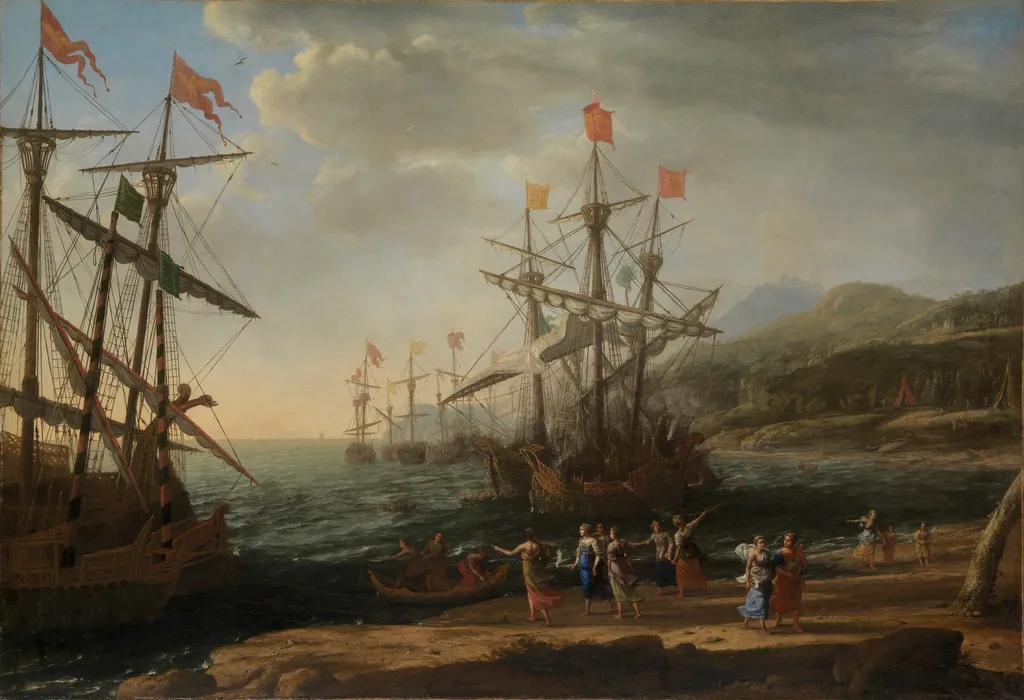
The Trojan Women Setting Fire to Their Fleet is an oil painting by the French Classical Baroque artist Claude Lorrain. It dates from 1643 and is held in the collection of the Metropolitan Museum of Art.
About this work
Subject & Meaning
The scene of women and burning ships on shore thus carries layered meaning, evoking the end of wandering and the founding of a new homeland.
The painting depicts an episode from Book 5 of the Aeneid in which the exiled women of Troy, instigated by the goddess Juno, set fire to the Trojan fleet to compel their men to abandon their wanderings and settle in Sicily. In response, Aeneas prays to Jupiter, who answers by summoning a rainstorm to extinguish the flames; Claude Lorrain alludes to this divine intervention through dark clouds gathered in the upper right of the composition. The scene of women and burning ships on shore thus carries layered meaning, evoking the end of wandering and the founding of a new homeland.
The subject also held personal resonance for the patron, Cardinal Girolamo Farnese, who commissioned the work around 1643 upon returning to Rome after an extended period abroad, lending the image of Trojan women ending their voyage an autobiographical dimension.
Technique & Style
Executed in 1643, this work is an oil painting on canvas. The composition illustrates a narrative from the Aeneid, depicting exiled Trojan women burning their fleet while dark clouds gather in the upper right corner to signify a divine rainstorm summoned to extinguish the flames. This atmospheric element serves as a formal device to allude to the intervention of Jupiter within the mythological scene.
History & Provenance
Claude Lorrain executed this oil on canvas painting around 1643. The work was commissioned by Cardinal Girolamo Farnese, who requested the piece shortly after returning to Rome from an extended period of work abroad. The subject matter, depicting the burning of the Trojan fleet from the Aeneid, was likely chosen to symbolize an end to wandering, reflecting the patron's own circumstances.
Following its creation, the painting entered a distinguished ownership chain. It was held by Girolamo Farnese before passing to William Waldegrave, 1st Baron Radstock. Subsequently, the work was owned by Abraham Wildey Robarts. Today, the painting resides in the collection of the Metropolitan Museum of Art in New York.
The painting is in the collection of the Metropolitan Museum of Art, New York, where it carries the accession number 59.114. It was painted in 1643 for Cardinal Girolamo Farnese and later passed through the hands of William Waldegrave, 1st Baron Radstock, and Abraham Wildey Robarts before entering the Museum’s holdings in 1859 as part of the Robarts bequest.
Context
Claude Lorrain’s The Trojan Women Setting Fire to Their Fleet (c. 1643) was commissioned by Cardinal Girolamo Farnese, a context that underscores the painting’s allegorical resonance for patrons returning from prolonged absence. The work interprets Virgil’s Aeneid (Book 5), where exiled Trojan women, urged by Juno, torch their fleet to halt further wandering, a narrative that resonated with Farnese’s recent return to Rome after extended diplomatic service abroad. Lorrain’s inclusion of ominous clouds in the upper right alludes to Jupiter’s intervention, a visual cue reinforcing the theme of divine resolution to human crisis.
The painting’s later influence is traced through British Romanticism: J. M. W. Turner drew inspiration from Lorrain’s composition, embedding the scene within a broader tradition of maritime and mythological landscape painting that shaped 19th-century European views of antiquity. Its presence in the Metropolitan Museum of Art since the 19th century further anchors its place in transatlantic art historical discourse.
Legacy
The painting's legacy includes a documented influence on the British artist J. M. W. Turner. According to the Metropolitan Museum of Art, Turner drew inspiration from Claude Lorrain's depiction of the scene. The work remains a significant example of mid-17th-century French art held within the museum's permanent collection in New York.
Overview
The painting "The Trojan Women Setting Fire to Their Fleet" was created by the French artist Claude Lorrain during the mid-17th century. Executed in oil on canvas, this work depicts a significant moment from the Trojan War narrative. It is presently part of the permanent collection at the Metropolitan Museum of Art in New York.
Own this work as a print
Artist & collection

Artist
Claude Lorrain (French:; born Claude Gellée, called le Lorrain in French; traditionally just Claude in English; c.