Artwork
Arrival of the Normandy Train, Gare Saint-Lazare
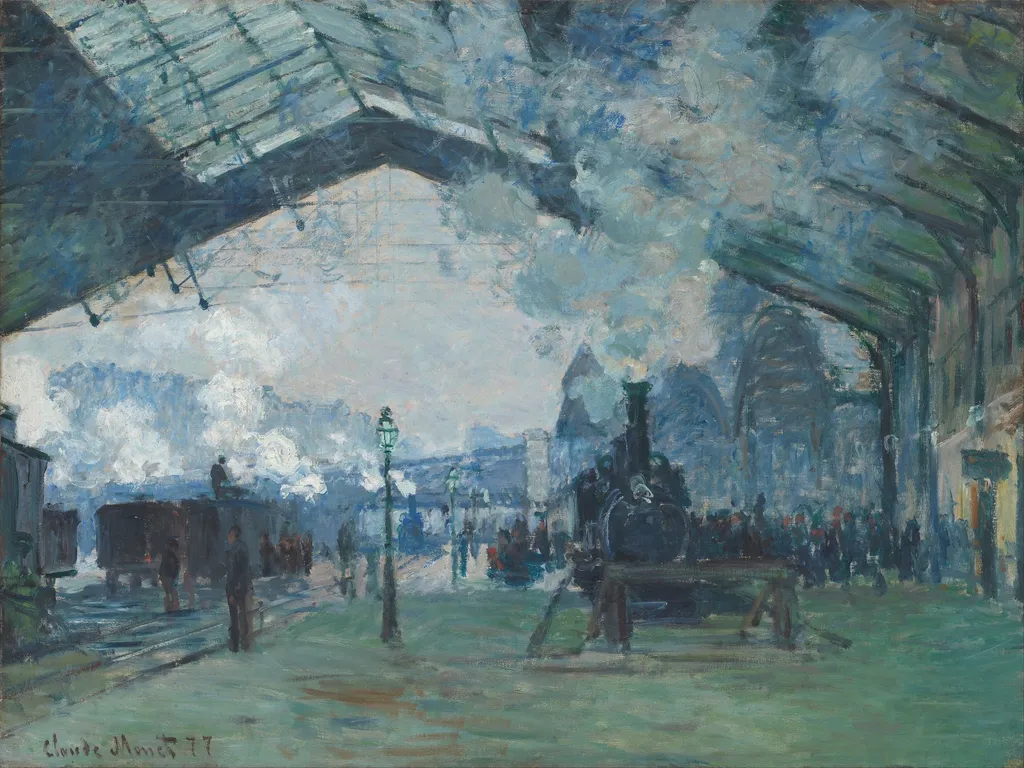
Arrival of the Normandy Train, Gare Saint-Lazare is an oil painting by the Impressionist artist Claude Monet. It dates from 1889 and is held in the collection of the Art Institute of Chicago.
About this work
Subject & Meaning
The painting depicts a steam train arriving from Normandy at the Gare Saint-Lazare in Paris, with crowds of people waiting amid clouds of steam and smoke beneath the vaulted iron-and-glass roof of the station's train shed. As one of twelve canvases Monet devoted to this single station, the work treats the modern railway terminal as a subject worthy of sustained pictorial investigation, capturing the interplay of locomotive vapor, architectural structure, and transient urban life. The scene belongs to the Impressionist movement and was painted en plein air at the station itself, reflecting the era's fascination with industry, speed, and the transformed Parisian landscape. Its inclusion at the Third Impressionist Exhibition in 1877 helped establish the railway and the modern city as legitimate themes for serious painting, marking a shift from traditional landscape and historical subjects toward the spectacle of contemporary life.
The billowing steam, a hallmark of Monet's Gare Saint-Lazare series, functions as both a compositional device and a symbol of modernity: it diffuses light across the canvas, obscures the arriving machinery, and transforms an ordinary arrival into an atmospheric, almost monumental event. By focusing on travelers, railway architecture, and the haze of coal-powered locomotion, the painting represents the experience of modern urban transit and the changing rhythms of nineteenth-century Paris.
Technique & Style
Claude Monet executed *Arrival of the Normandy Train, Gare Saint-Lazare* in 1877 using oil paint on canvas.
Claude Monet executed *Arrival of the Normandy Train, Gare Saint-Lazare* in 1877 using oil paint on canvas. The work measures approximately 60.3 cm in height by 80.2 cm in width and bears the signature and date "Claude Monet 77" in the lower left corner. As an urban landscape within the Impressionist movement, the painting captures a steam locomotive arriving at the station, surrounded by crowds and enveloped in smoke beneath the structure's vaulted iron and glass roof. Monet created this piece *en plein air* directly at the station, employing a style that emphasizes the atmospheric effects of steam and light typical of his series on the Gare Saint-Lazare.
History & Provenance
Claude Monet created *Arrival of the Normandy Train, Gare Saint-Lazare* in 1877 as an oil-on-canvas work, signed and dated "Claude Monet 77" in the lower left corner. The artist painted the scene en plein air at the railway station in Paris. It was sold to Ernest Hoschedé in March 1877 before passing to Georges de Bellio by the following year. The work was exhibited at the Third Impressionist Exhibition in Paris in April 1877. Upon de Bellio's death in 1894, the painting was inherited by his daughter Victorine and her husband, Ernest Donop de Monchy. It was subsequently sold to the Bernheim-Jeune gallery around 1899, later passing through dealers Paul Rosenberg and Durand-Ruel, who brought it to New York in 1911. That same year, it was acquired by collector Martin A. Ryerson for $7,000. Following Ryerson's death in 1932, the painting was bequeathed to the Art Institute of Chicago.
Arrival of the Normandy Train, Gare Saint-Lazare is held in the permanent collection of the Art Institute of Chicago. The painting entered the museum's holdings in 1932 as a bequest from the estate of Martin A. Ryerson, an industrialist who had purchased the work in 1911. Prior to this acquisition, the canvas passed through several private collections and galleries, including those of Georges de Bellio and Durand-Ruel.
The work has a documented exhibition history dating to its creation, notably appearing as one of eight station scenes Monet displayed at the Third Impressionist Exhibition in Paris in April 1877.
Context
Created in 1877 as part of a twelve-painting series depicting the Gare Saint-Lazare, this work exemplifies Claude Monet's Impressionist investigation of modern urban life, steam, and industrial architecture. Painted en plein air within the station's iron-and-glass vault, the canvas captures the atmospheric interplay of smoke and light surrounding a Normandy train arrival. The painting held a prominent position in the artist's career, serving as one of eight Monet works displayed at the Third Impressionist Exhibition in Paris in April 1877. This exhibition was a critical moment for the movement, showcasing Monet's dedication to capturing transient effects in contemporary settings. The work's subsequent provenance, passing through notable collectors like Ernest Hoschedé and Georges de Bellio before entering the Art Institute of Chicago, underscores its enduring significance within the canon of nineteenth-century French art.
Own this work as a print
Artist & collection
Artist
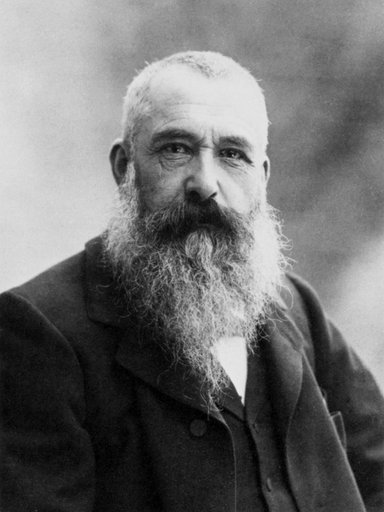
Oscar-Claude Monet was a French painter and founder of Impressionism who is seen as a key precursor to modernism, especially in his attempts to paint nature as he perceived it.