Artwork
The Cliff Walk at Pourville
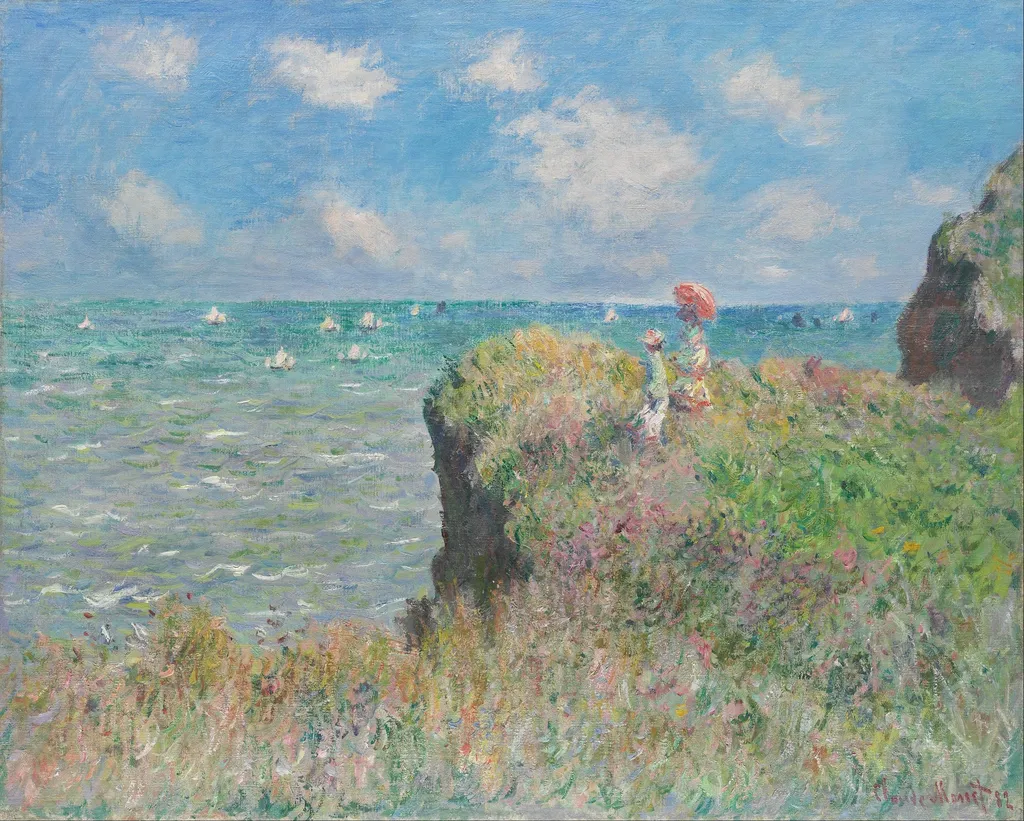
The Cliff Walk at Pourville is an oil painting by the Impressionist artist Claude Monet. It dates from 1892 and is held in the collection of the Art Institute of Chicago.
About this work
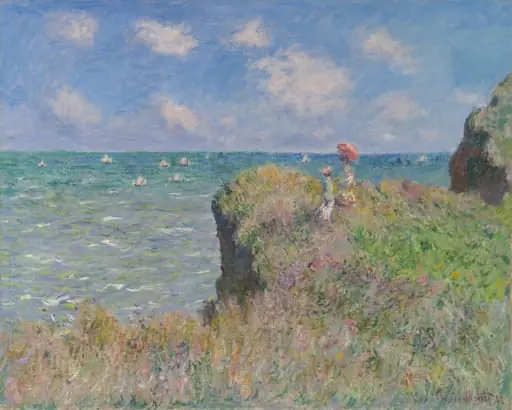
Claude Monet painted The Cliff Walk at Pourville in 1882. He used oil paint to show two girls on a cliff above the sea. The painting looks at leisure and work side by side.
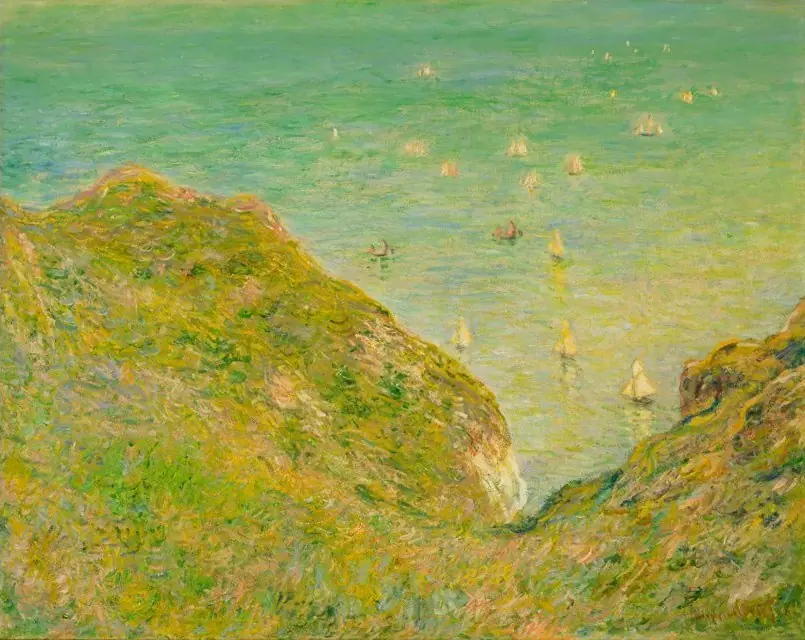
Monet made a series of these Normandy landscapes in summer. Fishing boats dot the horizon below the cliff. The breeze and sun feel light and quick.
Check out the Art Institute of Chicago.
Subject & Meaning
Interpretations suggest the figures characterize summer seaside vacations while serving as intermediaries who remind viewers of tourism's presence on the coast.
The painting depicts two female figures standing on a grassy cliff overlooking the English Channel at Pourville, with fishing boats visible on the horizon. This scene juxtaposes leisure and labor by contrasting the bourgeois women, potentially Alice Hoschedé and her daughter Blanche or Hoschedé's daughters Marthe and Blanche, against the working fishermen in the distance.
Interpretations suggest the figures characterize summer seaside vacations while serving as intermediaries who remind viewers of tourism's presence on the coast. Their inclusion prevents the audience from imagining themselves alone in the landscape, highlighting the interplay between visitors and the natural environment. The composition originally included a third figure, but its removal emphasizes the solitude of the remaining subjects within the setting.
Technique & Style
The Cliff Walk at Pourville is an oil painting on canvas, classified as a marine landscape and executed in 1882 in the Impressionist manner. The canvas measures 665 by 823 mm. Monet's brushwork is dynamic and loose, with painterly, calligraphic strokes animating the cliff grasses, the girls' drapery, and the distant sea to convey the energy of a brisk summer wind across land, water, figures, and clouds. This unified handling of texture and color integrates the two figures into the landscape without disrupting its overall unity, while his treatment of light balances brightness, shadows, and reflections to define the scene's atmospheric qualities.
Compositionally, the canvas is split along a diagonal, pitching the uneven line of the cliff edge against the flatness of the sea and looking outward at roughly a forty-five-degree angle. Depth is built through overlapping planes and atmospheric softening rather than linear perspective. Monet originally included a third figure and a rocky promontory at the far right; X-ray and pentimenti analysis show he later reduced the promontory and removed the figure, producing two shadow masses that frame the remaining pair and emphasize their solitude.
History & Provenance
The Cliff Walk at Pourville was painted in 1882 during Claude Monet’s extended stay at the Normandy fishing village of Pourville, which lasted from February to mid‑April, with the artist returning in June; the work belongs to his series of landscapes from that period. After Monet, the painting entered the collection of Annie Swan Coburn, who bequeathed it in 1933 to the Art Institute of Chicago, where it has remained.
The work is held at the Art Institute of Chicago. Its inventory number is 1933.1065. It was owned by Annie Swan Coburn before being acquired by the museum.
The painting has been part of the museum's collection since 1933 and is listed under that accession number. It is also documented in the Art Institute of Chicago's collection records as being housed in Chicago, Illinois, United States.
Context
The Cliff Walk at Pourville, painted by Claude Monet in 1882, reflects a period of personal retreat following the death of his wife Camille and a broader economic downturn in France that impacted his market. During a stay in Pourville between February and mid-April of that year, Monet produced a series of Norman landscapes that explored Impressionist techniques of light and atmosphere. The work, housed at the Art Institute of Chicago and originally owned by Annie Swan Coburn, depicts two women, possibly Alice Hoschedé and her daughter Blanche, on a grassy cliff overlooking the English Channel, symbolizing a leisurely summer scene juxtaposed with distant fishing activity.
Scholars have interpreted the figures as intermediaries between viewer and landscape, framing themes of tourism and the changing perception of coastal spaces. Monet’s compositional adjustments, including the reduction of a rocky promontory and the removal of an initial third figure, enhance spatial balance and focus on the solitary presence of the subjects within the expansive environment. His brushwork conveys movement through dynamic strokes that capture wind and light, while his use of overlapping planes and softened perspective aligns with Impressionist approaches to depth and atmosphere.
Overview
Created in 1882, this oil painting by Claude Monet captures a coastal scene at Pourville, a fishing village in Normandy. The work is part of the Art Institute of Chicago’s collection and belongs to a series of landscapes Monet produced during his summer stays in the region. The composition centers on two young women positioned on a cliff, with the sea and distant boats extending below.
Own this work as a print
Artist & collection
Artist
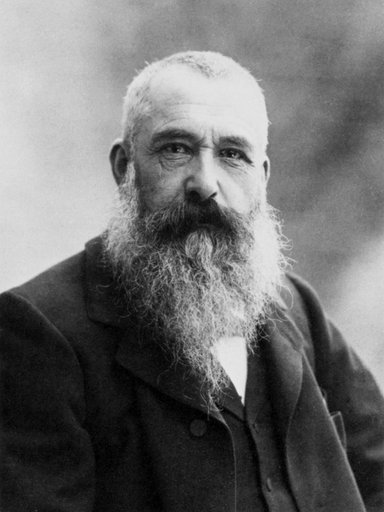
Oscar-Claude Monet was a French painter and founder of Impressionism who is seen as a key precursor to modernism, especially in his attempts to paint nature as he perceived it.