Artwork
A View of the Mountain Pass Called the Notch of the White Mountains (Crawford Notch)
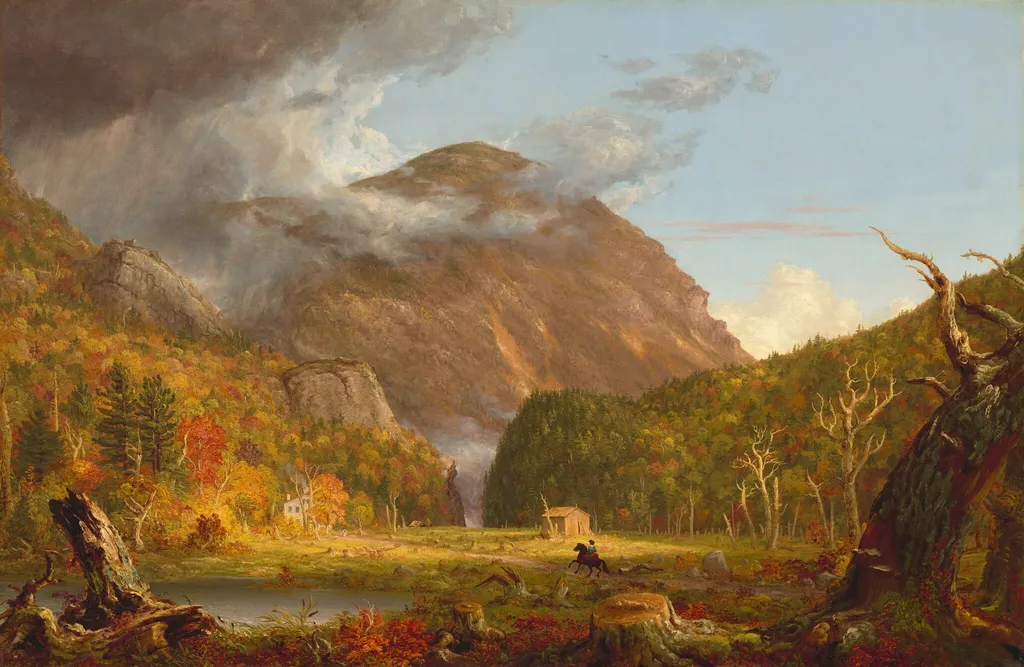
A View of the Mountain Pass Called the Notch of the White Mountains (Crawford Notch) is an oil painting by the Hudson River School artist Thomas Cole. It dates from 1839 and is held in the collection of the National Gallery of Art.
- Inscription
- Inscribed:lower left: T. Cole. / 1839
About this work
Subject & Meaning
Thomas Cole's depiction of Crawford Notch emphasizes the tension between sublime natural forces and human transformation of the landscape.
Thomas Cole's depiction of Crawford Notch emphasizes the tension between sublime natural forces and human transformation of the landscape. The painting foregrounds cleared trees and cultivated land, signaling both agricultural progress and environmental alteration, while the solitary rider, woman, child, and stagecoach suggest frontier settlement and domestic progress. The Notch itself, a dramatic V-shaped gorge, embodies the power of nature, heightened by storm clouds and twisted foreground trees that evoke the destructive flood of 1826, which Cole had earlier sketched.
This juxtaposition, between human industry and natural volatility, reflects Cole's ambivalence about westward expansion and settlement. The autumnal palette and dynamic composition convey beauty and vitality, yet the scene's instability evokes uncertainty about the balance between civilization and wilderness.
Technique & Style
Thomas Cole executed the work in oil on canvas, using a tightly woven support that measures approximately 102 cm high by 155.8 cm wide and is signed 'T. Cole./1839' in the lower left. His handling reflects the Hudson River School practice of plein-air sketching followed by studio elaboration; he recorded color and texture notes in summer sketches yet rendered the scene in an autumnal palette, applying layered glazes to capture the varied foliage, rocky terrain, and atmospheric light. The composition balances a cultivated foreground, cleared trees, a farmhouse, a rider, a woman with child, and a stagecoach, with the imposing V-shaped notch and storm-clouded sky, conveying the sublime tension between civilization and wilderness typical of his style.
History & Provenance
A View of the Mountain Pass Called the Notch of the White Mountains (Crawford Notch) was painted by Thomas Cole in 1839, having been commissioned that year by Rufus L. Lord. Executed in oil on canvas (102 × 155.8 cm), it passed through Lord's estate into the Sturges family, Jonathan Sturges, his son Henry C. Sturges, and his widow, before being sold to LeRoy Ireland by the early 1930s. Vose Galleries of Boston acquired the painting in June 1944 and sold it to the Sanitary Scale Company in April 1945.
It passed to Kennedy Galleries, New York, in 1966 and was purchased by the National Gallery of Art in Washington, D.C., on 25 May 1967, where it remains. Specific records of its public exhibition history are not provided in the available sources.
Context
Thomas Cole's 1839 canvas A View of the Mountain Pass Called the Notch of the White Mountains (Crawford Notch) exemplifies the Hudson River School's blend of topographic precision and moral symbolism. The work was commissioned by Rufus Lord and later passed through the Sturges family, LeRoy Ireland, Vose Galleries, and finally the National Gallery of Art, a documented provenance reflecting mid-nineteenth-century American art markets. Its subject, Crawford Notch, was a recurring motif for Cole, who linked natural grandeur with themes of progress and ruin.
Critics of the period highlighted the painting's juxtaposition of cultivated fields and untouched wilderness, interpreting it as a meditation on expansion and environmental vulnerability.
Overview
A View of the Mountain Pass Called the Notch of the White Mountains (Crawford Notch) is an oil on canvas painting that captures a specific New England landscape. The artwork emphasizes the dramatic scale and intricate details of the natural world, presenting a powerful vision of the American wilderness. It serves as a notable example of landscape painting from its era.
Own this work as a print
Artist & collection
Artist
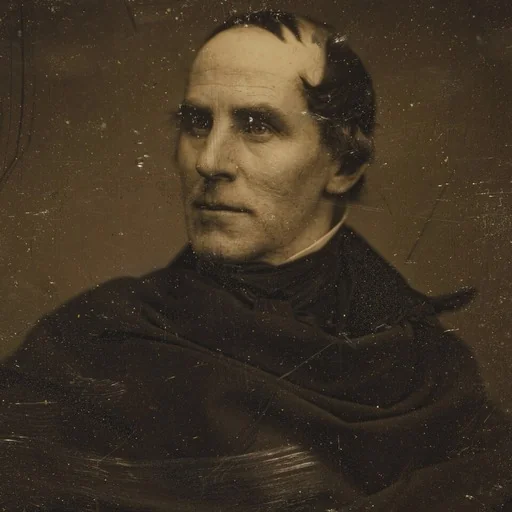
Thomas Cole (February 1, 1801 – February 11, 1848) was an Anglo-American artist who founded the Hudson River School art movement.

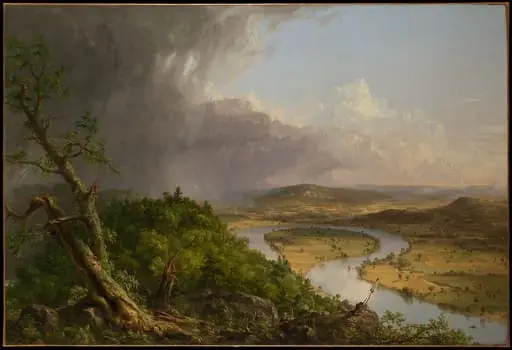

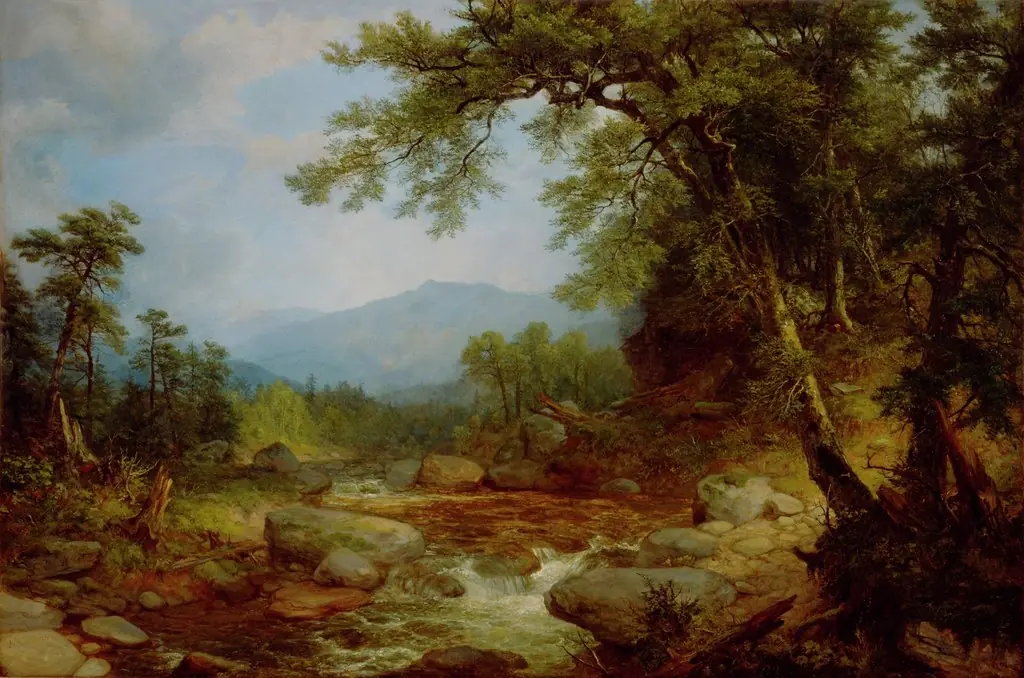 Monument Mountain, Berkshires
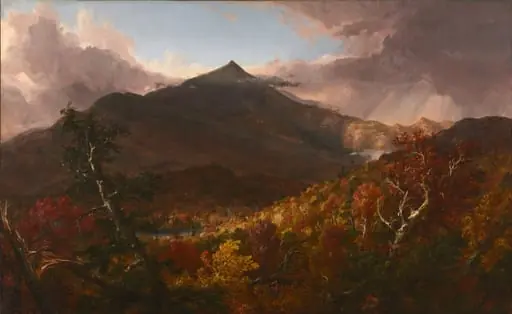 View of Schroon Mountain, Essex County, New York, After a Storm
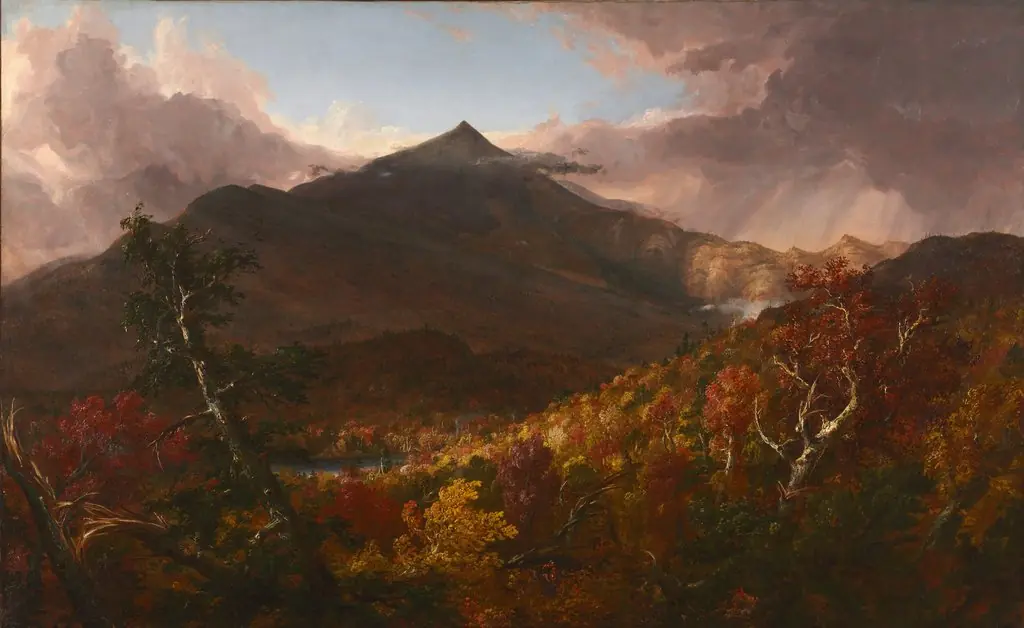 View of Schroon Mountain, Essex County, New York, After a Storm
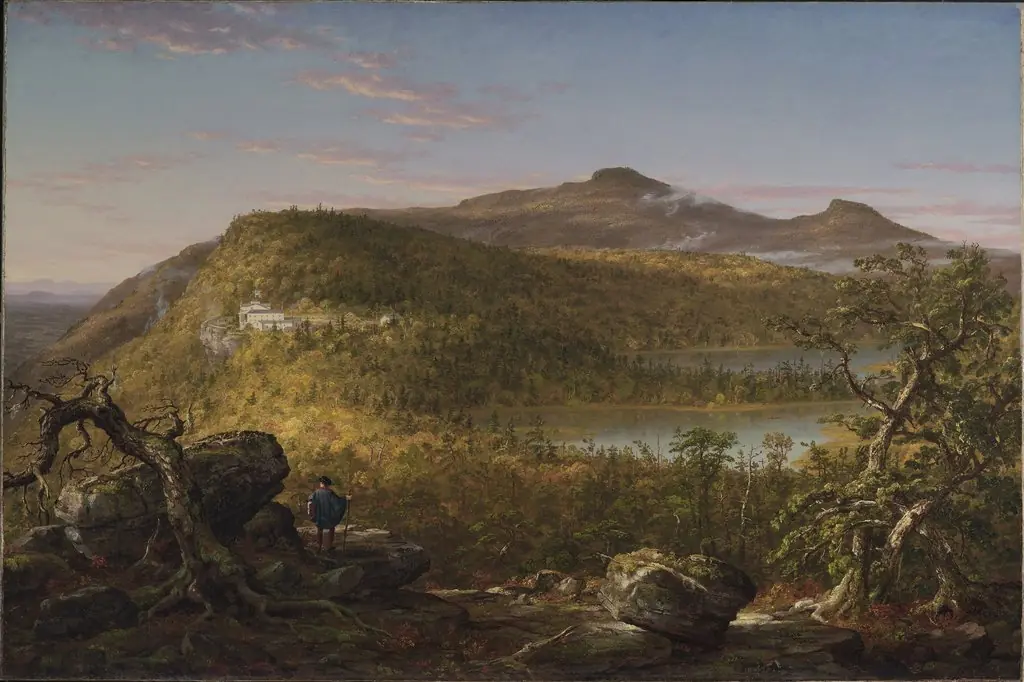 A View of the Two Lakes and Mountain House, Catskill Mountains, Morning
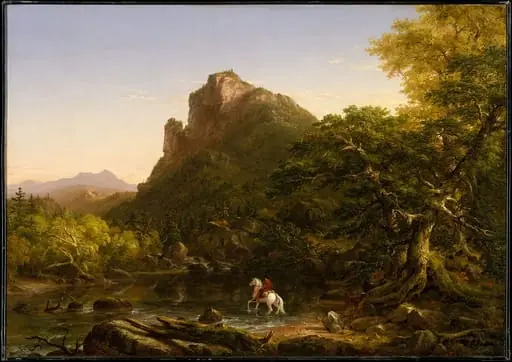 The Mountain Ford
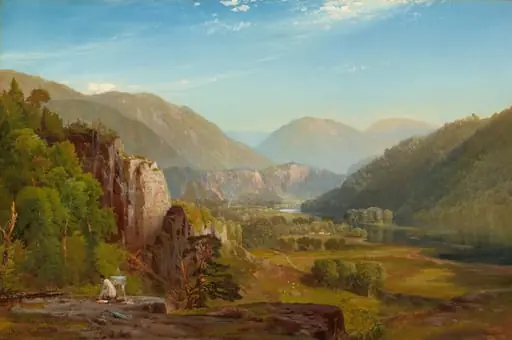 The Juniata, Evening
 American Landscape
 Autumn Morning on the Potomac
 Lake George