Artwork
The Voyage of Life: Old Age
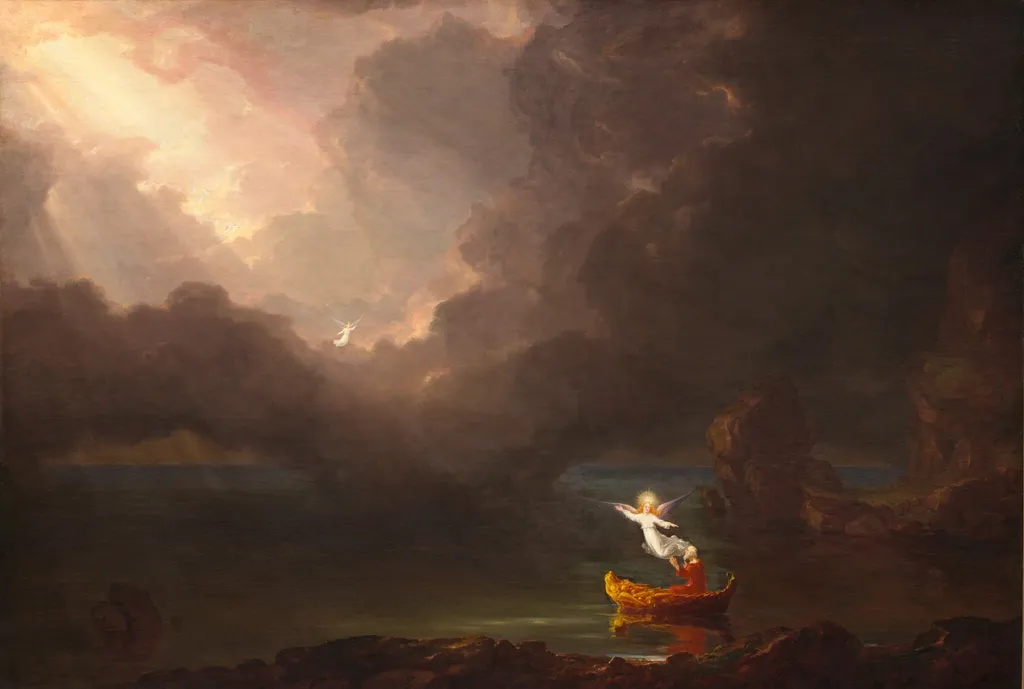
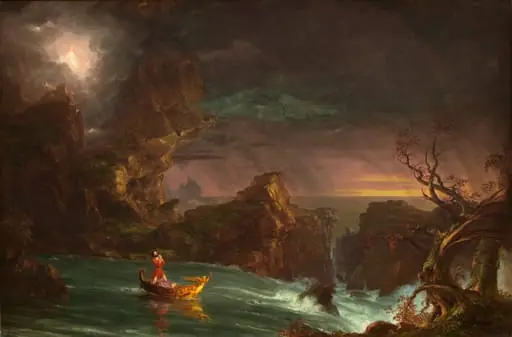
The Voyage of Life: Old Age is an oil painting by the Hudson River School artist Thomas Cole. It dates from 1842 and is held in the collection of the National Gallery of Art.
- Inscription
- Inscribed:bottom edge, left of center: T. Cole / 1842; bottom edge, right of center: Rome
About this work
Technique & Style
The application of oil on canvas allows for the layered execution characteristic of Cole's approach to the genre during this period.
Executed in 1842, this work is an oil painting on canvas measuring 133.4 by 196.2 centimeters. Classified as a landscape containing allegorical elements, the piece utilizes traditional materials to depict its subject. The composition adheres to the horizontal format typical of the series, employing oil paint to render the scene.
While specific details regarding surface condition or distinct brushwork handling are not explicitly detailed in the available records, the work's physical presence is defined by its substantial dimensions and medium. The application of oil on canvas allows for the layered execution characteristic of Cole's approach to the genre during this period.
History & Provenance
Thomas Cole completed Old Age, the final panel of The Voyage of Life series, in 1842. The artist sold the work to George K. Shoenberger of Cincinnati, likely between 1845 and early 1847, though a May 1846 newspaper reference confirms Shoenberger's ownership by that date. Following Shoenberger's death on January 20, 1892, the painting passed to his heirs.
In 1908, Ernst H. Huenefeld purchased the work and subsequently donated it to the Bethesda Hospital and Deaconess Association of the Methodist Church in Cincinnati. The hospital retained the piece until May 17, 1971, when it was sold through Hirschl & Adler Galleries in New York to the National Gallery of Art in Washington, D.C.
The Voyage of Life: Old Age, an 1842 oil on canvas by Thomas Cole, entered the National Gallery of Art in Washington, D.C., after being sold by Hirschl & Adler Galleries in New York on 17 May 1971. The work had previously been owned by George K. Shoenberger, who acquired it from the artist between 1845 and early 1847, and later passed it to his heirs before its 1908 purchase by Ernst H. Huenefeld, who gifted it to the Bethesda Hospital and Deaconess Association of the Methodist Church of Cincinnati. The painting remained in Cincinnati until its 1971 acquisition, after which it was accessioned into the National Gallery of Art’s collection and has been part of its permanent displays of American landscape and allegorical works.
Overview
Thomas Cole's The Voyage of Life: Old Age, painted in 1842, is an oil on canvas work. This painting serves as the concluding piece in Cole's allegorical series, The Voyage of Life, which traces human existence through distinct stages. It depicts a somber, dramatic landscape, characteristic of the artist's thematic explorations of nature and spirituality, reflecting his engagement with profound philosophical questions through natural settings.
Subject & Meaning
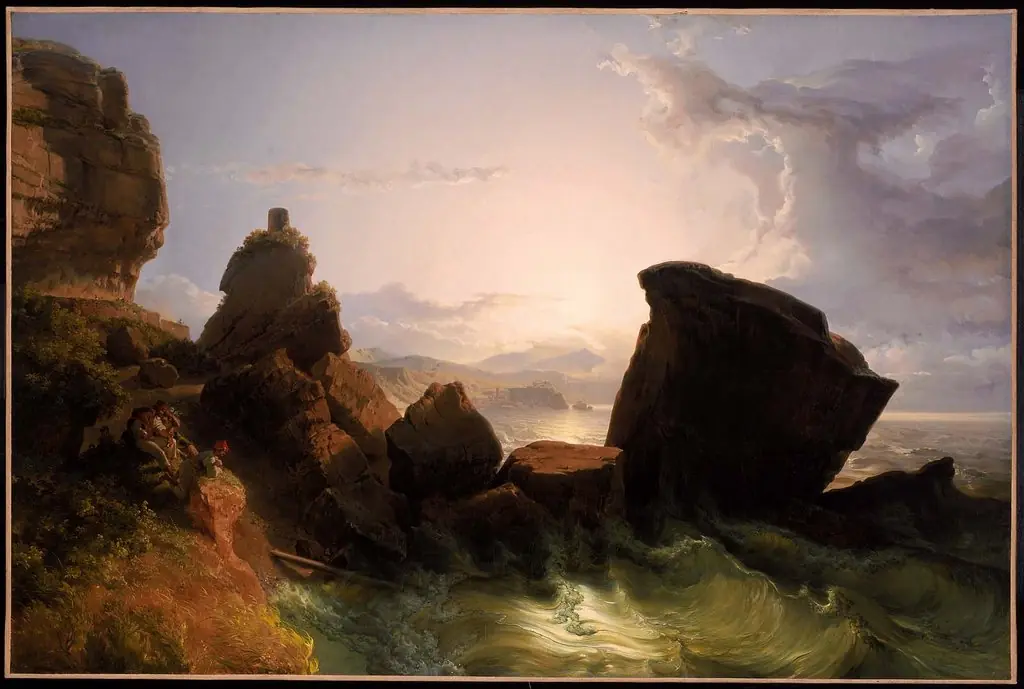
The painting presents a small boat adrift on a turbulent, dark lake under a sky heavy with swirling clouds. A solitary, weary figure occupies the vessel, while a luminous angel hovers above, extending a guiding hand with a rope. The stark contrast between the angel's radiant light and the surrounding gloom of the rocky shore and stormy waters symbolizes the soul's journey towards an ultimate destination, representing the final, contemplative stage of human life.
Context
Old Age is the culmination of Thomas Cole's four-part series, The Voyage of Life, which visually narrates the human journey from infancy to the end of life. Each painting in the series employs landscape as a metaphor for different stages, reflecting Cole's consistent interest in allegorical narratives and the sublime power of nature. This work, like others by Cole, uses dramatic natural settings to convey profound spiritual and philosophical themes.
Own this work as a print
Artist & collection
Artist
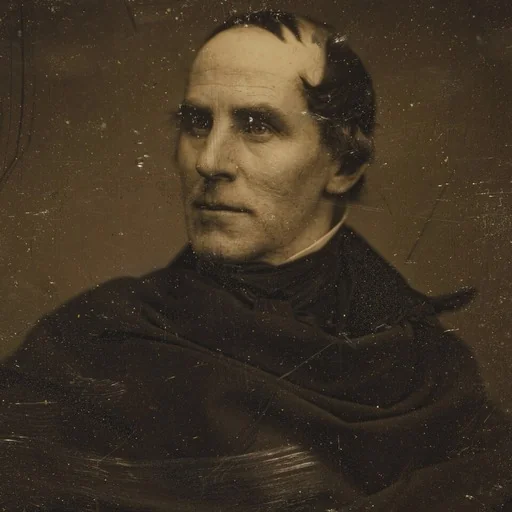
Thomas Cole (February 1, 1801 – February 11, 1848) was an Anglo-American artist who founded the Hudson River School art movement.