Artwork
Drapery Study for "Mary and Elizabeth Royall"
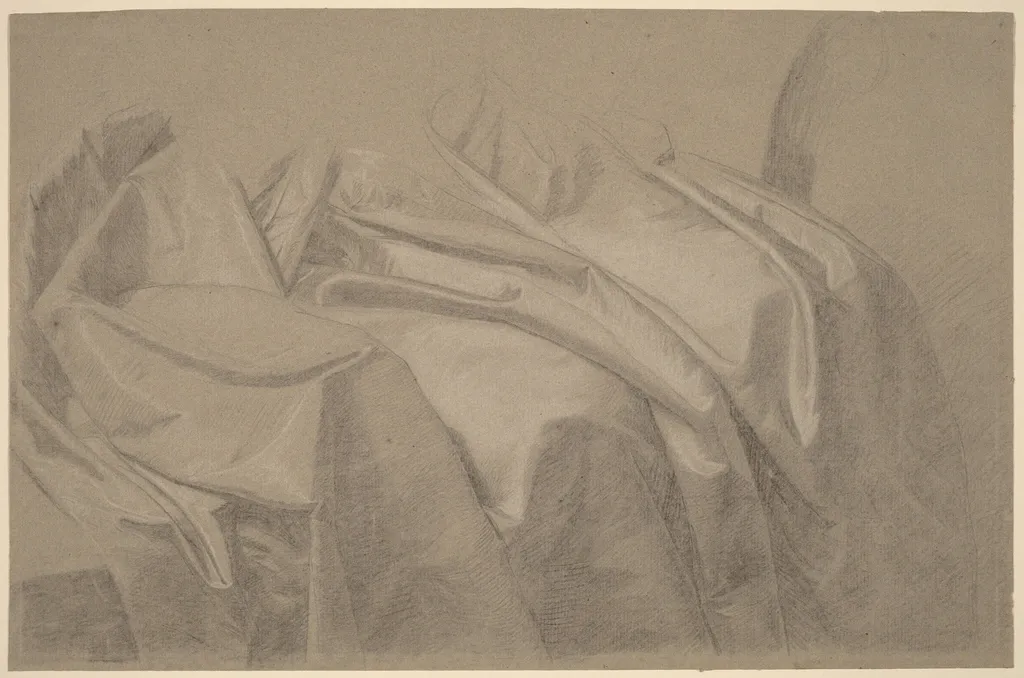
Drapery Study for "Mary and Elizabeth Royall" is a graphite drawing by the Romanticist artist John Singleton Copley. It dates from 1758 and is held in the collection of the National Gallery of Art.
- Inscription
- Inscribed:in later hand, lower right verso in graphite: 2126
- Markings
- Marked:lower right verso stamped in black ink: RMW
About this work
Overview
The drawing served as a technical exercise and reference for the drapery in the finished double portrait of Mary and Elizabeth Royall, completed the same year.
Created in 1758, Drapery Study for "Mary and Elizabeth Royall" is a preparatory drawing by John Singleton Copley executed in graphite and white chalk on gray-brown laid paper. The work focuses exclusively on the rendering of fabric, depicting a section of cloth draped over an unseen support. Copley employs the contrast between the dark ground of the paper, the deep shadows of the graphite, and the bright highlights of the white chalk to model the complex folds and creases of the material.
This study demonstrates the artist's rigorous approach to capturing the weight, texture, and volume of textiles, a skill essential to his reputation as a leading colonial portraitist. The drawing served as a technical exercise and reference for the drapery in the finished double portrait of Mary and Elizabeth Royall, completed the same year. It reflects Copley's early mastery of light and form, showcasing his ability to translate three-dimensional reality onto a two-dimensional surface with precise observation.
As a standalone sheet, it highlights the importance of such studies in the 18th-century artistic process, where the accurate depiction of costume was central to conveying the status and character of the sitter.
Subject & Meaning
The image records a single swath of cloth, rendered as if draped over an unseen form. The folds and creases convey volume, suggesting a smooth, lustrous material such as silk or satin that would have been appropriate for a formal garment in the mid‑eighteenth century.
Technique & Style
Copley employed graphite for the deeper shadows and white chalk for highlights, creating a broad tonal range that models the surface of the fabric. The contrast between dark and light gives the paper a sense of three‑dimensionality, while the loose, gestural strokes reveal the artist’s exploratory approach to texture.
History & Provenance
The drawing was executed as part of Copley’s preparatory work for the commissioned portrait of the Royall sisters. It remains a documented example of his early American practice, predating his later, larger oil paintings.
Own this work as a print
Artist & collection

Artist
John Singleton Copley (July 3, 1738 – September 9, 1815) was an American-born British painter active in both the Thirteen Colonies and England.


![Drapery Studies [recto], by Baldassare Franceschini](https://artifactworldgallery.com/img/baldassare-franceschini--drapery-studies-recto--8283f7732b58979e-w320.webp)
![Study of Drapery [verso], by John Singer Sargent](https://artifactworldgallery.com/img/john-singer-sargent--study-of-drapery-verso--af011b294c02210f-w320.webp)