Artwork
The Copley Family
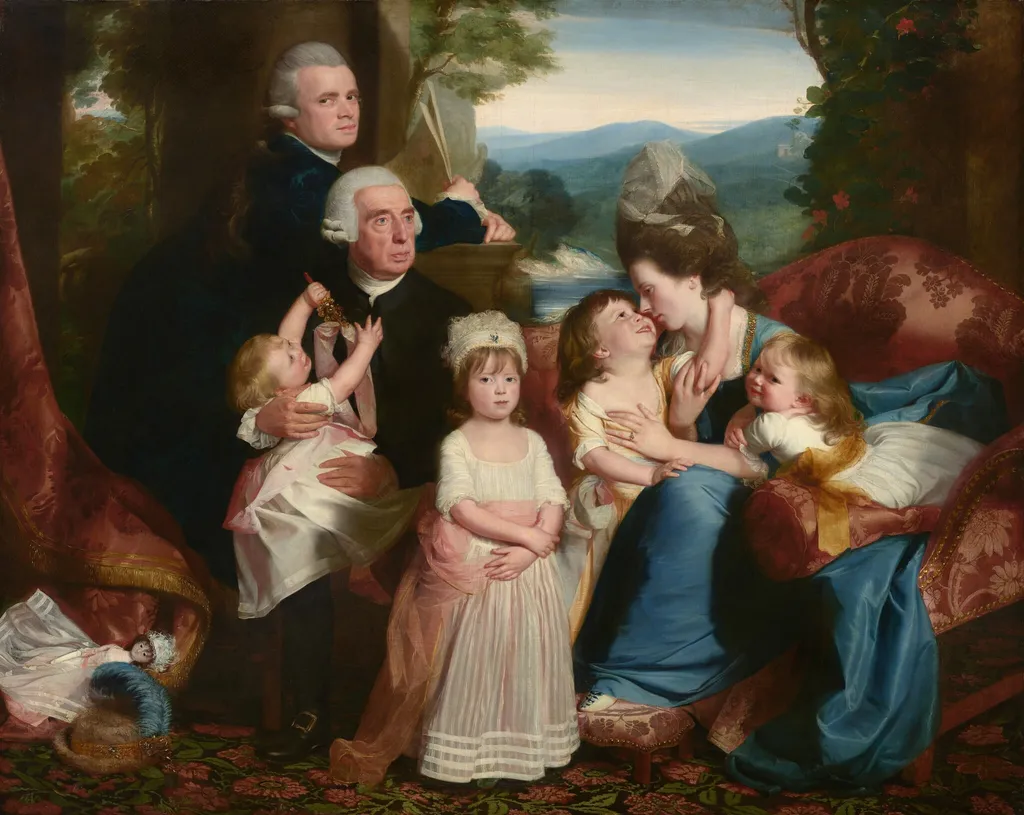
The Copley Family is an oil painting by the Rococo painting artist John Singleton Copley. It dates from 1776 and is held in the collection of the National Gallery of Art.
About this work
Subject & Meaning
The painting depicts a group portrait of John Singleton Copley seated with his wife Susanna, their children, and his father‑in‑law Richard Clarke, a Loyalist merchant. As a group portrait, the work presents the artist’s immediate family alongside a figure representing his transatlantic Loyalist ties, underscoring his identity as an American expatriate who had settled in Britain after the outbreak of the Revolutionary War. The composition thus conveys both familial affection and the artist’s political allegiance, marking the Copley family’s position within the Loyalist community in London.
Technique & Style
Executed in 1776, this work is an oil painting on canvas measuring 184.
Executed in 1776, this work is an oil painting on canvas measuring 184.1 by 229.2 centimeters. Created in London, the piece functions as a large-scale group portrait that incorporates a self-representation of the artist alongside his family members and father-in-law. The composition reflects Copley's transition to British artistic circles following his departure from America, showcasing the grand manner style he employed for modern history subjects.
The painting was publicly exhibited at the Royal Academy's Summer Exhibition in 1777, held at Pall Mall, demonstrating the artist's engagement with the London exhibition circuit shortly after his arrival.
History & Provenance
John Singleton Copley painted The Copley Family in 1776 while working in London; the work is an oil on canvas group portrait measuring 184.1 cm by 229.2 cm. The painting remained in the artist’s family, passing from him to his son, the 1st Earl of Lyndhurst, and then through a documented sale at Christie, Manson & Woods in March 1864 to a purchaser identified as “Clarke” for Martha Babcock Amory. Subsequent owners included Charles Amory, their son Edward Linzee Amory, nephew Copley Amory, and later descendants until 1961, when the National Gallery of Art acquired the work. The portrait was first exhibited at the Royal Academy Summer Exhibition in 1777.
The Copley Family is held by the National Gallery of Art in Washington, D.C. The painting entered the museum’s collection in 1961 after being sold by the Amory family, though the specific accession number is not recorded in the available sources. Its earliest documented exhibition was at the Royal Academy’s Summer Exhibition in London in 1777, where it was displayed alongside other works by John Singleton Copley. The work remains part of the NGA’s permanent holdings and has been included in occasional retrospectives of Copley’s transatlantic career.
Legacy
The Copley Family was exhibited at the Royal Academy’s Summer Exhibition of 1777 in London, where it received notable attention and contributed to Copley’s growing reputation in Britain.
Provenance records show the painting descended through Copley’s son Lord Lyndhurst, was sold in 1864, and eventually entered the collection of the National Gallery of Art in Washington, D.C., in 1961, where it remains on public view.
Its status as a premier example of 18th‑century group portraiture has influenced subsequent American portraiture and is frequently cited in studies of Copley’s role in shaping transatlantic artistic exchange.
Overview
The Copley Family, an oil on canvas painting from 1777, is a group portrait by American artist John Singleton Copley. It features a self-portrait of the artist with his wife, Susanna, their children, and his father-in-law, Richard Clarke. This work was completed after Copley's relocation to Britain during the American War of Independence, marking a significant period in his career. The painting was subsequently exhibited in London, showcasing his continued prominence in portraiture.
Own this work as a print
Artist & collection

Artist
John Singleton Copley (July 3, 1738 – September 9, 1815) was an American-born British painter active in both the Thirteen Colonies and England.