Artwork
Four Naked Women
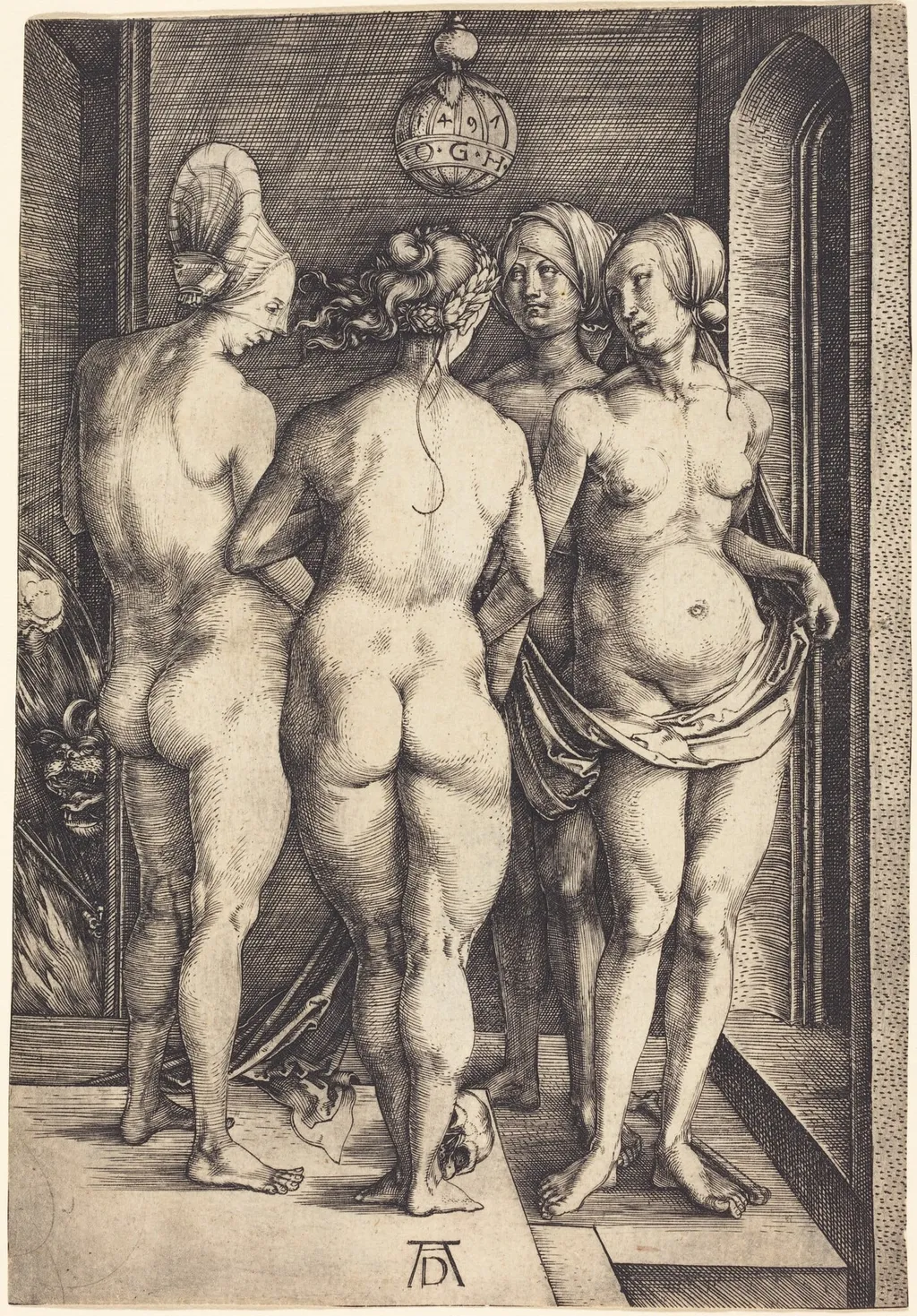
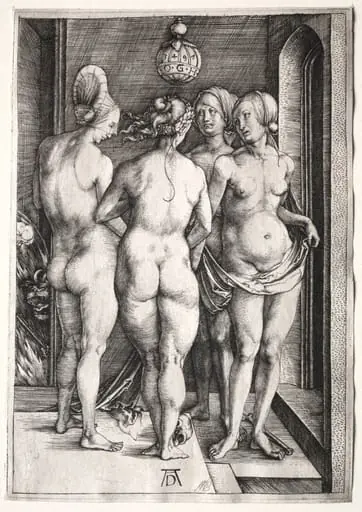
Four Naked Women is an ink print by the Northern Renaissance artist Albrecht Dürer. It dates from 1497 and is held in the collection of the Israel Museum.
- Inscription
- Inscribed:in plate, upper center, on hanging ball: 1497 / ·O·G·H·; in plate, bottom center: AD [artist's monogram]; verso, lower left, in graphite by a later hand: FB [?] [erased]; verso, lower right, in graphite by a later hand: B.75 I / D.14 [?]; verso, lower center, in graphite by a later hand: 82 [upside down]; verso, bottom right, in graphite by a later hand: 392-; verso, bottom left, in graphite by a later hand: B-6492 [upside down]
- Markings
- Marked:none
About this work
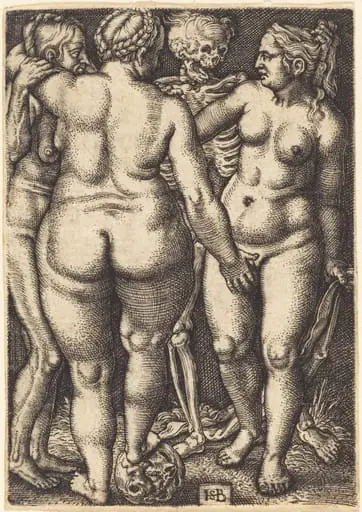
Four naked women stand in a row. Their bodies twist a little. One holds a stick. Details like hair and muscles look sharp.
Albrecht Dürer made this in 1497. He used a needle on metal to carve lines. That technique is called engraving.
See how he cuts tiny lines close together? That’s cross-hatching. It makes shadows look real.
Look up Dürer, Albrecht.
Subject & Meaning
No consensus exists on Dürer's specific intent, leaving the image an enigmatic blend of eroticism, demonology, and mythological reference.
Albrecht Dürer’s 1497 engraving depicts four exuberant nude women gathered conspiratorially in a confined interior, possibly a bathhouse or brothel, standing beneath a suspended sphere inscribed with the letters 'OGH'. The scene is populated by ambiguous iconography: a horned, bat-like demon peering from a left portal amidst flames, and a human skull with a thigh bone at the women's feet, suggesting a gateway to death or symbols of magic. Art historians remain divided on the work's meaning, with interpretations ranging from a depiction of witches linked to the 1487 treatise *Malleus Maleficarum* to representations of classical figures such as Hecate, Diana, Venus, or the Three Graces. The varied hairstyles and headdresses, including a *Haube* for a married woman and a *Schleier* for a middle-class figure, have further fueled debates regarding social class and moral allegory. No consensus exists on Dürer's specific intent, leaving the image an enigmatic blend of eroticism, demonology, and mythological reference.
Technique & Style
Created in 1497, this work is an engraving on laid paper, representing one of Albrecht Dürer's earliest signed prints. The composition features four nude women arranged in a circle within a confined interior, possibly a bathhouse, depicted from varied angles including front, back, and three-quarter rear views to demonstrate the artist's engagement with Renaissance prototypes for the human form. The figures are distinguished by specific hairstyles and headdresses, such as the Festhaube and Schleier, which signal differing social classes. A small horned demon appears in a left-hand portal engulfed in flames, while a human skull and thigh bone lie near an open window or doorway, introducing macabre elements to the scene. Dürer's monogram is inscribed on the floor, and a suspended sphere or globe hangs above the group. Art historians note that while the figures are taller and more graceful than in some contemporary works, the piece reflects the artist's early struggles with the technical restrictions of engraving nudes.
History & Provenance
Four Naked Women, also known as The Four Witches, Die Vier Hexen, or Scene in a Brothel, is a 1497 engraving by Albrecht Dürer. The work was created in Nuremberg and first entered the Kupferstichkabinett, Staatliche Museen zu Berlin, where it was catalogued under Lugt numbers 1606 and 2398. In 1929 the print was sold at auction XLII (Hollstein & Puppel), lot 392, and subsequently acquired by Lessing J. Rosenwald, who donated it to the National Gallery of Art in Washington, D.C., in 1943.
The print is held in several major collections, including the National Gallery of Art, the Cooper Hewitt Smithsonian Design Museum, the Germanisches Nationalmuseum in Celje, the Israel Museum, the Städel Museum, and the Kupferstich-Kabinett Dresden. Its provenance is documented in the Kupferstichkabinett records (Lugt 1760b, 1932d) and Rosenwald’s acquisition is noted in the same cataloging system.
The engraving measures 19.1 cm by 13.1 cm and is signed with Dürer’s monogram “AD” on the floor. It is one of Dürer’s earliest signed prints and exemplifies his early exploration of the female nude within the constraints of engraving technique.
The engraving is held by the National Gallery of Art, Washington, D.C., with inventory/accession R.K.43. It entered the Gallery in 1943 as a gift from Lessing J. Rosenwald, who had purchased it at the 1929 Hollstein & Puppel auction (lot 392). Earlier, it was part of the Kupferstichkabinett, Staatliche Museen zu Berlin (Lugt 1606 and Lugt 2398).
The work has appeared in multiple institutional holdings worldwide, including the Kupferstich-Kabinett Dresden, the Israel Museum, the Städel Museum, the Germanisches Nationalmuseum, the Rijksmuseum, and the Cooper Hewitt, Smithsonian Design Museum.
Context
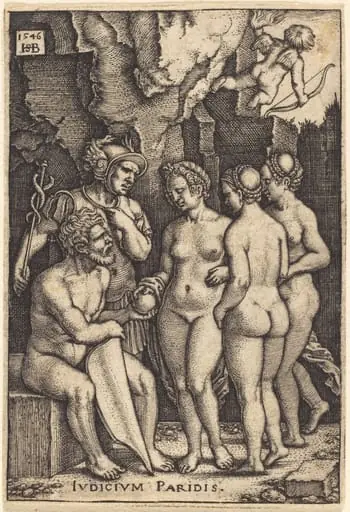
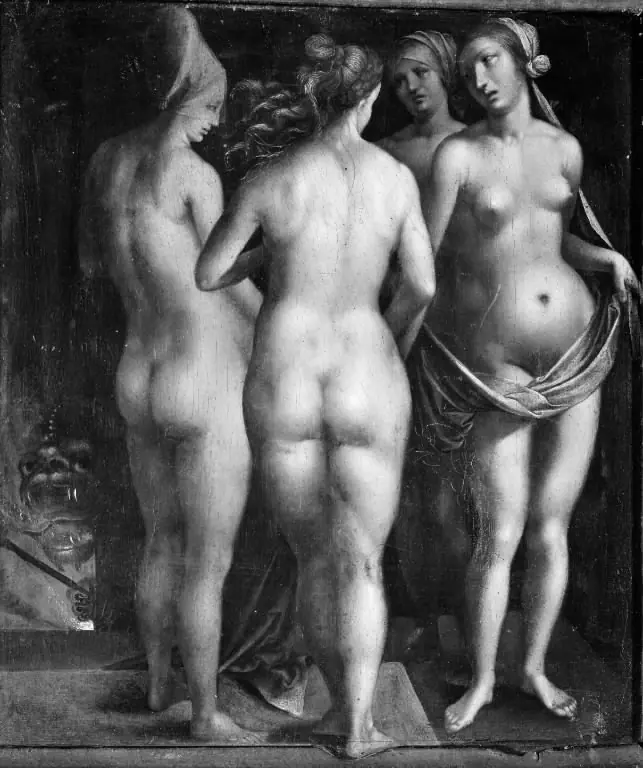
Albrecht Dürer's 1497 engraving *Four Naked Women* remains a central subject of enigmatic scholarly debate, lacking a definitive interpretation due to the artist's silence on his intent. Art historians have proposed divergent readings, ranging from a depiction of witchcraft linked to the 1487 *Malleus Maleficarum* to representations of classical goddesses such as Hecate or Diana. Some scholars, including Marcel Briton, suggest the work may simply be a study of the nude form, reflecting a young artist's response to local puritanical conventions. The piece is frequently analyzed alongside contemporaries like Hans Baldung Grien and Dürer's own *The Dream of the Doctor*, highlighting a fascination with the occult rather than a moral crusade against witchcraft. As one of his earliest signed engravings, it marks a decisive step in Dürer's mastery of the female nude, blending Renaissance prototypes with Northern European iconography.
Own this work as a print
Artist & collection
Artist
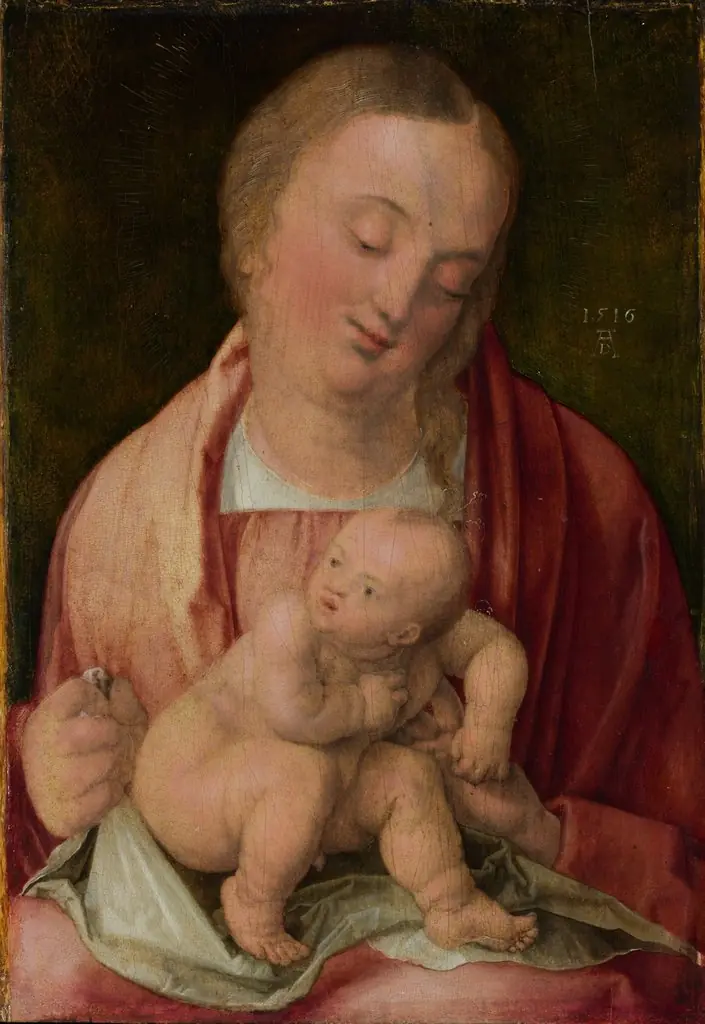
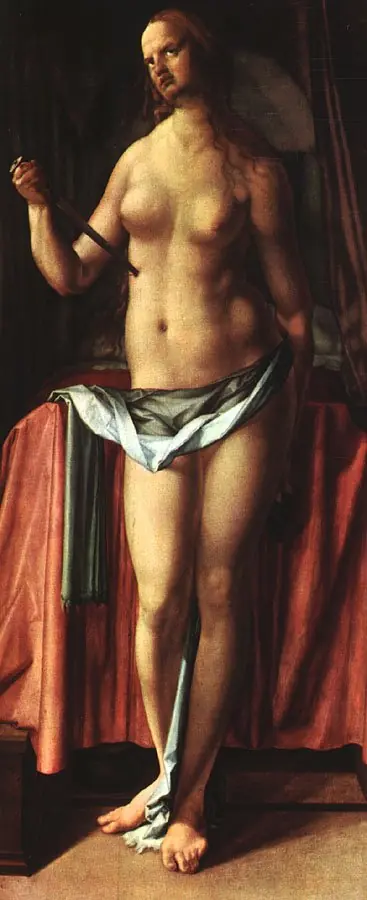
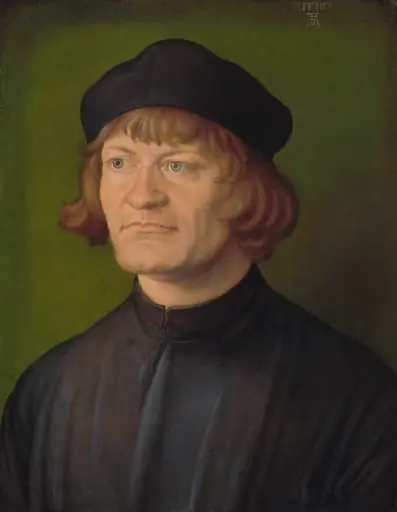
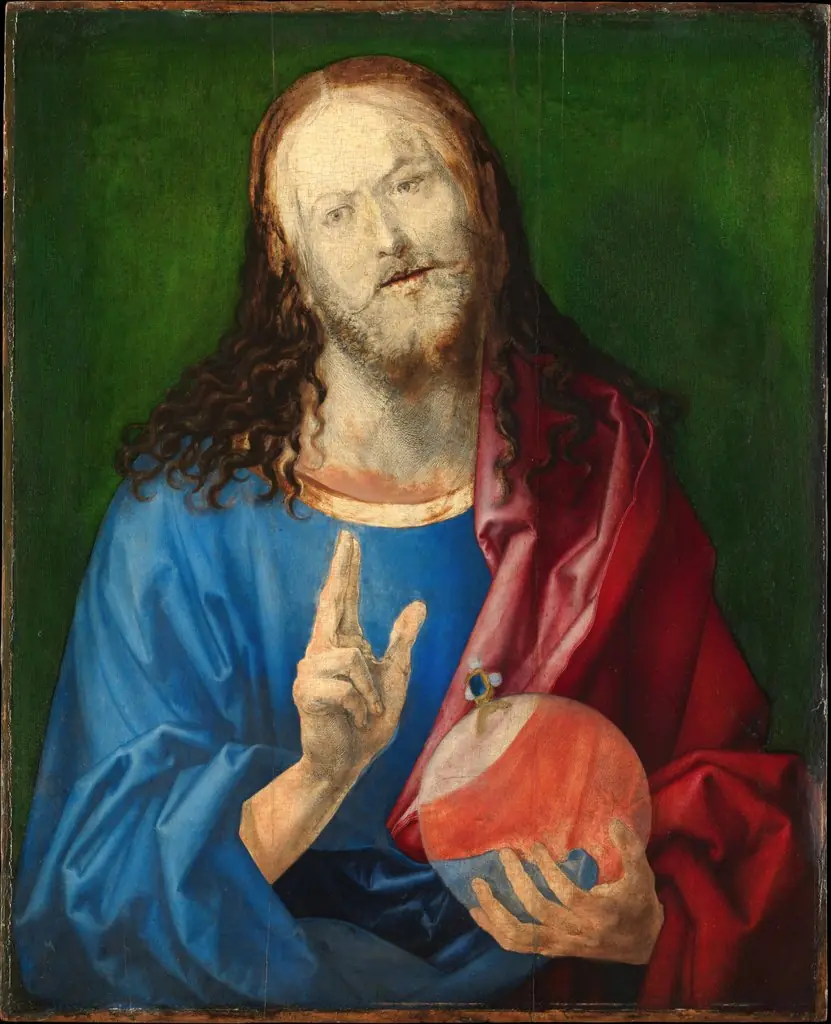
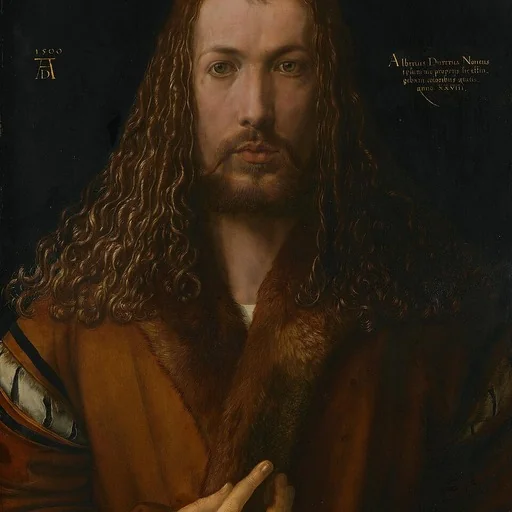
Albrecht Dürer spent his life in Nuremberg, a busy German city where artists traded prints like currency.

![Madonna and Child [obverse], by Albrecht Dürer](https://artifactworldgallery.com/img/albrecht-durer--madonna-and-child-obverse--d7b8ebf05d22ebe5-w320.webp)
![Lot and His Daughters [reverse], by Albrecht Dürer](https://artifactworldgallery.com/img/albrecht-durer--lot-and-his-daughters-reverse--b4ebf9b282faa17a-w320.webp)