Artwork
Landscape with the Cannon
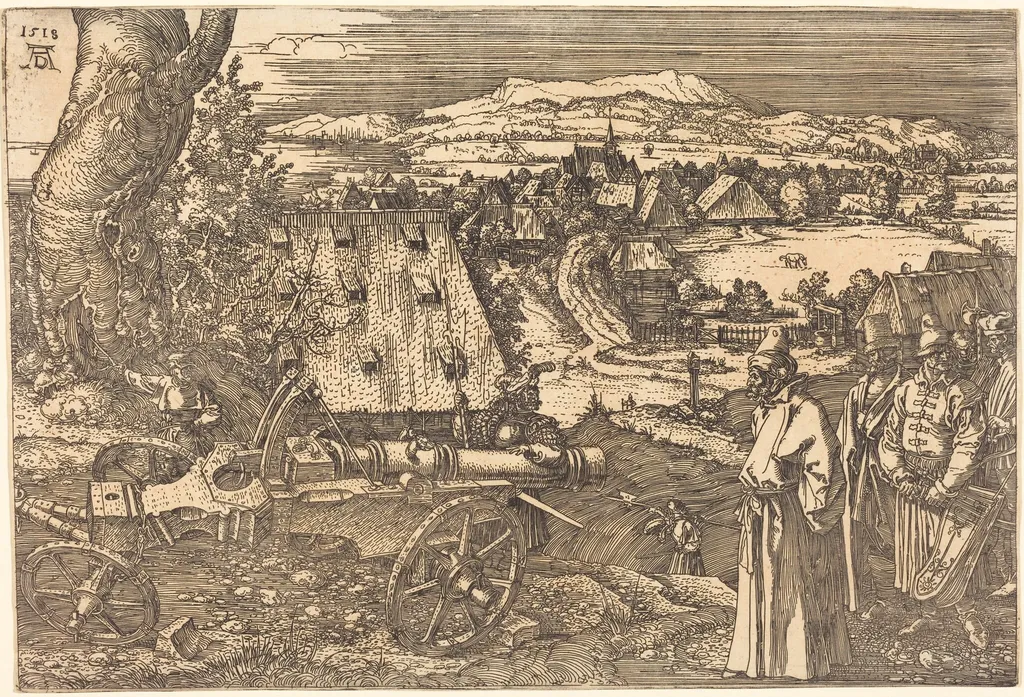
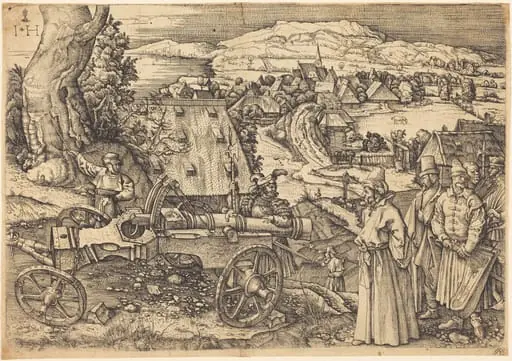
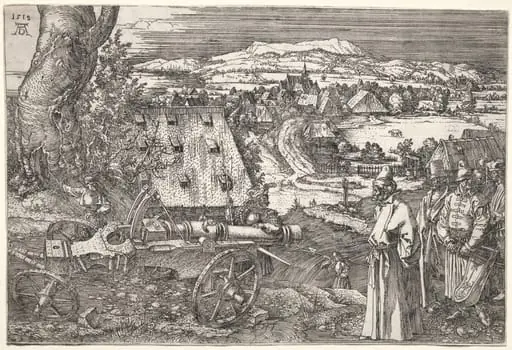
Landscape with the Cannon is an ink print by the Northern Renaissance artist Albrecht Dürer. It dates from 1518 and is held in the collection of the Cleveland Museum of Art.
- Inscription
- Inscribed:in plate, top left: 1518 / AD [artist's monogram]; verso, top center, in graphite by a later hand: e- [?]; verso, upper center, in graphite by a later hand: 137/8x16 [upside down]; verso, upper center, in graphite by a later hand: 15897 [upside down]; verso, lower left, in graphite by a later hand: 30/95 [?] [underlined] / [illegible]; verso, lower left, in graphite by a later hand: 136 [underlined]; verso, lower left, in graphite by a later hand: B.99; verso, lower left, in graphite by a later hand: [4?] D [sideways]; verso, lower right, in graphite by a later hand: 438; verso, lower left, in graphite by a later hand: 23; verso, bottom left, in graphite by a later hand: B-21 [upside down]
About this work
Subject & Meaning
The work depicts a specific landscape associated with the village of Eschenau near Nuremberg, showing a cannon in the foreground that carries the arms of the imperial city of Nuremberg. Symbolically, the cannon represents imperial authority and military power, while the surrounding terrain, a valley with thatched-roof houses and distant mountains, reflects Dürer’s interest in naturalistic landscape and regional identity. The scene includes foreign soldiers and dignitaries, possibly Hungarians, linking the imagery to historical alliances involving Emperor Maximilian I and Louis II, and to contemporary calls for a crusade against the Ottoman threat.
Dürer’s composition combines detailed observation of local architecture with broader geographic space, using innovative engraving techniques to layer tonal depth and convey atmospheric perspective. This integration of topographic detail, historical reference, and artistic innovation underscores the work’s significance as a sophisticated synthesis of military symbolism and landscape representation in early Northern Renaissance printmaking.
Technique & Style
Created in 1518, Landscape with the Cannon is an etching executed on iron using the acid-bath technique rather than traditional burin engraving.
Created in 1518, Landscape with the Cannon is an etching executed on iron using the acid-bath technique rather than traditional burin engraving. The work is printed on laid paper, measuring 21.7 cm in height and 32.0 cm in width. Stylistically, it represents a complex departure from Dürer's earlier drawn quality in line work; instead, the artist adopted a burin-like approach to prioritize tonal effects.
By alternating dark and light areas, Dürer successfully carved out spatial depth and layered the composition's various planes. This method allowed him to translate his interest in landscape into printmaking for the first time, utilizing the etching needle to mimic the fluidity of a pen or pencil on paper. The result is a sophisticated interplay of light and shadow that defines the atmospheric perspective of the Franconian valley depicted.
History & Provenance
The work was created by Albrecht Dürer in 1518 as an etching on laid paper, classified as a print and landscape within the German Renaissance movement. Its provenance begins with Robert Scholtz in Budapest, then passes to Dr. R. Hermann, Albert Voigtländer-Tetzner in Frankfurt, and Emil M. Baerwald in New York and Berlin. It was sold at auction by C.G. Boerner in Leipzig on April 27, 1931, before being acquired by William Goodwin Russell Allen in Boston.
The print was subsequently gifted to the National Gallery of Art in 1941, where it remains part of the Rosenwald Collection. The National Gallery of Art in Washington, D.C., and the Cleveland Museum of Art both hold the work within their print collections, reflecting its documented presence in institutional holdings. Dating is confirmed by multiple sources to 1518, and the composition draws on earlier artistic models, including works by Israhel van Meckenem and Gentile Bellini, though the specific iconographic interpretation remains subject to scholarly analysis.
The work is held in the National Gallery of Art in Washington, D.C., as part of the Prints in the National Gallery of Art, Rosenwald Collection, and is also housed at the Cleveland Museum of Art. Its inventory number is Lugt 2241, recorded in the provenance of Robert Scholtz, who owned it from 1834 to 1912. The piece was later acquired by Dr. R. Hermann (Lugt 1256e) and Albert Voigtländer-Tetzner (Lugt 196), then purchased from C.G. Boerner in Leipzig on April 27, 1931 (sale no. 136) and bought by William Goodwin Russell Allen in Boston.
In 1941, it was gifted to the National Gallery of Art. The work was exhibited in the National Gallery of Art, Washington, D.C., as documented in its accession records and provenance chain.
Context
Landscape with the Cannon (1518) holds a foundational position in the history of etching and European landscape art. It is the last of six etchings Dürer produced between 1515 and 1518, a period in which he experimented with the iron-etching technique developed by Daniel Hopfer in Augsburg shortly before 1500. Stylistically, the print is among Dürer's most complex etchings: he treats the plate with tonal, burin-like effects, alternating dark and light passages to articulate successive planes and create depth, rather than relying on the drawn line quality etching typically allows.
The composition subordinates its foreground narrative, a group of figures observing a Nuremberg cannon, to a broad Franconian landscape with a winding path leading to a thatched-roof village identified as Eschenau, near Nuremberg, and distant mountains under an overcast sky.
The work is widely regarded as the first transposition of Dürer's longstanding interest in landscape into printmaking, opening the way for the long tradition of etched landscape. Albrecht Altdorfer's nine etchings of around 1520, for which he is often called a pioneer of landscape representation in European art, owe much to Dürer's watercolors and even more to this etching. The print is classified within the German Renaissance movement and is held in the National Gallery of Art's Prints collection and the Cleveland Museum of Art.
Legacy
Landscape with the Cannon is widely cited as a watershed in the history of printmaking for its pioneering integration of landscape as the dominant subject. Dürer’s experimental handling of etching, treating the plate with acid as if it were a burin, transformed tonal depth and spatial layering into graphic form, a method that subsequent German printmakers adopted and expanded.
By the early sixteenth century, the work’s compositional innovations inspired Albrecht Altdorfer’s own etched landscapes around 1520, which are frequently described as foundational to the European landscape tradition in print media. Modern scholarship underscores this lineage, linking Dürer’s etching to Altdorfer’s reputation as a pioneer of landscape representation in art.
Overview
Landscape with the Cannon is an etching on laid paper created by Albrecht Dürer in 1518.
Own this work as a print
Artist & collection
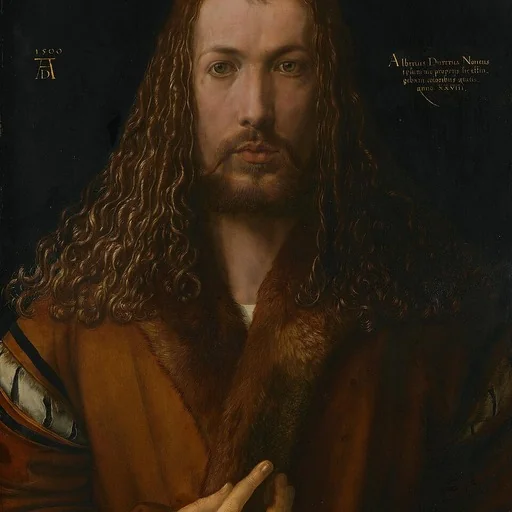
Artist
Albrecht Dürer spent his life in Nuremberg, a busy German city where artists traded prints like currency.

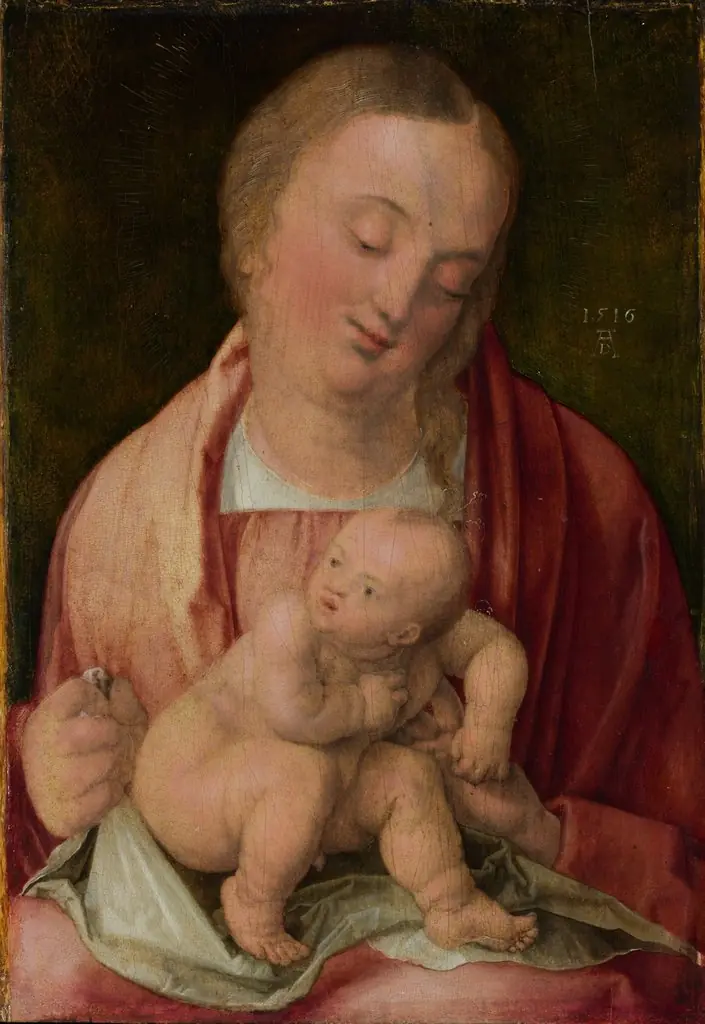
![Madonna and Child [obverse], by Albrecht Dürer](https://artifactworldgallery.com/img/albrecht-durer--madonna-and-child-obverse--d7b8ebf05d22ebe5-w320.webp)
![Lot and His Daughters [reverse], by Albrecht Dürer](https://artifactworldgallery.com/img/albrecht-durer--lot-and-his-daughters-reverse--b4ebf9b282faa17a-w320.webp)