Artwork
The Dream of the Doctor (Temptation of the Idler)
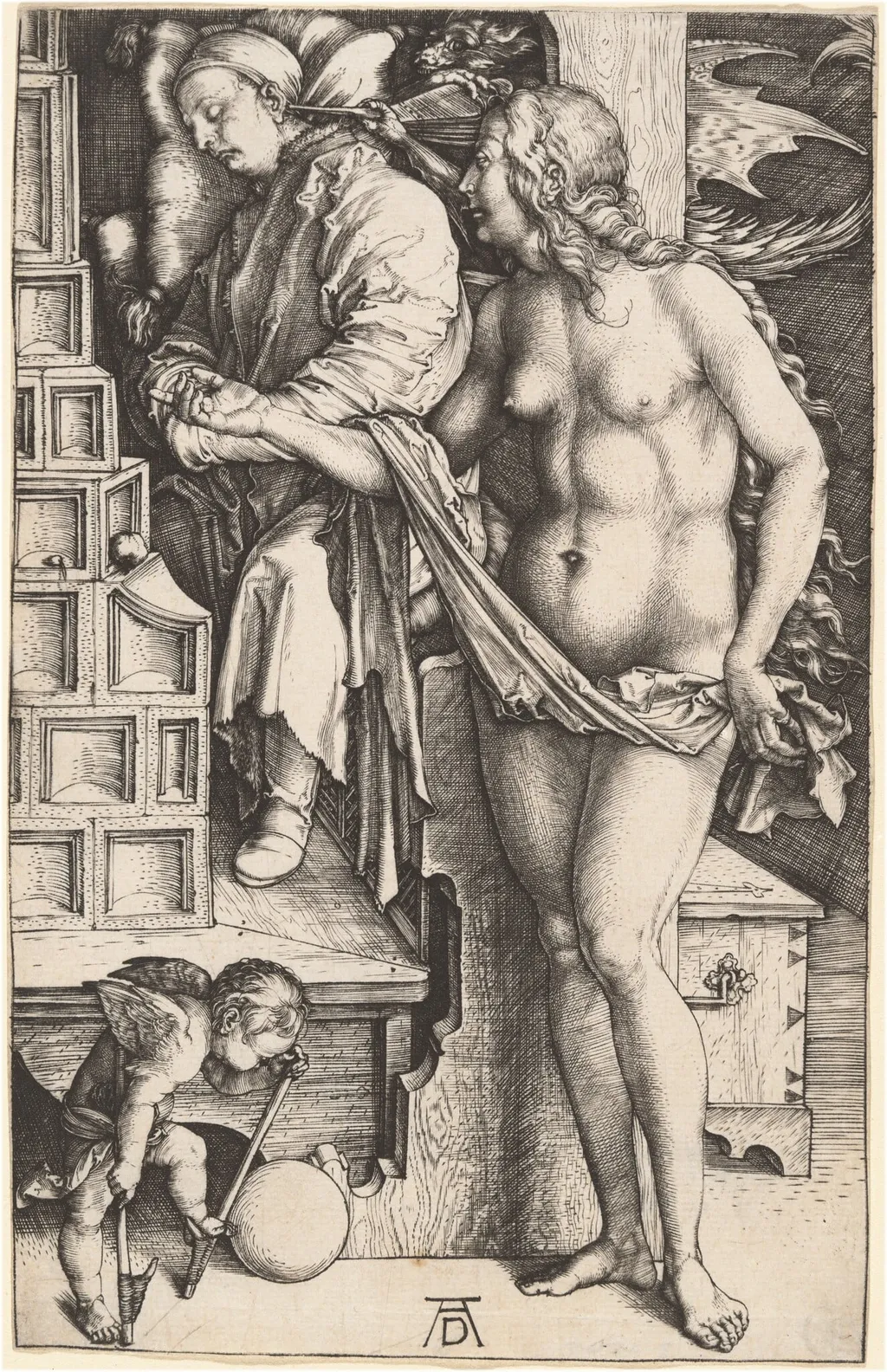
The Dream of the Doctor (Temptation of the Idler) is an ink print by the Northern Renaissance artist Albrecht Dürer. It dates from 1498 and is held in the collection of the Israel Museum.
- Inscription
- Inscribed:in plate, bottom center: AD [artist's monogram]; verso, lower left, in graphite by a later hand: Conts 4 [?] / J.4942; verso, lower left, in graphite by a later hand: 369; verso, lower center, in graphite by a later hand: B76; verso, lower right, in graphite by a later hand: B; verso, lower left, in graphite by a later hand: B-6505
About this work
A sleeping man slumps over a table, his head on a book. A demon peeks from the shadows, whispering in his ear. A bony hand grips a scroll labeled with sins.
Albrecht Dürer carved this scene in 1498. He used fine lines to show light and dark, called engraving. The demon’s small size makes the threat feel sneaky, not scary.
Look for his later work at the National Gallery of Art, Washington.
Subject & Meaning
A nude woman in the foreground embodies both the object of the sleeper’s dream and the embodiment of sinful allure whispered by Satan.
The engraving depicts a sleeping man in a dressing gown, seated with his head against a tiled stove, as a demonic, winged figure uses a bellows to blow into his left ear, symbolizing the temptation of idleness. A nude woman in the foreground embodies both the object of the sleeper’s dream and the embodiment of sinful allure whispered by Satan.
The iconography draws on late-fifteenth-century German moral discourse that linked sloth (acedia) with moral corruption, a theme popularized by Sebastian Brant’s 1494 satire La Nef des fous. The woman’s ring references a medieval legend in which a nobleman unwittingly binds himself to the devil by placing a ring on a statue’s finger, reinforcing the moral warning against indulgence. By inverting the hierarchy of reality and dream, Dürer shifts focus to the monumental female nude, whose contrapposto stance, rendered flesh, and flowing hair evoke Italian Renaissance ideals of Venus, signaling his engagement with classical and Italian models.
Technique & Style
The Dream of the Doctor is an engraving executed with a burin on copper, printed on laid paper. Created around 1498, the work measures 18.8 cm in height and 12 cm in width. Stylistically, the print demonstrates Dürer's early engagement with Italian Renaissance models and classical antiquity, particularly through the monumental female nude in the foreground. This figure exhibits a contrapposto stance and sinuous contours reminiscent of a Florentine Venus, with detailed rendering of flesh and long hair. The composition employs a deliberate spatial inversion: the actual scene of the sleeping man and the demon is relegated to the background and partially obscured by a heavy wooden beam, while the hallucination occupies the immediate foreground. This arrangement highlights the artist's focus on the representation of the nude and the contrast between the solid architectural elements and the fluidity of the female form.
History & Provenance
The engraving was produced by Albrecht Dürer in Nuremberg, dated 1498. It circulated widely among contemporaries and was soon copied by Italian printmakers such as Marcantonio Raimondi and Giovanni Antonio da Brescia, as well as by the Northern artist Wenzel von Olmütz. A documented ownership chain begins with David Bernhard Hausmann (1784-1874) of Hanover, whose collector's mark (Lugt 377) appears on impressions of the print. It subsequently passed to Clendenin J. Ryan, Sr. (1881-1939) of New York. Ryan's collection was dispersed at Parke-Bernet Galleries in New York on 17 January 1940 (lot 82), at which point the impression was purchased by Lessing J. Rosenwald (1891-1979) of Jenkintown, Pennsylvania (Lugt 1760b and 1932d). In 1943, Rosenwald gave the impression to the National Gallery of Art in Washington, D.C., where it remains part of the Rosenwald Collection. A specific impression of this engraving entered the collection of the National Gallery of Art in Washington, D.C., in 1943 as a gift from Lessing J. Rosenwald. Rosenwald had acquired the work in 1940 at a Parke-Bernet Galleries sale in New York, where it was sold as part of the estate of Clendenin J. Ryan, Sr. Prior to Ryan, the print was held by David Bernhard Hausmann in Hanover. While impressions are also held by institutions such as the Art Institute of Chicago, the Metropolitan Museum of Art, and the Cleveland Museum of Art, the Rosenwald impression provides the most documented ownership history.
Context
The work known as The Dream of the Doctor (Temptation of the Idler) was created by Albrecht Dürer in 1498 as an engraving on laid paper, classified as a print within the allegorical genre. It depicts a sleeping figure in a robe, identified only by convention as a doctor, surrounded by symbolic elements of idleness and temptation, reflecting late‑15th‑century German moral concerns about acedia. The composition places a nude female figure in the foreground, rendered with contrapposto and delicate flesh modeling that recalls a Florentine Venus, while a demonic visitor whispers temptation, a motif tied to legends such as that of Astrolabius and recorded in contemporary texts like Sebastian Brant’s Das Narrenschiff. Dürer’s engagement with the nude form and antique models is evident, and the print was quickly reproduced by Italian artists including Marcantonio Raimondi and Giovanni Antonio da Brescia as well as Northern artists such as Wenzel von Olmütz.
Legacy
The print's legacy is marked by its immediate influence on contemporary artists and its role in Dürer's exploration of the nude form. It was widely copied by Italian artists such as Marcantonio Raimondi and Giovanni Antonio da Brescia, as well as Northern printmakers like Wenzel von Olmütz, demonstrating its impact across artistic circles. The work's complex iconography, particularly its moralizing depiction of idleness and temptation, reinforced Dürer's early engagement with themes of human vice and the allegorical use of dreams. Its popularity among peers underscored its technical and thematic innovation, contributing to the broader dissemination of Dürer's printmaking techniques and symbolic language.
The piece is held in major institutional collections including the National Gallery of Art (Washington, D.C.), the Art Institute of Chicago, and the Metropolitan Museum of Art, affirming its enduring significance in art historical narratives.
Own this work as a print
Artist & collection
Artist
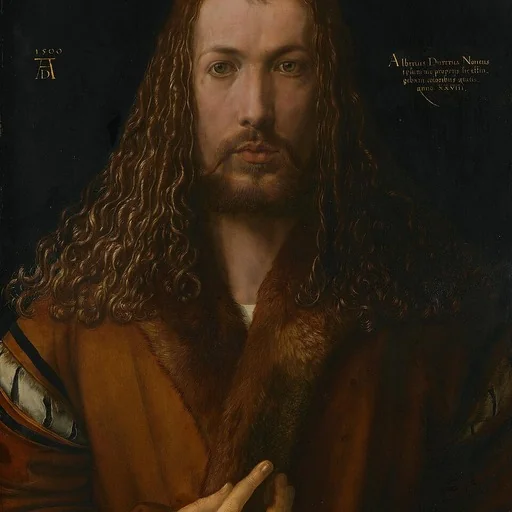
Albrecht Dürer spent his life in Nuremberg, a busy German city where artists traded prints like currency.

![Madonna and Child [obverse], by Albrecht Dürer](https://artifactworldgallery.com/img/albrecht-durer--madonna-and-child-obverse--d7b8ebf05d22ebe5-w320.webp)
![Lot and His Daughters [reverse], by Albrecht Dürer](https://artifactworldgallery.com/img/albrecht-durer--lot-and-his-daughters-reverse--b4ebf9b282faa17a-w320.webp)