Artwork
The Holy Family with the Mayfly
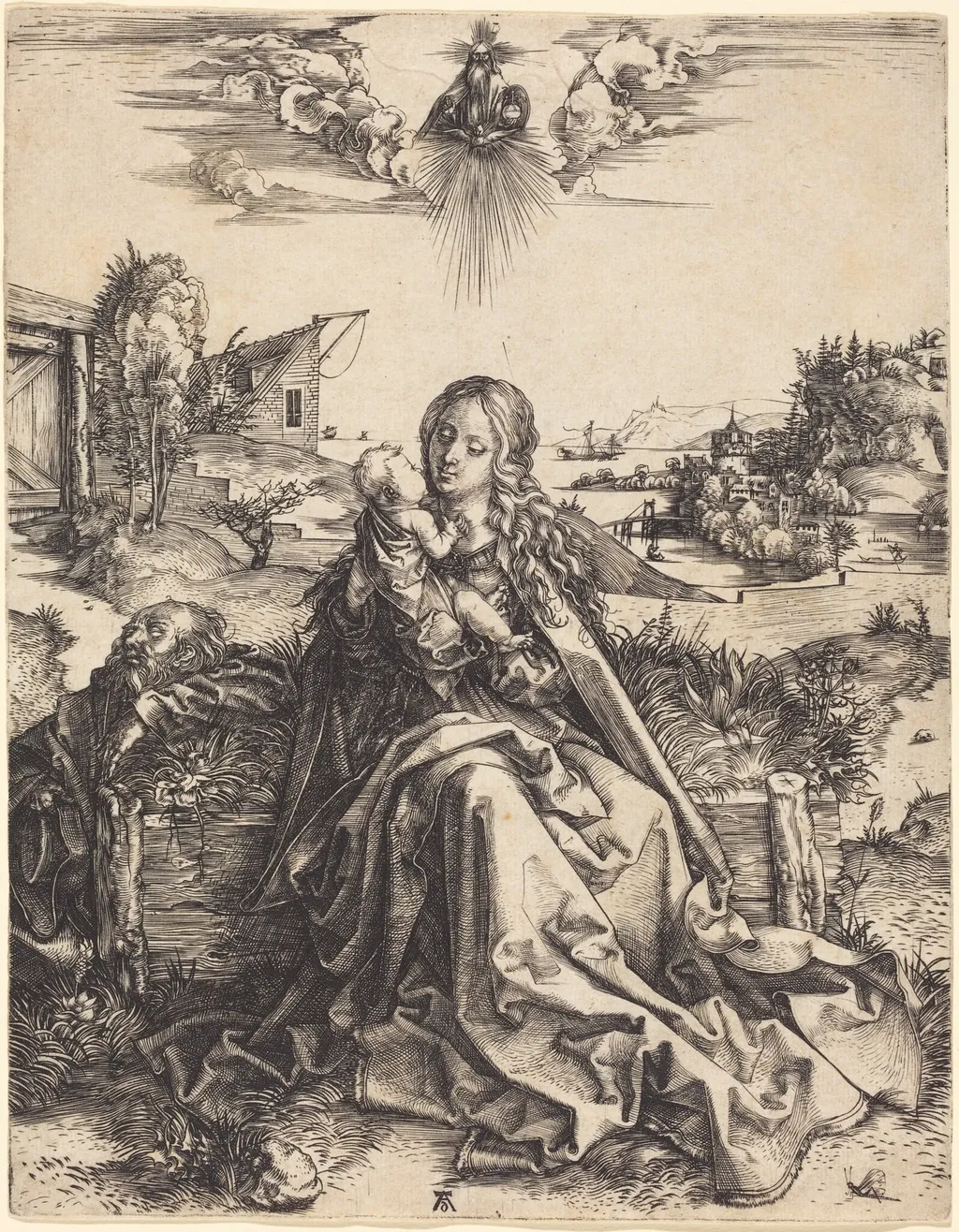
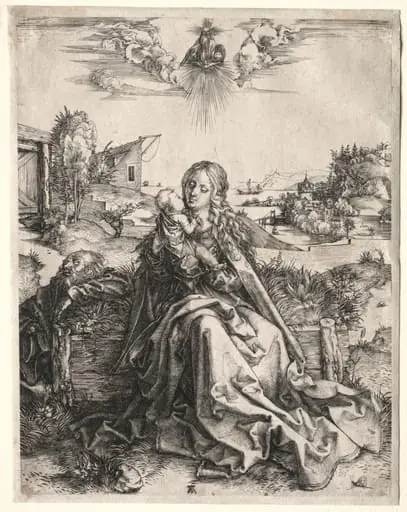
The Holy Family with the Mayfly is an ink print by the Northern Renaissance artist Albrecht Dürer. It dates from 1496 and is held in the collection of the National Gallery of Art.
- Inscription
- Inscribed:in plate, bottom center: Ad [artist's monogram]; verso, lower center, in graphite by a later hand: B 44
About this work
Subject & Meaning
The engraving depicts the Holy Family alongside the Holy Trinity, with the Virgin Mary seated on a grassy bench holding the infant Jesus, Joseph asleep on the ground beside them, and God the Father and the Holy Spirit in the form of a dove appearing from clouds above. A small insect in the lower right corner is variously identified as a mayfly, dragonfly, locust, or butterfly, with scholars suggesting it symbolizes resurrection and redemption due to its transformative life cycle, particularly linking to the infant Christ. The work combines established iconographies of the rest during the Flight into Egypt and the Virgin in the enclosed garden (hortus conclusus), reflecting Dürer's synthesis of Northern and Italian influences. Its intricate details, especially in drapery and landscape, showcase his mastery of engraving, while the insect's symbolic resonance bridges celestial and terrestrial realms, underscoring themes of divine connection and spiritual transformation.
Technique & Style
Dürer employed fine burin lines to render intricate textures in the landscape and delicate rendering of fabric, showcasing his early mastery of the medium.
The work is an engraving printed on laid paper, measuring 23.7 cm by 18.5 cm and created in Nuremberg around 1495. Dürer employed fine burin lines to render intricate textures in the landscape and delicate rendering of fabric, showcasing his early mastery of the medium. The composition combines the Holy Family with the Holy Trinity in a space bounded by a wall that serves as a Marian hortus conclusus symbol, with the Virgin seated on a grassy bench holding the infant Jesus while Joseph sleeps below; God the Father and the Holy Ghost appear as a dove in the clouds. An insect in the lower right corner is variously interpreted as a dragonfly, mayfly, locust or butterfly, with scholars noting its symbolic resonance as a motif of resurrection and redemption tied to the Christ child. The print is noted for its richly detailed textures and the deep integration of figures with a distant landscape, linking celestial and terrestrial realms.
History & Provenance
The work titled The Holy Family with the Mayfly was created by Albrecht Dürer around 1495 in Nuremberg. It is an engraving on laid paper measuring 23.7 cm by 18.5 cm, depicting the Holy Family alongside symbolic elements including the Holy Trinity and an insect. Dürer placed his monogram on this print, marking the first time he signed a work in this manner and asserting authorship, a practice that did not prevent widespread copying of the image across Italy and Germany by 1500. The piece was likely produced shortly after Dürer's 1494 trip to Venice and reflects influences from Martin Schongauer and the 'Master of the Amsterdam Cabinet.' It was made available to the public through commercial sale, purchased by collectors and reproduced by traveling vendors for devotional use. The work entered the collection of Richard H. Zinser in Forest Hills, NY, was acquired by Lessing J. Rosenwald, and was gifted to the National Gallery of Art in Washington, D.C., in 1941.
The National Gallery of Art in Washington, D.C. holds a print of the engraving from the Rosenwald Collection. According to the provenance record, it was purchased by Lessing J. Rosenwald in 1940 from Richard H. Zinser of Forest Hills, New York, and given to the NGA in 1941. The work was identified by the title "The Holy Family with the Mayfly" at the NGA, where the insect is read as a mayfly (Ephemeroptera) signifying the ephemeral nature of human life.
Impressions of the engraving are widely distributed across major print collections. Wikidata lists holdings at the Chester Beatty Library, the Cleveland Museum of Art, the Städel Museum, the Metropolitan Museum of Art, and the Staatliche Museen zu Berlin, among others. The Indianapolis Museum of Art, the Rijksmuseum in Amsterdam (inventory number RP-P-OB-1204), and the UK Royal Collection also hold impressions, and the print's popularity led to copies by other printmakers within five years of its creation, circulating throughout Italy and Germany by 1500.
Context
Scholars have long debated the identity and symbolic meaning of the insect in the lower right corner, which has generated the work's multiple titles. While traditionally called a dragonfly (Odonata), Kate Heard and Lucy Whitaker have suggested Dürer may have intended a butterfly (Lepidoptera), whose metamorphosis symbolized resurrection and redemption in connection with the Christ Child. The insect has also been interpreted as a locust, praying mantis, or mayfly, the latter reading, adopted by the National Gallery of Art, evokes the ephemerality of human life. The engraving occupies a pivotal position in Dürer's early development. Dated to circa 1495 following his first Italian journey, it represents his first use of his monogram, marking a significant assertion of artistic authorship in an era of anonymity, and his earliest engraved treatment of the Virgin and Child in a landscape, a theme he would revisit repeatedly. Erwin Panofsky characterized the work as a synthesis between the Master of the Amsterdam Cabinet and Martin Schongauer, reflecting northern influences on the young artist. Its popularity was immediate: copies circulated in Italy and Germany by 1500, and the image was widely disseminated as a devotional object. Critics Larry Silver and Pamela H. Smith have emphasized its cosmic resonance, noting how the composition creates an explicit link between heaven and earth, sacred and profane.
Legacy
Created around 1495, this engraving achieved immediate and widespread popularity, inspiring unauthorized copies by other printmakers within five years of its release. By 1500, pirated versions circulated extensively throughout Italy and Germany, a testament to Dürer's burgeoning international renown as an artistic genius. The work established a significant precedent in Dürer's career as the first print to bear his monogram, marking a pivotal shift toward claiming authorship in an era of anonymous production. Its composition became a leitmotiv for the artist, who subsequently produced at least eleven additional engravings on the theme of the Virgin and Child in a landscape. The image's intricate detail and humanized depiction of the Holy Family made it a favored devotional object, widely sold by traveling salesmen and collected for insertion into books or display on walls.
Own this work as a print
Artist & collection
Artist
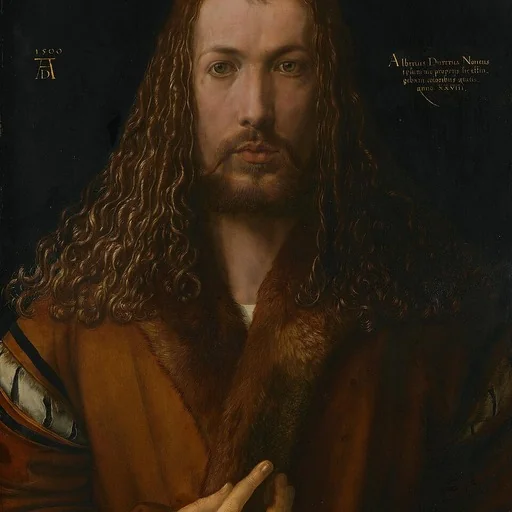
Albrecht Dürer spent his life in Nuremberg, a busy German city where artists traded prints like currency.

![Madonna and Child [obverse], by Albrecht Dürer](https://artifactworldgallery.com/img/albrecht-durer--madonna-and-child-obverse--d7b8ebf05d22ebe5-w320.webp)
![Lot and His Daughters [reverse], by Albrecht Dürer](https://artifactworldgallery.com/img/albrecht-durer--lot-and-his-daughters-reverse--b4ebf9b282faa17a-w320.webp)
 Holy Family with the Butterfly
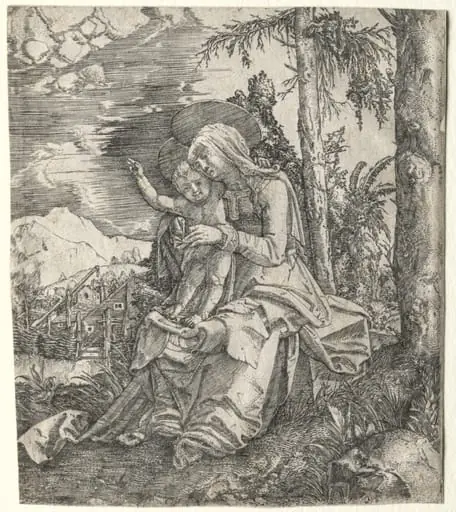 The Virgin in a Landscape
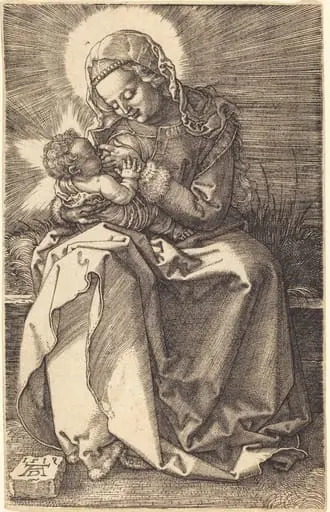 The Virgin Nursing the Child
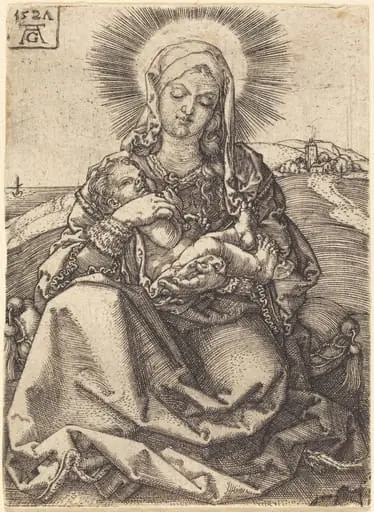 Madonna in a Landscape Sitting on a Cushion
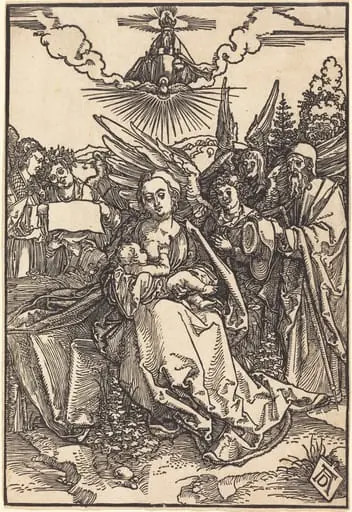 The Holy Family with Five Angels
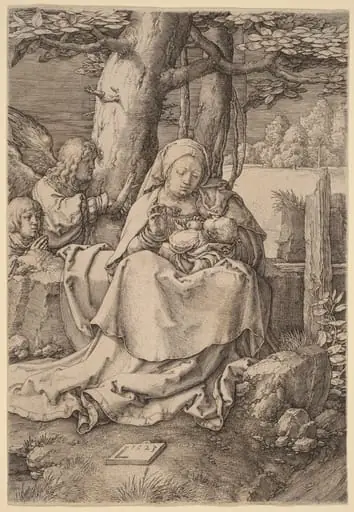 The Virgin and Child with Two Angels
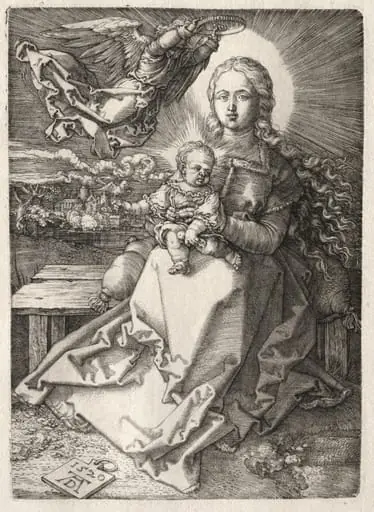 Virgin Crowned by an Angel
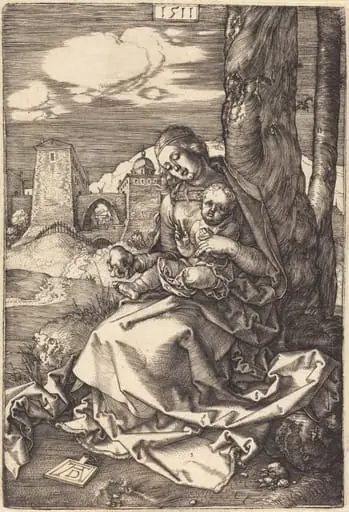 The Virgin and Child with the Pear
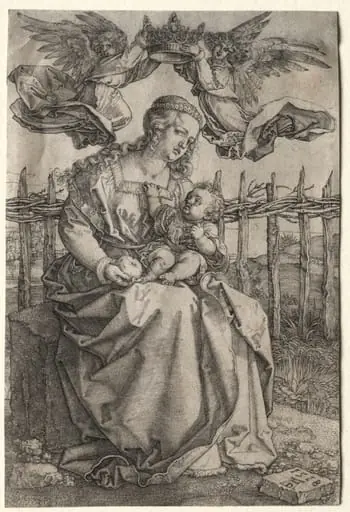 The Virgin Crowned by Two Angels
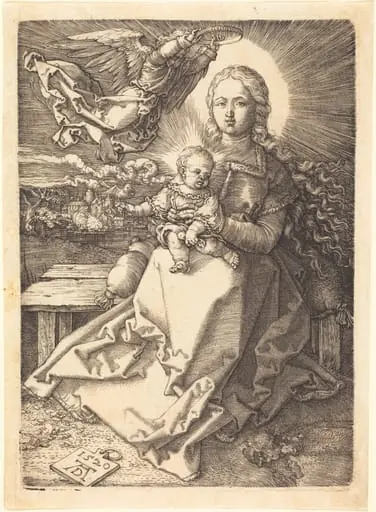 The Virgin and Child Crowned by One Angel
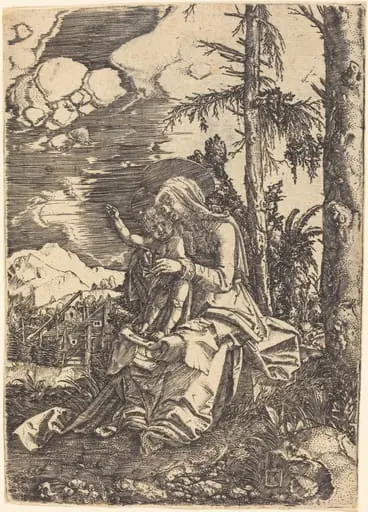 The Virgin with the Blessing Child in a Landscape
- The Holy Family with the Butterfly