Artwork
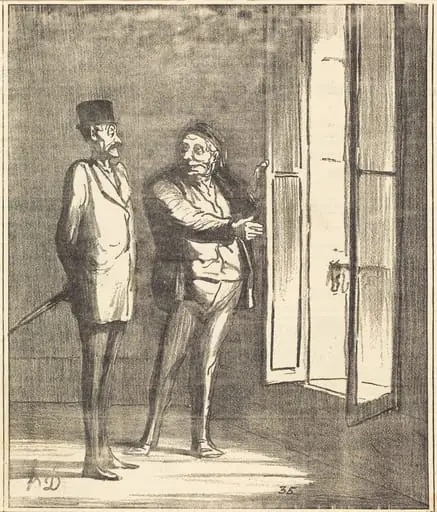
Monsieur sera très bien ici...
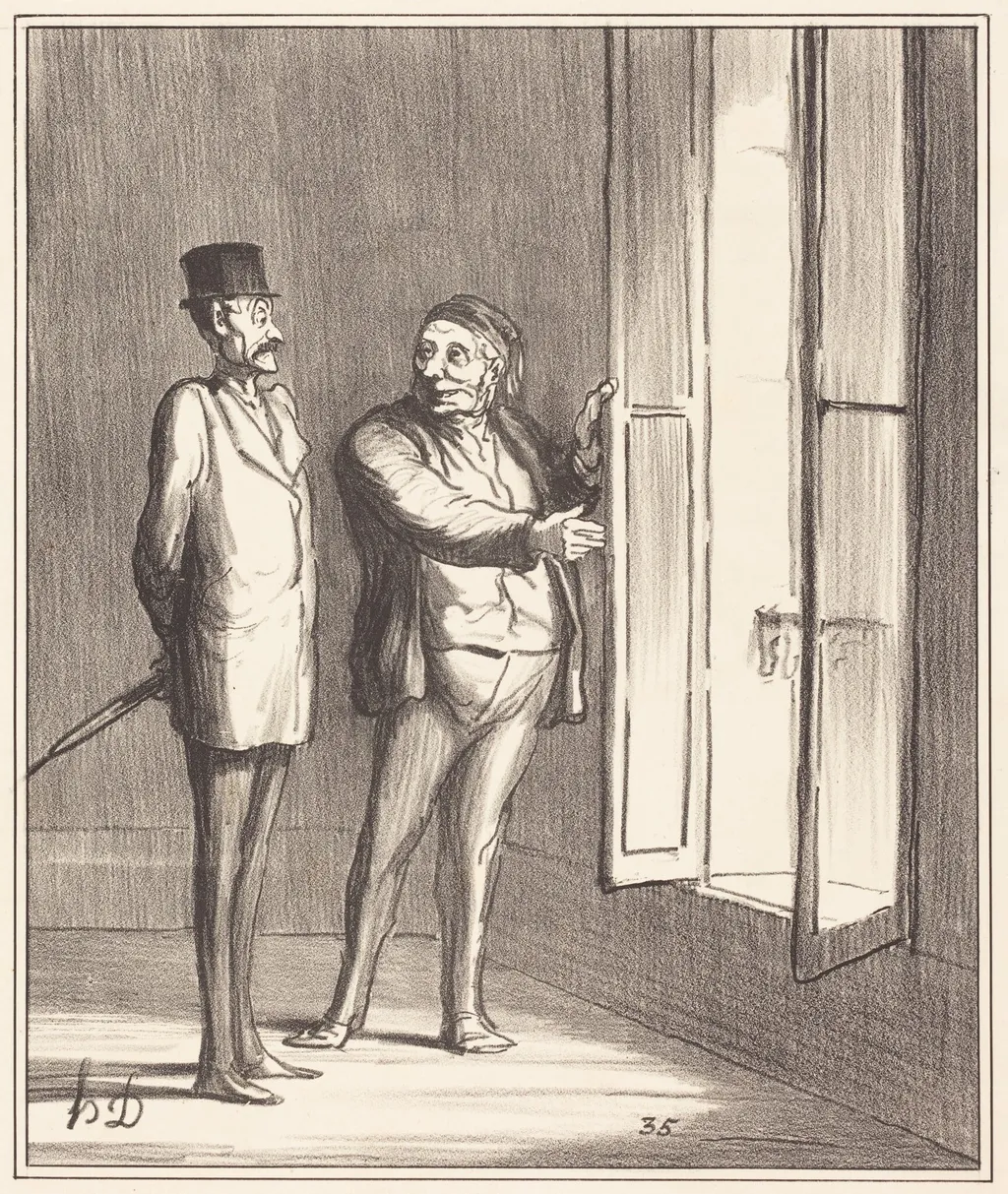
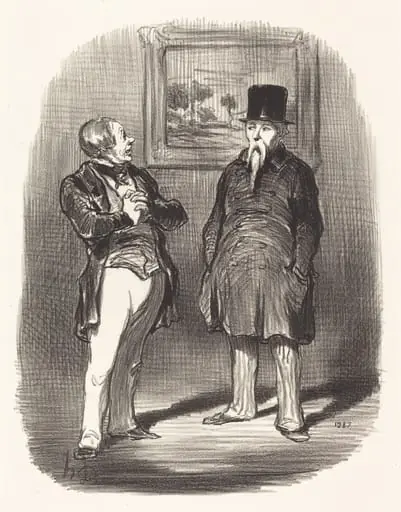
Monsieur sera très bien ici... is an ink print by the Impressionist artist Honoré Daumier. It dates from 1870 and is held in the collection of the National Gallery of Art.
About this work
Overview
Daumier, long known for his satirical prints, here conveys ambiguity rather than overt mockery, inviting reflection on social roles and unspoken power dynamics.
Created in 1870, this lithograph by Honoré Daumier captures a moment of quiet tension between two figures in a modest interior. Executed in the artist’s signature graphic style, it belongs to a body of work that responded to France’s shifting political landscape during the final years of the Second Empire. Daumier, long known for his satirical prints, here conveys ambiguity rather than overt mockery, inviting reflection on social roles and unspoken power dynamics.
Subject & Meaning
Two men stand in a sparse room: one in a top hat and coat, holding an umbrella; the other gestures toward a window. Their expressions are unreadable, their postures restrained. The scene suggests a moment of transition, perhaps a landlord showing a tenant a room, or an official delivering news.
The title, translated as 'Monsieur will be very well here...', implies a transactional or bureaucratic encounter, subtly critiquing the impersonal nature of authority in everyday life.
Technique & Style
Daumier employed lithography to achieve subtle tonal contrasts, using ink washes and hatching to model form and atmosphere. Light from the window casts a soft glow on the figures’ faces, while the surrounding space recedes into shadow. The minimal furnishings and rough textures of walls and floor ground the scene in realism.
His economy of line and focus on gesture over detail reflect his background in caricature, refined into a more restrained, psychological mode.
History & Provenance
The print was produced during a period of political instability in France, shortly before the fall of Napoleon III. Though not published in a newspaper, it aligns with Daumier’s decades-long practice of using print media to observe societal shifts. Likely made for private circulation or as part of a series, it entered museum collections in the 20th century as interest grew in his non-satirical works. Its provenance traces through French private collections before institutional acquisition.
Context
In 1870, France was on the brink of war and revolution. Daumier, once imprisoned for political caricature, had shifted from overt satire to quieter observations of urban life. This print reflects his mature focus on the ordinary, bureaucrats, tenants, clerks, whose lives were shaped by institutional forces.
Unlike his earlier works, it avoids direct ridicule, instead conveying unease through composition and silence, mirroring the nation’s apprehension.
Legacy
Daumier’s later lithographs, including this one, influenced modern artists seeking emotional depth in everyday scenes. His ability to convey psychological weight through minimal means prefigured elements of 20th-century realism and expressionism. Though less celebrated than his political cartoons, works like this reveal his enduring interest in human dignity amid systems of control, securing his place beyond satire into the broader canon of social observation.
Own this work as a print
Artist & collection
Artist
Honoré-Victorin Daumier (French: ; 26 February 1808 – 10 or 11 February 1879) was a French painter, sculptor, and printmaker, whose many works offer commentary on the social and political life in France, from the…