Artwork
Scene from the Steeplechase: The Fallen Jockey
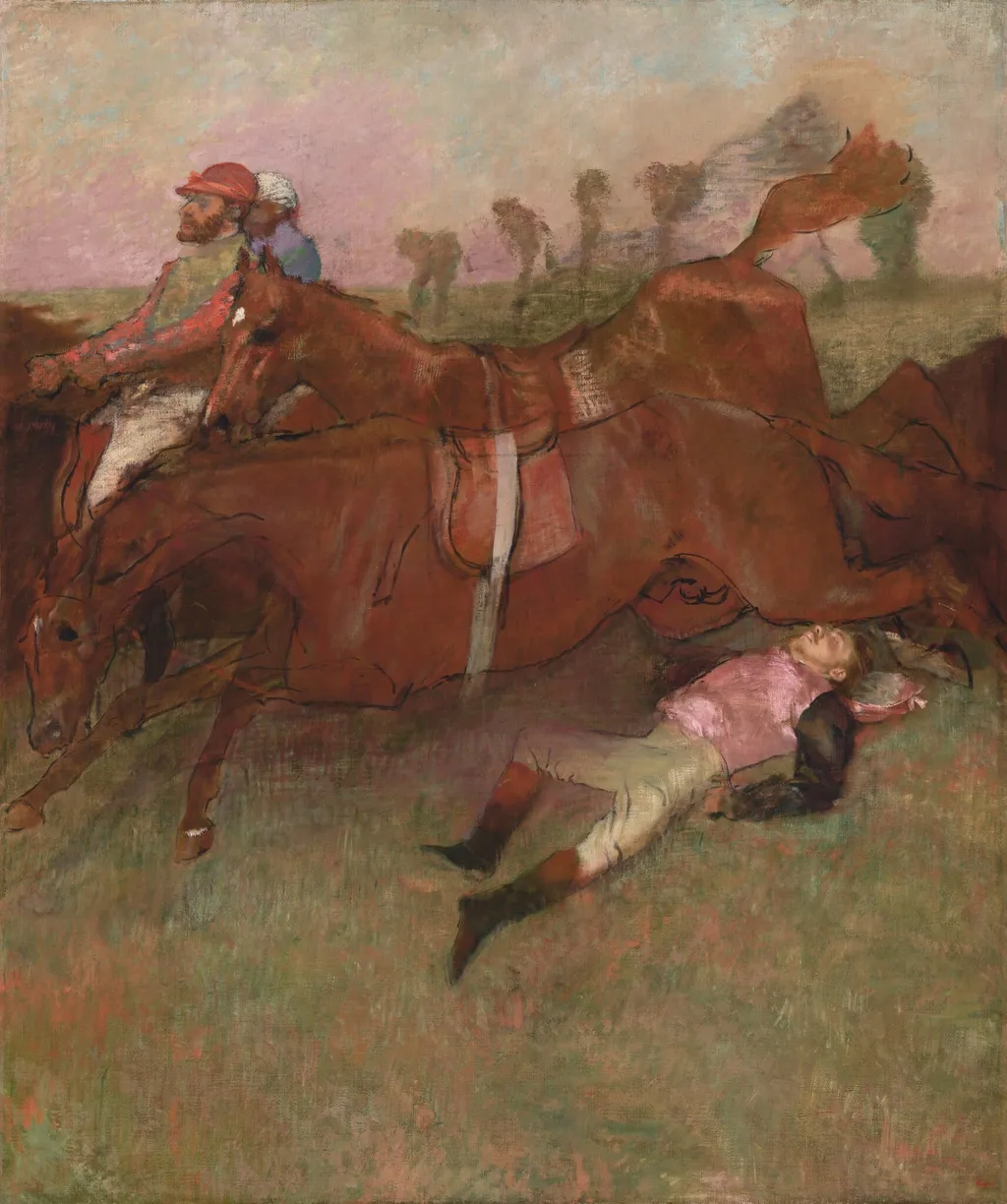
Scene from the Steeplechase: The Fallen Jockey is an oil painting by the Impressionist artist Edgar Degas. It dates from 1880 and is held in the collection of the National Gallery of Art.
- Inscription
- Inscribed:lower right, vente stamp: Degas
About this work
Subject & Meaning
This composition emphasizes the danger and chaos inherent in the sport, which was a fashionable but relatively new phenomenon in France at the time.
The painting depicts a dramatic moment during a steeplechase, focusing on a jockey lying motionless in the foreground after falling from his horse. Three other horses and their riders stampede past from right to left, while the absence of spectators or stewards isolates the fallen figure, raising questions about whether he is alive or dead. This composition emphasizes the danger and chaos inherent in the sport, which was a fashionable but relatively new phenomenon in France at the time.
Scholars have debated the work's deeper meaning, suggesting it may represent an exploration of weakness or serve as a critique of the artist's brother, Achille, who is thought to have posed for the jockey and was viewed as a failure within the family. The scene also marks a shift in Degas's career from history painting to modern subjects, capturing the raw energy and movement of contemporary life rather than idealized narratives.
Technique & Style
Degas painted Scene from the Steeplechase: The Fallen Jockey in oil on canvas in 1866. The work measures 180 by 152 centimeters and depicts four horses and three jockeys in motion from right to left, with one jockey fallen in the foreground. Degas reworked the composition twice, in 1880–81 and again in 1897, retaining the central figure of the fallen rider while altering surrounding details.
The painting reflects Degas's interest in contemporary leisure activities and his response to the rising popularity of steeplechase events in France. It was first exhibited at the 1866 Salon in Paris and later entered the collection of Paul Mellon, who bequeathed it to the National Gallery of Art in 1999.
History & Provenance
Edgar Degas painted Scene from the Steeplechase: The Fallen Jockey in 1866 on a large canvas measuring 180 by 152 centimeters, exhibiting it that same year at the Paris Salon. The work remained in Degas's own atelier until his estate's first sale at Galerie Georges Petit on 6–8 May 1918, where it was offered as Aux Courses: le jockey blessé (lot 19). It subsequently passed through the hands of Joseph Durand-Ruel in Paris and the dealer Ambroise Vollard, before reaching Jacques Seligmann, Paris.
Seligmann consigned it at the American Art Galleries in New York on 27 January 1921 (lot 70), where William W. Seaman purchased it on behalf of the painter Gari Melchers of Fredericksburg, Virginia. After Melchers's death in 1932, the canvas descended by inheritance to his wife Corinne Lawton Mackall Melchers, and then to her residuary legatee Lawton Mackall. Wildenstein & Co., Inc., New York, handled the next transfer, selling the painting in June 1960 to Mr. and Mrs. Paul Mellon of Upperville, Virginia.
Paul Mellon's 1999 bequest placed it in the National Gallery of Art, Washington, D.C., where it remains today.
Scene from the Steeplechase: The Fallen Jockey is held in the collection of the National Gallery of Art in Washington, D.C., having entered the institution as a bequest from Paul Mellon in 1999. Prior to this acquisition, the canvas passed through the estates of Gari and Corinne Melchers and the inventory of Wildenstein & Co., following its purchase by the Mellons in June 1960. The work's exhibition history traces back to its debut at the 1866 Salon in Paris.
Although the painting was subsequently reworked by the artist in the 1880s and again in 1897, specific records of public displays between the 1866 Salon and its modern tenure at the National Gallery of Art are not detailed in the available documentation.
Context
Critical reception of the painting was modest at its 1866 Salon debut, with one anonymous critic noting Degas's limited familiarity with equine anatomy. The work was later reworked by the artist in the 1880s and again in 1897, reflecting his persistent engagement with the composition. Degas's interest in steeplechases emerged amid their rising popularity as elite sporting events in France, a subject he approached with both competitive ambition and technical experimentation.
His reworking of the piece, including a 1896 version titled Fallen Jockey, underscores its enduring significance within his exploration of motion and narrative. The painting's provenance traces from its 1918 sale through private collectors to its acquisition by the National Gallery of Art in 1960, where it remains on display.
Scholars have debated the identity of the fallen jockey, with some suggesting a familial connection to Degas's brother Achille, while others link the figure to his friend Ludovic-Napoléon Lepic. The work's large scale, dynamic composition, and focus on the moment of crisis reflect Degas's broader artistic inquiries into modernity and human vulnerability. Its reworking history and transmission through collectors like Joseph Durand-Ruel and Paul Mellon further illuminate its place in 19th-century art markets and Degas's evolving relationship with his audience.
Overview
Scene from the Steeplechase: The Fallen Jockey is an oil on canvas executed by Edgar Degas in 1866. The work portrays a moment of a horse‑race accident, with a jockey lying in the mud while the horse rears, its legs suspended. The painting is part of the collection of the National Gallery of Art in Washington, D.C., and was first shown at the Paris Salon of 1866.
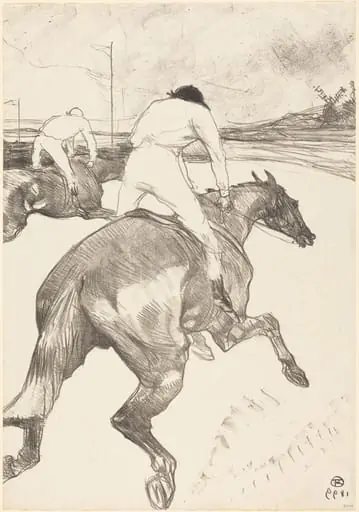
Own this work as a print
Artist & collection
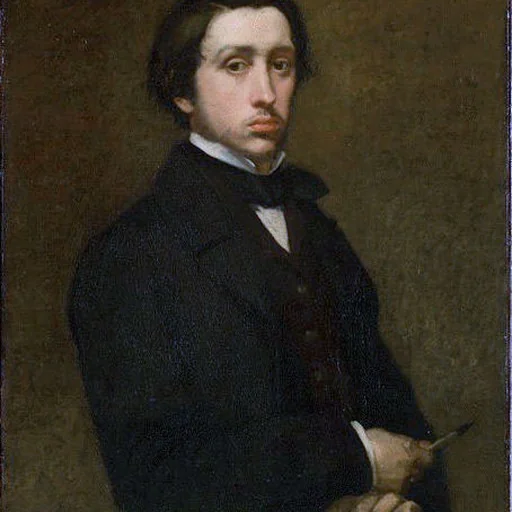
Artist
Born Hilaire-Germain-Edgar De Gas on 19 July 1834 in Paris, Edgar Degas came from an affluent banking family with aristocratic roots and spent his childhood among the cultivated circles of the French capital.