Artwork
Head of Saint Matthew
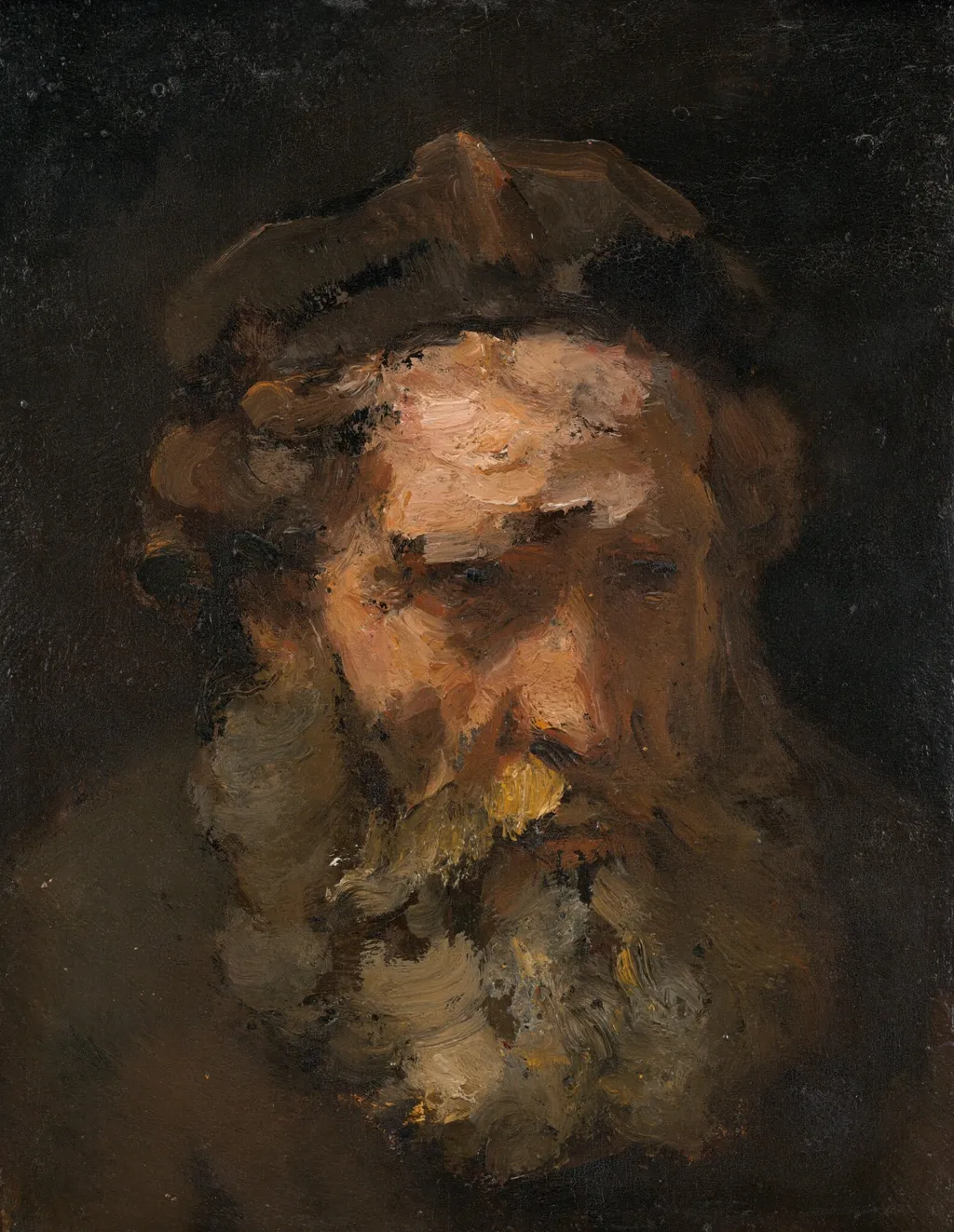
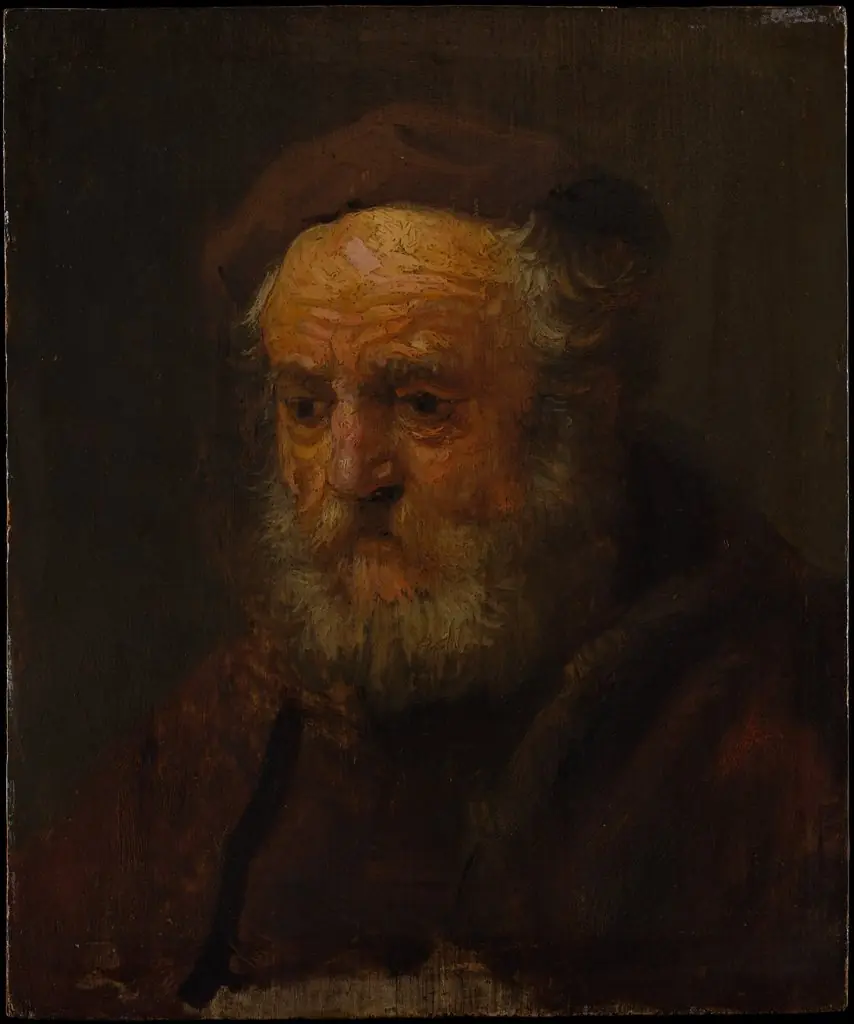
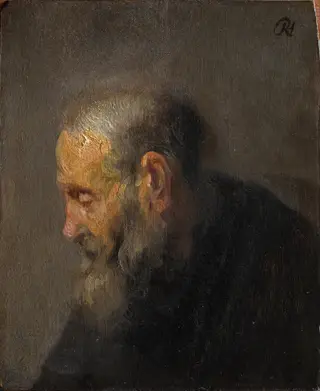
Head of Saint Matthew is an oil painting. It is held in the collection of the National Gallery of Art.
About this work
Technique & Style
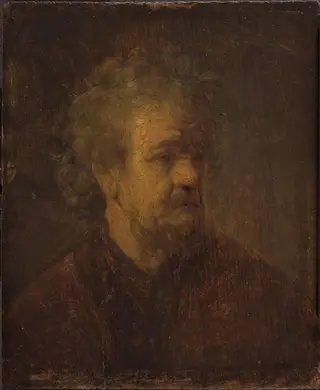
The composition isolates the head of a bearded male sitter wearing a beret, focusing attention on facial modeling and expression rather than narrative context.
Head of Saint Matthew is executed in oil on panel, a support and medium combination characteristic of small-scale seventeenth-century Dutch cabinet pictures. According to the National Gallery of Art records, the work is classified as a painting and falls within the tronie genre, a Dutch category of character study rather than formal portraiture. The panel measures 25 cm in height by 19.5 cm in width, making it an intimate, closely viewed object.
The composition isolates the head of a bearded male sitter wearing a beret, focusing attention on facial modeling and expression rather than narrative context. Dated 1664, the work reflects late handling in which paint is applied to suggest texture in flesh, hair, and headwear through layered glazes and impasto highlights typical of oil-on-panel technique.
History & Provenance
The Head of Saint Matthew was created in 1664 and is attributed to a Dutch 17th-century artist, with historical associations to Rembrandt's circle. Its earliest documented ownership traces to Alfred Buckley of New Hall, England, by 1882, who lent it to the Royal Academy's Winter Exhibition that year. It later entered the collection of Rodolphe Kann in Paris, likely between 1893 and 1900, as recorded in Wilhelm von Bode's 1900 catalogue.
In 1907, the painting was acquired by Duveen Brothers as part of the Kann collection, then exchanged to F. Kleinberger & Co., and subsequently to Leo Nardus in early 1909. Nardus traded it to Peter A.B. Widener, whose estate gifted it to the National Gallery of Art in 1942.
The painting is held in the permanent collection of the National Gallery of Art in Washington, D.C., accessioned under the number 1942.9.63. It entered in 1942 as a gift from Joseph E. Widener, who inherited it from his father, Peter A.B. Widener. No public exhibitions beyond the 1882 Royal Academy loan are documented in the provided sources.
Context
The 1664 oil portrait attributed to Rembrandt, commonly referred to as Head of Saint Matthew, entered public view through its loan to the Royal Academy's 1882 Winter Exhibition, marking early scholarly attention to the work. Subsequent catalogues by Wilhelm von Bode (1900) and Émile Michel (1893) documented the painting within the Rodolphe Kann collection, underscoring its significance in early 20th-century Rembrandt scholarship. As a tronie rather than a commissioned portrait, the piece exemplifies the artist's interest in character studies and psychological immediacy, situating it within the broader trajectory of Dutch Golden Age portraiture.
The work's provenance, from Alfred Buckley to the Kann collection and eventually the National Gallery of Art, reflects a documented exchange pattern among European dealers, reinforcing its role as a touchstone for studies of Rembrandt's oeuvre.
Overview
The painting "Head of Saint Matthew" is an oil on panel work depicting a bearded man. The artist presents the figure with a serious yet serene expression, his gaze directed outward. The composition emphasizes the subject's face, rendered with a focused simplicity that contributes to the work's overall quietude.
Through a restrained palette, the painting achieves a sense of spatial depth, drawing the viewer's attention to the saint's contemplative presence.
Subject & Meaning
The painting portrays Saint Matthew, identifiable by his traditional attributes, though here depicted without overt religious symbols. He wears a beret and a beard, conveying an impression of wisdom and introspection. The artist centers the composition on Matthew's face, highlighting his calm demeanor and the subtle details of his features. This direct and unadorned representation invites contemplation of the saint's character rather than a narrative event.

Artist & collection