Artwork
Venus and Mars Surprised by Vulcan
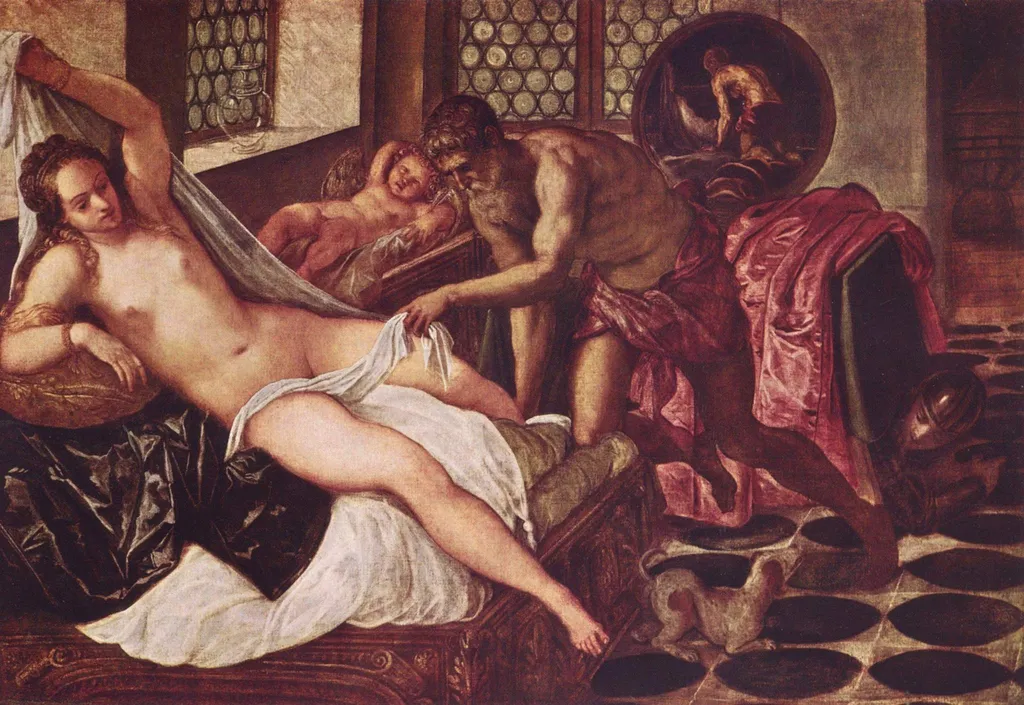
Venus and Mars Surprised by Vulcan is an oil painting by the Mannerist artist Jacopo Tintoretto. It dates from 1555 and is held in the collection of the Bavarian State Painting Collections.
About this work
Vulcan lifts the sheet from Venus's bed while Mars cowers beneath it, his hiding place already given away by a small yapping dog. Jacopo Tintoretto painted this comic take on the adultery myth around 1555, setting it in a Venetian bedroom where a convex mirror catches the cuckolded husband's search. The oil on canvas, 140 by 197 centimetres, hangs in the Alte Pinakothek in Munich.
Subject & Meaning
The work thus transforms a serious myth into a humorous, intimate domestic drama, possibly intended to comment on marital fidelity in a bridal chamber context.
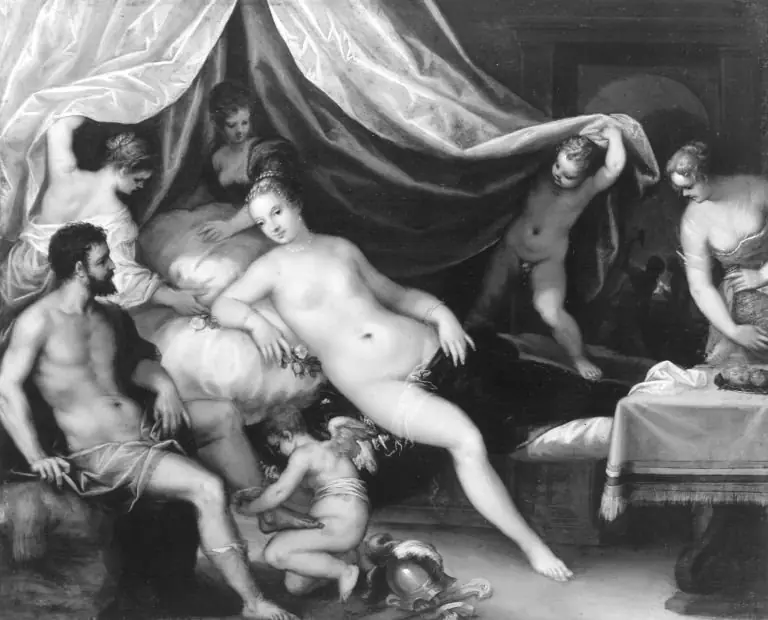
The painting depicts a mythological scene of adultery drawn from Ovid and Homer: Venus, the goddess of love, lies naked on a bed while her husband Vulcan, god of fire, unexpectedly returns, tipped off by Apollo. Mars, Venus's lover, hides under the bed wearing a helmet, and a barking dog threatens to reveal him. Cupid sleeps in a cradle nearby.
Tintoretto deviates from the classical narrative, Vulcan's magical net is absent, and instead presents a comic, burlesque interpretation. Vulcan is not enraged but distracted by his wife's nudity as he lifts the cloth covering her pubis, his desire outweighing his jealousy. The contemporary Venetian bedroom and the mirror reflecting Vulcan underscore the scene's humanized, almost vaudevillian tone.
The work thus transforms a serious myth into a humorous, intimate domestic drama, possibly intended to comment on marital fidelity in a bridal chamber context.
Technique & Style
The painting is executed in oil on canvas, measuring 135 × 198 cm. Tintoretto employs a rapid, sketch-like handling of the figures, paired with refined chiaroscuro to create an elegant painterly effect. The composition, studied by the artist using a small model with figures, demonstrates a careful treatment of volumes, light, and spatial relationships. The floor's tiled pattern generates a strong perspectival thrust toward the background, while the overall space is deliberately compressed and claustrophobic.
This domestic, Renaissance Venetian interior, with luxurious brocades, a curved mirror, and a window providing the main light source, grounds the mythological scene in a contemporary, bourgeois setting. The work is described as wittily Mannerist, combining a lively narrative spirit with a burlesque, anecdotal quality that undercuts the heroic ideal.
History & Provenance
The original commission and early provenance of Venus and Mars Surprised by Vulcan remain unknown. A speculative link to the painter Peter Lely's collection in the first half of the 17th century, and a possible acquisition by the Duke of Devonshire in 1682, is debated. Documented history begins in 1854 when the painting was recorded in the Munro collection.
It was sold at auction in Paris in 1865 to dealer Charles Sedelmeyr, and later to the painter August von Kaulbach, who owned it from 1890 until 1925. In 1925, the Alte Pinakothek in Munich acquired it, where it remains as part of the Bavarian State Painting Collections. Dating is disputed: most scholars place it in the early 1550s (c. 1551–1552 or c. 1555), though some argue for an earlier date of c. 1545–1547. A preparatory drawing is held at the Kupferstichkabinett, Berlin.
The painting is held in the Alte Pinakothek in Munich as part of the Bavarian State Painting Collections (Bayerische Staatsgemäldesammlung). Its provenance begins with a mid-19th-century record in the Munro collection (1854). It was sold in Paris in 1865 to dealer Charles Sedelmeyr, then passed to painter August von Kaulbach, who owned it until 1925, when the Alte Pinakothek acquired it.
Some scholars suggest it may have been the work purchased in 1682 by the Duke of Devonshire from Peter Lely’s collection, but this remains uncertain. No specific exhibition history beyond its current location is documented in the sources.
Context
Critical reception has focused on the painting's inventive Mannerist character, with art historian Rodolfo Pallucchini describing it as “un'opera di sapore argutamente manieristico” (a work of witty Mannerist flavor). Scholarship notes its deviation from classical narrative, Vulcan’s distraction by Venus’s nudity and Mars’s comic concealment, lending the scene a burlesque, almost vaudeville-like quality. The work is considered autograph and a rare example of Tintoretto’s preparatory studies, as a drawing for it survives in Berlin.
Dating remains debated, with most scholars placing it in the early 1550s or around 1555; the Alte Pinakothek now favors circa 1555. Within Tintoretto’s oeuvre, the painting exemplifies his original, discursive style and his ability to merge mythological themes with contemporary Venetian domestic settings, marking a key moment in Venetian Mannerism.
Overview
Jacopo Tintoretto's painting, Venus and Mars Surprised by Vulcan, created between 1551 and 1552, is an oil on canvas work housed in the Alte Pinakothek in Munich. This artwork presents a humorous, burlesque interpretation of a well-known Roman mythological episode of divine adultery. The scene unfolds within a domestic Venetian setting, capturing a moment of unexpected discovery and comic tension.
Own this work as a print
Artist & collection
Artist
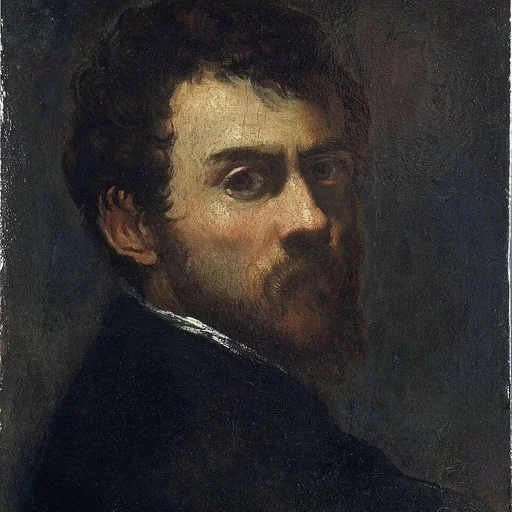
Jacopo Robusti (late September or early October 1518 – 31 May 1594), best known as Tintoretto ( TIN-tə-RET-oh; Italian:; Venetian: ), was an Italian Renaissance painter of the Venetian school.



 Studied in the Mythology in Art course