Artwork
Saint Catherine
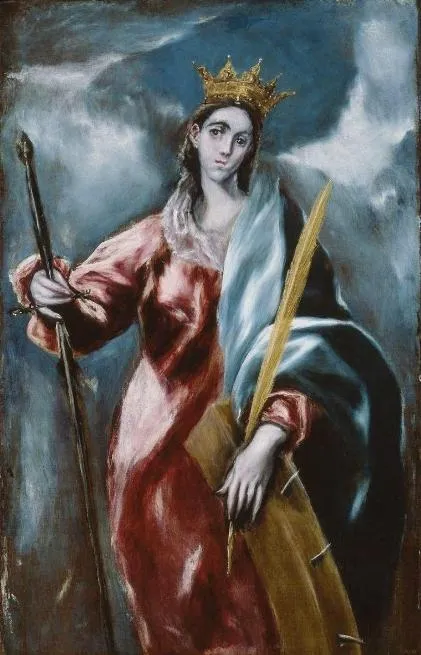
Saint Catherine is an oil painting by the Mannerist artist El Greco. It dates from 1610 and is held in the collection of the Museum of Fine Arts Boston.
About this work
Overview
It is the only autograph painting of this subject securely attributed to El Greco, making it a significant, if unusual, entry in his corpus.
Saint Catherine is an oil on canvas painting by El Greco (Doménikos Theotokópoulos), dated to approximately 1610 and now held at the Museum of Fine Arts, Boston. Measuring 90 by 61 cm according to the scholar Harold Wethey, though the museum records it as 100.5 by 63.8 cm, the work depicts the martyred saint in a vertical, full-length composition. It is the only autograph painting of this subject securely attributed to El Greco, making it a significant, if unusual, entry in his corpus. The painting entered the museum through the bequest of William A. Coolidge and is catalogued under inventory number 1993.38.
Subject & Meaning
The painting portrays Catherine of Alexandria, a legendary Christian martyr celebrated for her beauty, erudition, and steadfast faith. According to hagiographic tradition, the Roman emperor Maxentius sought to marry her, but Catherine refused on account of his paganism. She was subsequently tortured on a spiked wheel, which tradition holds was destroyed by a lightning bolt from heaven, before finally being beheaded with a sword. El Greco depicts her with her principal attributes: a golden crown signifying her royal dignity and perhaps her spiritual sovereignty; a palm frond of martyrdom held in her left hand; the broken spiked wheel upon which her left arm rests; and a sword in her right hand, the instrument of her execution. The saint gazes directly at the viewer with what sources describe as an expression of solemn, even haughty dignity. The absence of a ground line or architectural setting places her in an indeterminate atmospheric space of turbulent clouds, emphasizing her spiritual rather than earthly presence.
Technique & Style
The work is executed in oil on canvas with the loose, visible brushwork characteristic of El Greco's late manner. The paint surface varies between thinner passages and more heavily worked areas, with luminous highlights on the crown and palm frond. Light falls from the upper left, illuminating the face, hands, and drapery folds while deep shadows pool in the fabric and background. The palette is dominated by cool blues and grays contrasted with warm pinks, reds, and gold. The saint wears a pale blue-green mantle over a rose-colored gown with deep red shadows, the pink tunic rendered with brilliant white reflections and the pale blue of the cloak recalling the coloristic refinement of El Greco's late Apostolados. In the lower left corner, the artist left visible a reddish ground typical of his final period. The brushwork consists of elongated, fluid strokes that distort natural proportions and create a sense of restless movement, with forms defined through color and tone rather than precise contour. An illegible and fragmentary signature in large cursive Greek letters appears on the wheel.
History & Provenance
The painting's documented ownership begins with the Marqués de Alós at Castillo de Balsareny, where it remained until 1936. It then passed through the London dealer Thomas Harris, then to Pinakos & Knoedler in New York, and subsequently to Mrs. Charles S. Payson of Manhasset. After being returned to Pinakos & Knoedler, it was acquired by William A. Coolidge, whose bequest brought it to the Museum of Fine Arts, Boston, where it is now held at the Coolidge Estate. The work is catalogued by Harold Wethey as number 201 and by Tiziana Frati as number 165. In the posthumous inventories compiled by El Greco's son Jorge Manuel Theotocópuli, a painting of this subject is mentioned, which may correspond to the present work; a Saint Catherine of Siena is also recorded but is now lost.
Context
The subject of Saint Catherine is unusual within El Greco's painted oeuvre. While the artist habitually produced multiple versions of his compositions, only this single autograph painting of Catherine of Alexandria is known to survive. Scholarly cataloguing reflects some uncertainty about precise dating: the French Wikipedia suggests a broad range of circa 1600-1614, while the Spanish Wikipedia and Wethey favor a date around 1610-1614, with the Wikidata corpus specifying 1610. The work belongs to El Greco's final period, when his style had become increasingly mannered, with elongated proportions and expressive, almost abstract brushwork that prioritizes spiritual intensity over naturalistic description. The direct outward gaze of the Boston version distinguishes it from other known variants: a private collection version in New York shows the saint turning her gaze leftward with a calmer, more melancholic expression, while an earlier version at the Musée Cau Ferrat depicts her in a penitential mode akin to Mary Magdalene, with hand pressed to breast and supplicating look. The Swedish National Museum holds a copy by a follower, dated by Wethey to 1625-1650, which he connected compositionally to El Greco's Penitent Magdalene type.
Legacy
The singular status of this painting, as the only surviving autograph Saint Catherine by El Greco, has made it a key work for understanding both his devotional imagery and his late stylistic development. Its provenance through major dealers and collectors of the twentieth century, including Knoedler and William A. Coolidge, testifies to its sustained recognition as an important work. The existence of multiple versions and copies, including the follower copy now in Stockholm and the variant in a New York private collection, indicates that the composition had some currency, even if the subject itself was not one El Greco repeated as frequently as others in his repertoire. The painting remains at the Museum of Fine Arts, Boston, as part of the Coolidge bequest, where it continues to be studied as a defining example of the artist's late religious manner.
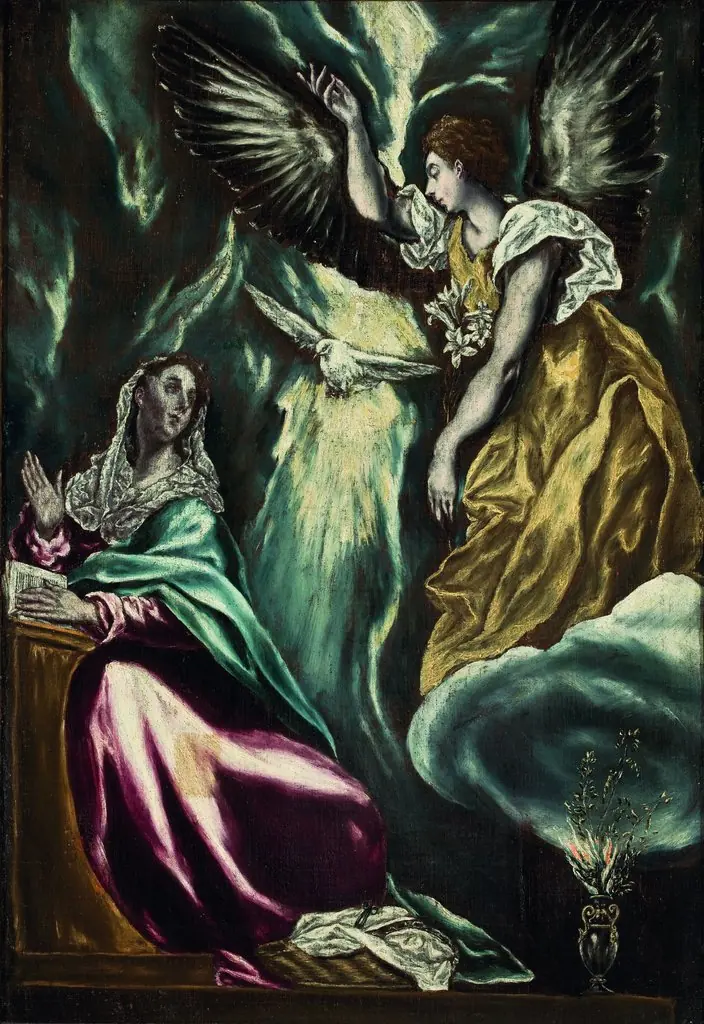
Artist & collection
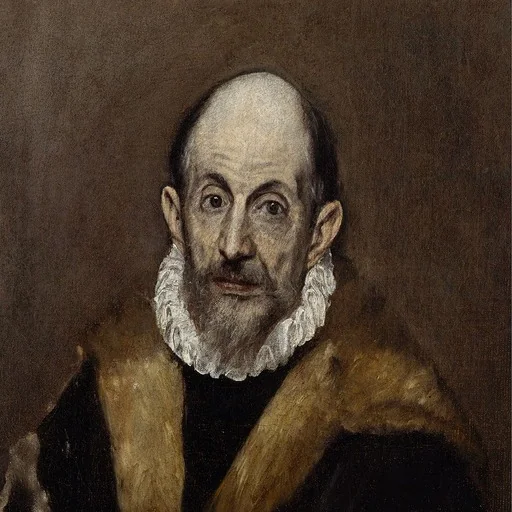
Artist
Doménikos Theotokópoulos was born in 1541 in Candia (modern Heraklion), the capital of Venetian-ruled Crete, where he was trained in the post-Byzantine tradition of icon painting.