Artwork
Opening of the Fifth Seal
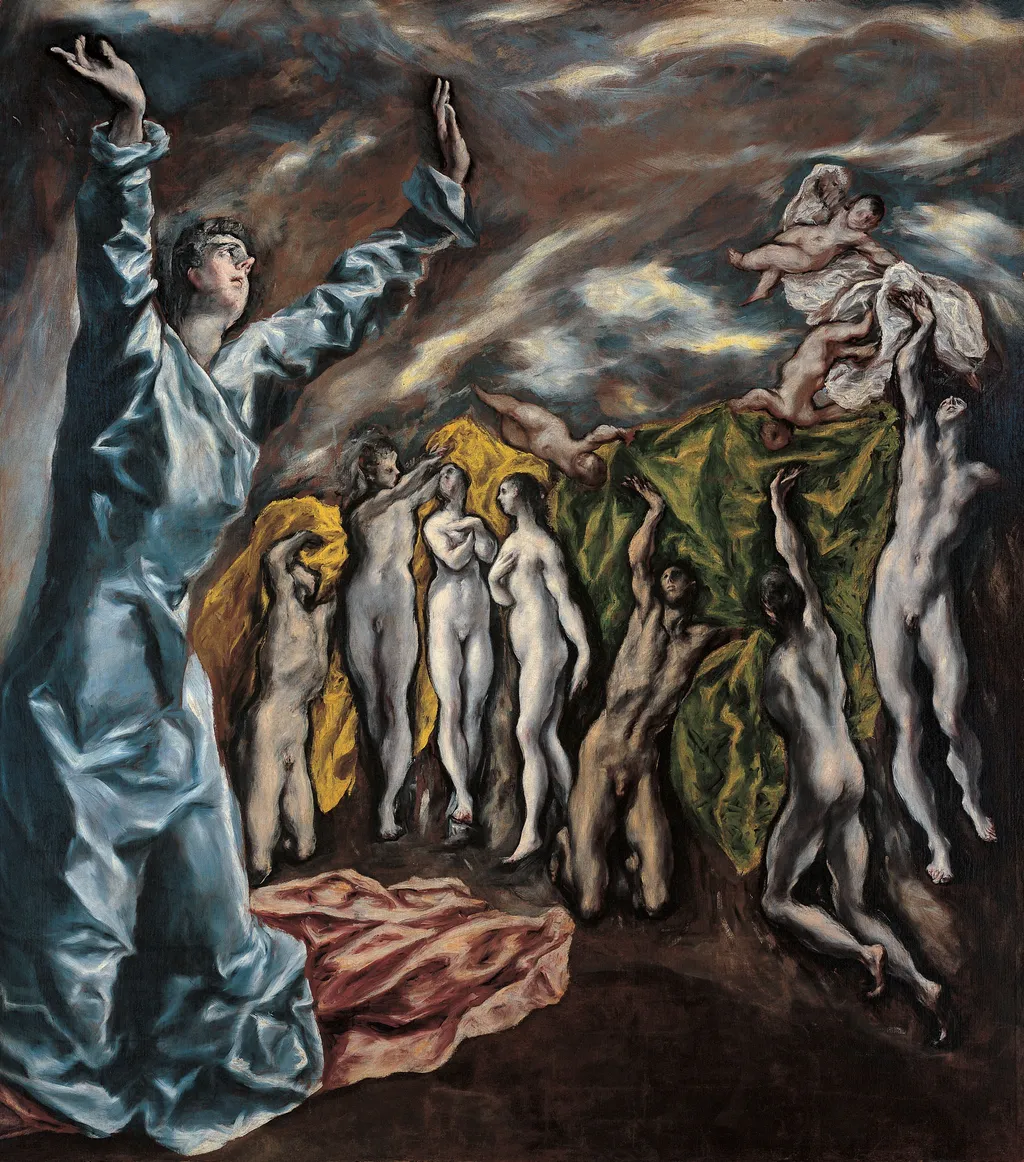
Opening of the Fifth Seal is an oil painting by the Mannerist artist El Greco. It dates from 1610 and is held in the collection of the Metropolitan Museum of Art.
About this work
Saint John throws his arms toward heaven while naked souls reach behind him for white robes. El Greco painted this fragment in his last years for the Hospital of Saint John the Baptist outside Toledo and died before finishing it. Around 1880 restorers cut away the upper portion, leaving the saint pointing at empty space, a loss that later fascinated painters like Picasso.
Subject & Meaning
The colossal, ecstatic figure of Saint John the Evangelist dominates the left foreground, kneeling with arms raised toward a lost heavenly vision.
The painting depicts the opening of the fifth seal from the Book of Revelation (6:9–11): the souls of martyrs cry out to God for justice while receiving white robes of salvation from angels. The colossal, ecstatic figure of Saint John the Evangelist dominates the left foreground, kneeling with arms raised toward a lost heavenly vision. Behind him, naked martyrs writhe in a storm of emotion, forming two groups; cherubim offer them the white robes symbolizing salvation.
The upper portion, cut off around 1880, likely showed the Lamb opening the seal or, alternatively, represented divine love, contrasting with the surviving lower section once interpreted as profane love (hence the earlier title Sacred and Profane Love). The work thus presents a visionary apocalyptic drama of judgment and redemption.
Technique & Style
El Greco painted Opening of the Fifth Seal in oil on canvas, a large work now reduced by about 175 cm at the top. The surviving fragment is unfinished and heavily abraded. Executed in his late Mannerist style, the composition is dominated by the ecstatic figure of Saint John, whose kneeling pose and upward gesture recall forms El Greco developed in Italy.
Behind him, naked martyrs writhe in a storm of emotion, their elongated bodies and angular draperies echoing Michelangelo's Ignudi. The lost upper section likely showed the sacrificial lamb; the severe cropping from an 1880 restoration leaves John pointing emphatically into empty space, enhancing the work's visionary power and its appeal as a precursor to modernism.
History & Provenance
Commissioned by Pedro Salazar de Mendoza for a side-altar of the church of the Hospital de San Juan Bautista (Hospital Tavera) outside Toledo, the painting was created between 1608 and 1614. It remained unfinished at El Greco's death in 1614 and passed to his son Jorge Manuel. By the 19th century it was owned by J. Núñez del Prado, then Spanish Prime Minister Antonio Cánovas del Castillo.
Dissatisfied with its condition, he had it 'restored' in 1880, which removed approximately 175 cm from the top. After Cánovas' death in 1897, it was sold to Rafael Vázquez de la Plaza, then in 1905 to Ignacio Zuloaga for 1,000 pesetas. Zuloaga kept it until 1945; his museum sold it in 1956 to the Metropolitan Museum of Art in New York, where it is held under accession number 56.48.
The work was exhibited at the Grand Palais in Paris from October 2019 to February 2020 as part of a retrospective dedicated to El Greco.
Context
Initially misidentified as Profane Love, the painting was reattributed to the subject of the Fifth Seal by scholar Manuel B. Cossío in 1908. Its fragmented, unfinished state and expressive angularity captivated early modernists. Ignacio Zuloaga, who owned it from 1905, hailed it as a "precursor of modernism" with "visionary power."
The work has been central to scholarship tracing El Greco's influence on Picasso's Les Demoiselles d'Avignon, with art historians Ron Johnson, John Richardson, and Efi Foundoulaki analyzing the stylistic parallels and the triangle of Picasso, Cézanne, and El Greco. Its impact extended to Robert Delaunay and Jackson Pollock. As a late Mannerist painting that prefigured modernist distortions, it occupies a pivotal place in the reception of El Greco as a proto-modernist.
Legacy
The painting gained a reputation as a precursor to modernism after Ignacio Zuloaga acquired it in 1905, declared it possessed a "visionary power," and displayed it in his Paris studio. It appears in the background of Zuloaga's group portrait Mis amigos, which depicts members of the Generation of '98. Zuloaga showed the work to Pablo Picasso and Rainer Maria Rilke.
Scholars have identified Picasso's Les Demoiselles d'Avignon as directly inspired by El Greco's composition, with art historians such as John Richardson and Efi Foundoulaki tracing morphological parallels and noting that Picasso's dialogue with El Greco continued into Cubism. Additionally, Robert Delaunay referred to the painting in his La Ville de Paris, and a drawing by Jackson Pollock also reproduces its motifs. The work's damaged, cut-down state and dramatic angularity made it especially compelling to early-twentieth-century avant-garde artists.
Overview
El Greco's The Opening of the Fifth Seal is an oil painting from the final years of the artist's life. This large-scale work, also known as The Vision of Saint John, was left incomplete at the time of his death. It currently resides in the Metropolitan Museum, which notes its damaged and abraded condition, reflecting its age and history.
Own this work as a print
Artist & collection
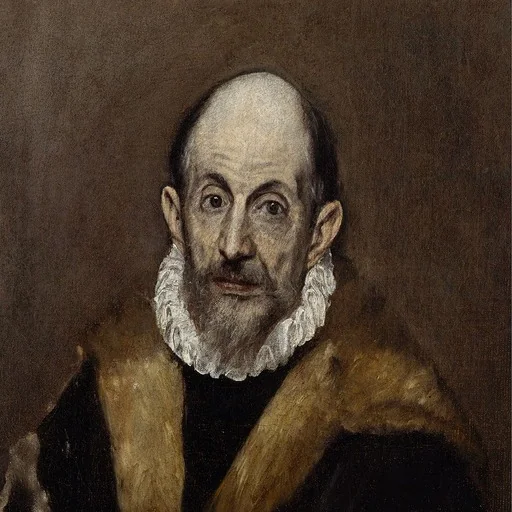
Artist
Doménikos Theotokópoulos was born in 1541 in Candia (modern Heraklion), the capital of Venetian-ruled Crete, where he was trained in the post-Byzantine tradition of icon painting.