Artwork
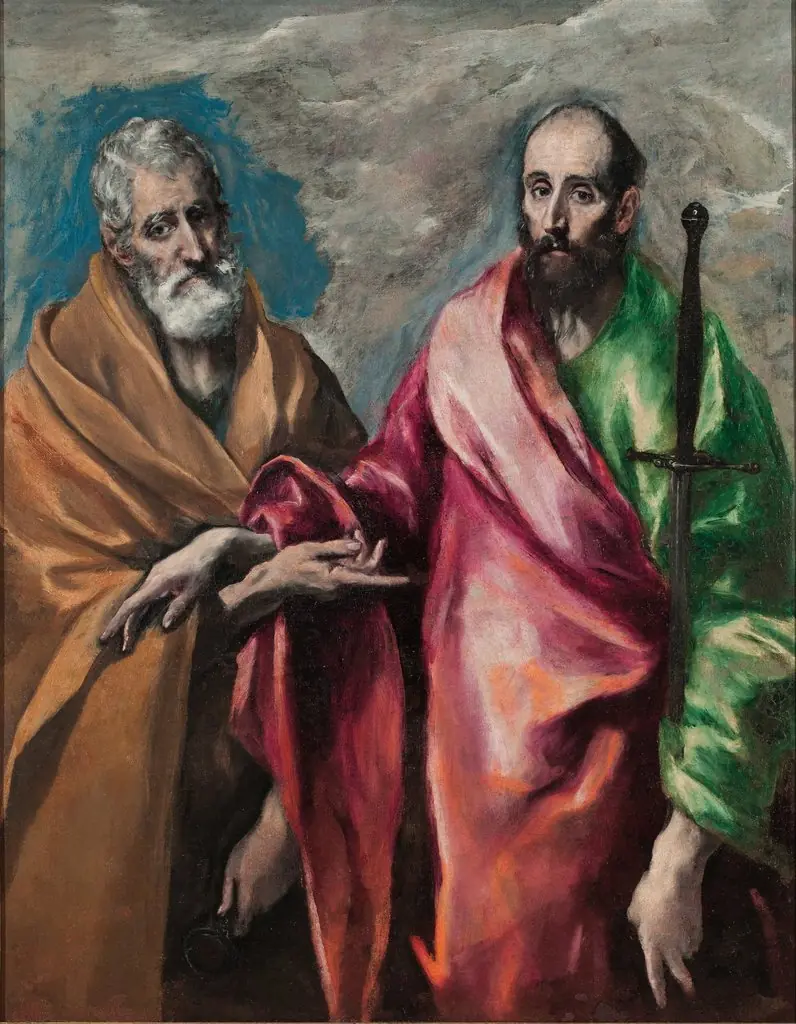
Saints Peter and Paul
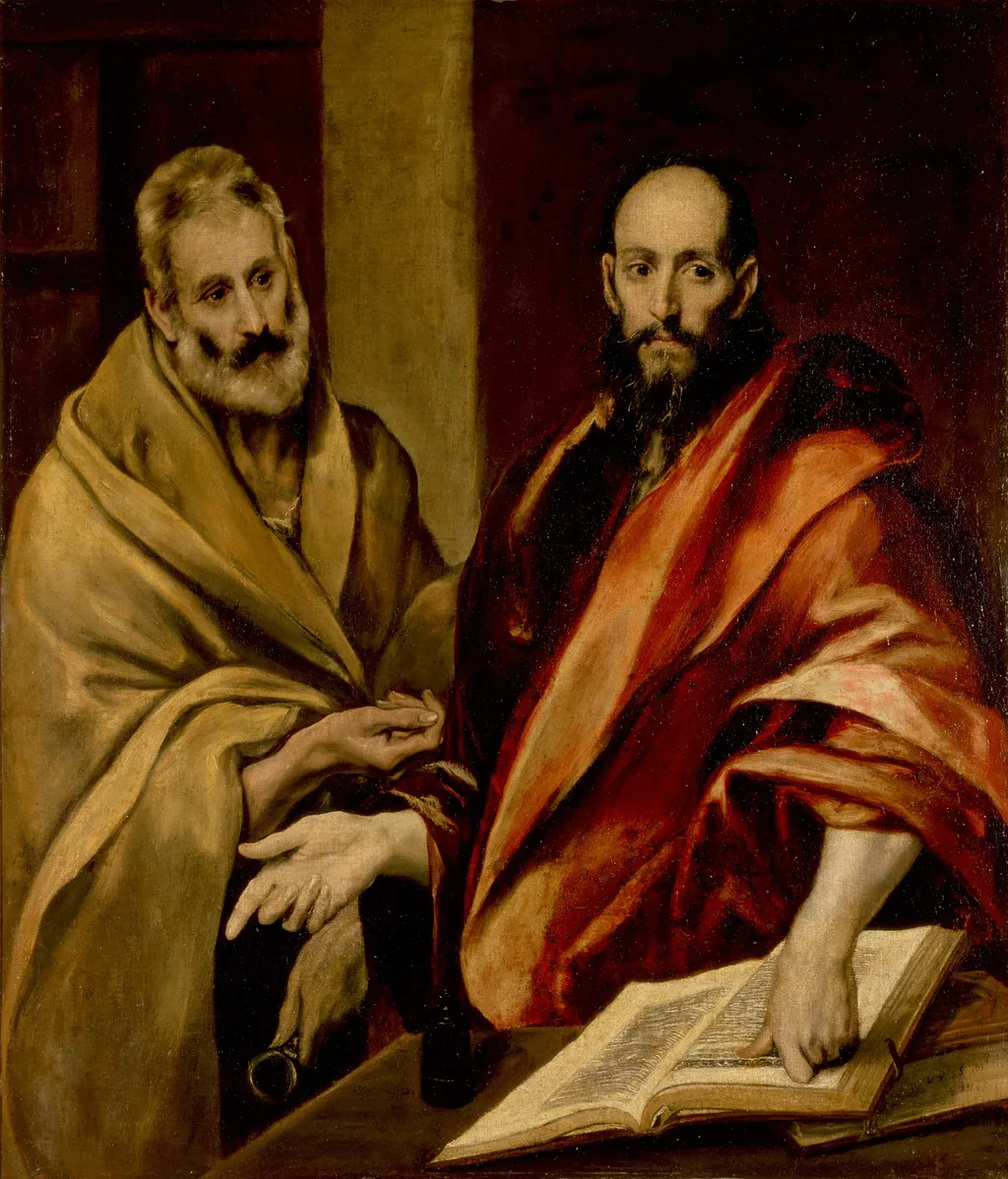
Saints Peter and Paul is an oil painting by the Mannerist artist El Greco. It dates from 1594 and is held in the collection of the Hermitage Museum.
About this work
Subject & Meaning
The composition emphasizes their complementary roles in apostolic tradition, with Peter as the rock of the Church and Paul as the missionary to the Gentiles.
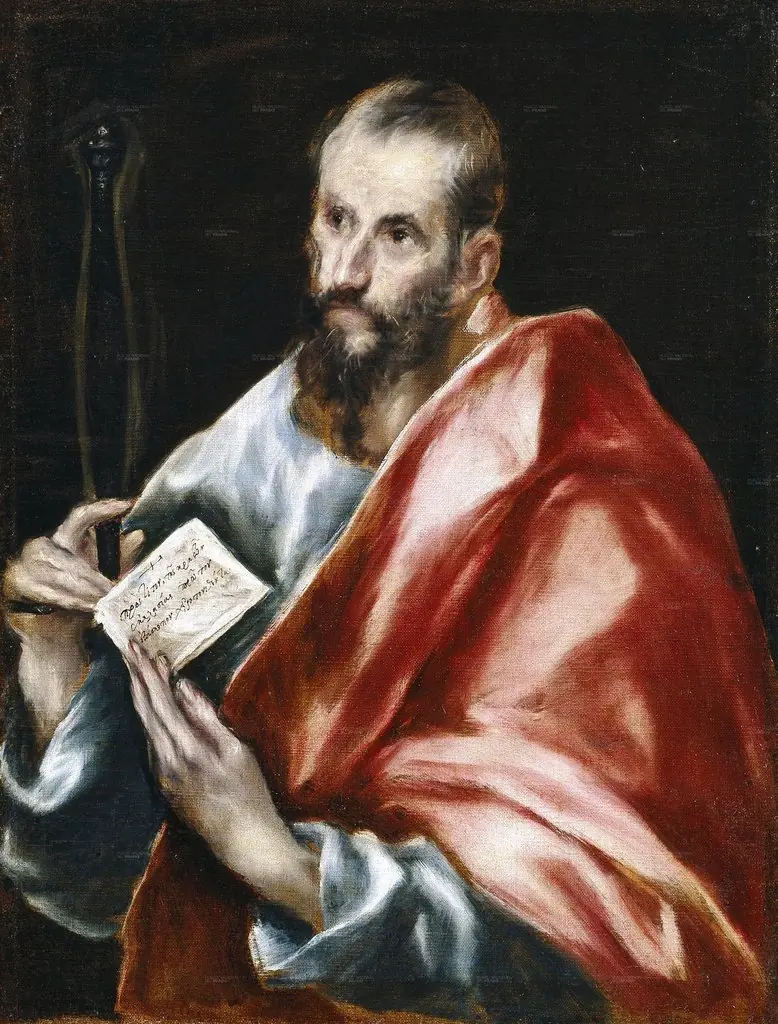
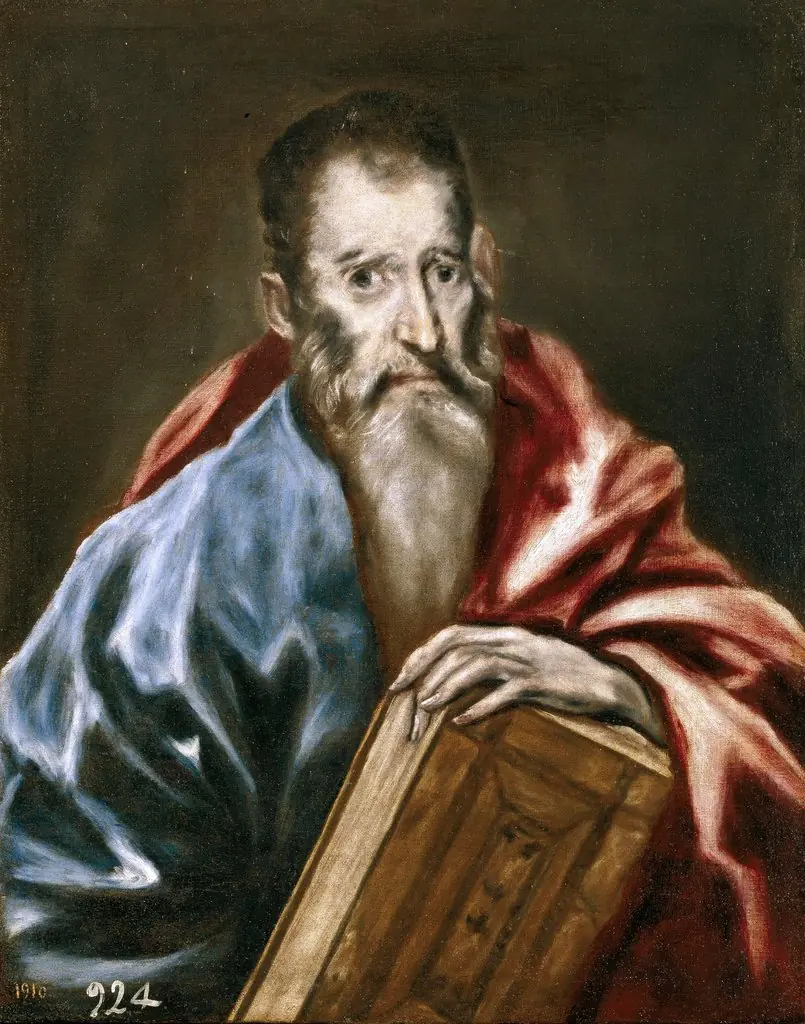
The painting depicts Saints Peter and Paul, two foundational apostles of early Christianity, arranged symmetrically yet psychologically contrasted. Peter, on the left, holds a key, a traditional attribute referencing Christ’s words recorded in the Gospel of Matthew, while Paul, on the right, points to an open book, symbolizing his authorship of epistles to Christian communities. The two are visually separated by a rectangular architectural element, possibly a column, which underscores their distinct personalities: Peter appears passive, Paul dynamic, reflecting El Greco’s psychological emphasis. The composition emphasizes their complementary roles in apostolic tradition, with Peter as the rock of the Church and Paul as the missionary to the Gentiles.
Technique & Style
El Greco executed this religious painting using oil paint on canvas, with the Hermitage version measuring 121.5 by 105 cm. Stylistically, the composition places the two apostles before a neutral background, visually separating them with a vertical architectural element, likely a column or the edge of a wall. The figures are rendered with traditional iconographic attributes: Saint Peter holds a key in his left hand, while Saint Paul rests his left hand on an open book symbolizing his epistles. The artist distinguishes the figures through deliberate psychological contrast, portraying Peter as passive and Paul as dynamic. Paul wears a reddish-orange mantle and has a dark beard, whereas Peter has a white beard and wears yellow drapery that shifts to green in the shadows, a technique characteristic of El Greco's late works. Additionally, remnants of a Greek cursive signature are visible on the edge of a closed book.
History & Provenance
Created in Spain, this oil on canvas painting by El Greco depicts Saints Peter and Paul. While some internal records assign the work to 1587, museum authorities and scholars date its execution to a range between 1587 and 1592, though art historian Harold Wethey proposed a later date of circa 1610. The canvas bears the inventory number ГЭ-390 at the Hermitage Museum, where remnants of the artist's signature in Greek cursive are visible on the edge of a closed book depicted within the scene.
The work's documented ownership history begins with General P. P. Durnowo of Leningrado. The Hermitage Museum acquired the painting from Durnowo in 1911, establishing its presence in the Russian collection. This specific version is distinguished from other iterations of the theme held in Barcelona and Stockholm by its specific dimensions and the dynamic portrayal of Saint Paul alongside a more passive Saint Peter.
Context
The Saints Peter and Paul in the Hermitage is one of several versions of this apostolic pair that El Greco produced, with related canvases now in Barcelona and Stockholm. Scholarship has distinguished two typologies among these works, notably through Harold Wethey’s catalogue raisonné and Tiziana Frati’s numbering, which place the Hermitage painting as Type‑II (sources 3,6). Studies by José Álvarez Lopera and Michael Scholz‑Hänsel have examined El Greco’s contrasting portrayal of the saints, noting Peter’s passive demeanor and Paul’s more dynamic stance as a psychological study (source 6). The painting’s art‑historical significance lies in its religious subject, its oil‑on‑canvas execution dated to 1587‑1592, and its later cultural resonance, including a Soviet postage stamp issued in 1970 (sources 3,4,5,6).
Legacy
The Hermitage version of *Saints Peter and Paul* by El Greco achieved recognition beyond the art world when the Soviet Union featured the painting on a postage stamp issued in 1970. This philatelic inclusion highlights the work's status as a significant cultural icon within the former USSR. The painting is one of several versions of this religious theme created by the artist, with other known iterations located in Barcelona and Stockholm. Art historical analysis, such as that by Harold Wethey, categorizes the Hermitage canvas as part of a specific typology (Type-II) alongside the Stockholm version, distinguishing it from an earlier composition now held in Barcelona. The existence of these multiple versions underscores the subject's importance in El Greco's late career.
Own this work as a print
Artist & collection
Artist
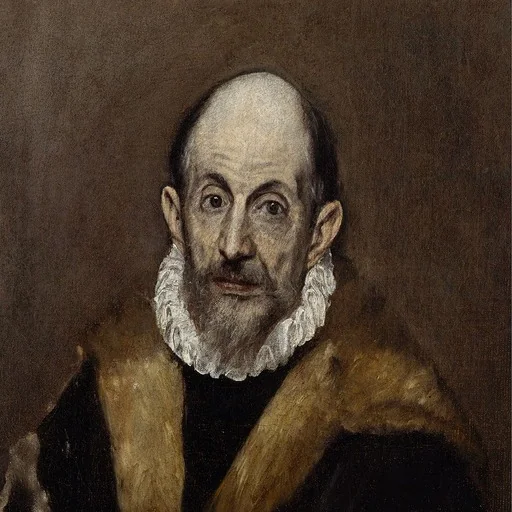
Doménikos Theotokópoulos was born in 1541 in Candia (modern Heraklion), the capital of Venetian-ruled Crete, where he was trained in the post-Byzantine tradition of icon painting.