Artwork
William Sidney Mount
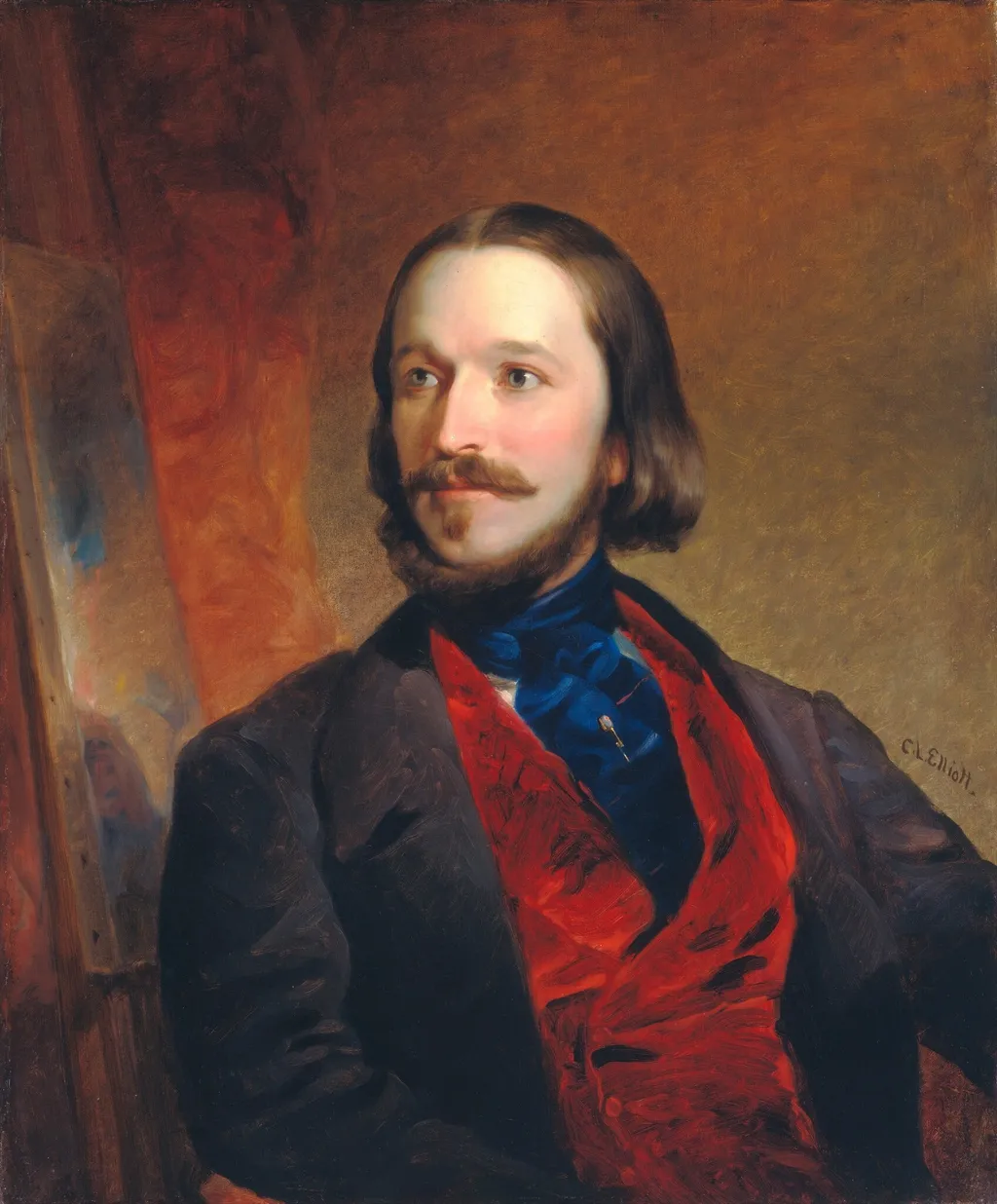
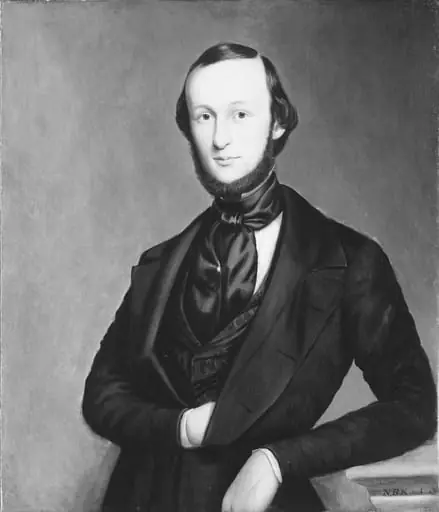
William Sidney Mount is an oil painting by the Impressionist artist Charles Loring Elliott. It dates from 1850 and is held in the collection of the National Gallery of Art.
- Inscription
- Inscribed:center right: C.L. Elliott.
About this work
History & Provenance
The provenance begins with the artist himself, who retained the work at his homes in Hoboken, New Jersey, and Albany, New York.
Charles Loring Elliott's oil-on-canvas portrait of William Sidney Mount was completed in 1850. The provenance begins with the artist himself, who retained the work at his homes in Hoboken, New Jersey, and Albany, New York. After Mount's death, it passed to his estate and was offered at the George A. Leavitt estate sale in New York on 7–8 December 1876, listed as lot 46 on the first day under the title "Portrait of Wm. Mount," as indicated by a tattered stretcher label clipped from that catalogue.
The painting subsequently entered the collection of the landscape painter David Johnson in New York. Following Johnson's death in 1908, it descended to his widow, Marie Louise Johnson, in Walden, New York, and then to John W. Reid, also of Walden. On either 26 or 28 March 1917, Thomas B. Clarke of New York purchased the portrait, a date documented in an annotated copy of the 1928 Philadelphia Museum of Art exhibition catalogue and in a prospectus compiled by Charles X. Harris.
After Clarke's death, the work was sold on 29 January 1936 through M. Knoedler & Co. to The A.W. Mellon Educational and Charitable Trust in Pittsburgh, which gifted it to the National Gallery of Art in 1947.
The painting is held by the National Gallery of Art in Washington, D.C., as part of the Andrew W. Mellon Collection. It entered the NGA in 1947 as a gift from The A.W. Mellon Educational and Charitable Trust of Pittsburgh, which had acquired it on 29 January 1936 through M. Knoedler & Co., New York, as part of the Thomas B. Clarke collection.
Earlier in its provenance, the work was purchased on 26 or 28 March 1917 by Thomas B. Clarke from John W. Reid of Walden, New York, who had received it from Marie Louise Johnson, widow of David Johnson, of Walden. It had previously been sold at the artist's estate sale by George A. Leavitt in New York on 7–8 December 1876 (first day, no. 46), described there as "Portrait of Wm. Mount."
The painting was exhibited in 1928 at the Philadelphia Museum of Art in the show _Portraits by Early American Artists of the Seventeenth, Eighteenth, and Nineteenth Centuries Collected by Thomas B. Clarke_.
Overview
Created around 1850, this oil on canvas by Charles Loring Elliott bears the title William Sidney Mount. The work portrays a solitary male figure rendered against an indistinct, warm‑toned backdrop. Though modest in size, the painting draws attention through its restrained palette and the sitter’s solemn demeanor.
Subject & Meaning
The central figure is dressed in a dark coat over a vivid red vest, complemented by a blue necktie secured with a decorative pin. His expression is grave, suggesting a portrait intended to convey dignity or professional stature rather than casual intimacy. The lack of surrounding detail focuses the viewer’s attention on the individual’s character.
Technique & Style
Elliott employs loose, visible brushwork particularly on the vest and coat, creating a textured surface that contrasts with the smoother, muted background. This handling of paint reflects an early move toward a more painterly realism that was emerging in mid‑nineteenth‑century American art, departing from the tighter finishes of earlier portraiture.
Context
During the 1850s American art was shifting toward realistic representation of everyday subjects, influenced by European movements and domestic demand for personal likenesses. Elliott’s portrait aligns with this trend, emphasizing truthful depiction over idealized elegance, and reflects contemporary tastes for modest, character‑focused portraiture.
Own this work as a print
Artist & collection

Artist
Charles Loring Elliott (1812 – 1868) was an American painter known for his portraits.

- Portrait of Aleksander Titz
 El pintor Benito Soriano Murillo
 John Gibson, Sculptor
 Eulogio Florentino Sanz y Sánchez
 Portrait of Edmund Wasilewski
 Portrait of a man in a fur
 C. Edwards Lester
 El pintor Vicente Palmaroli
 Portret de bărbat-Vasile Mălinescu
 William Crook Rudman, Jr.
 Juan Perea
 Charles Henry Augustus Carter