Artwork
Sunday. Church entrance in Berchtesgaden
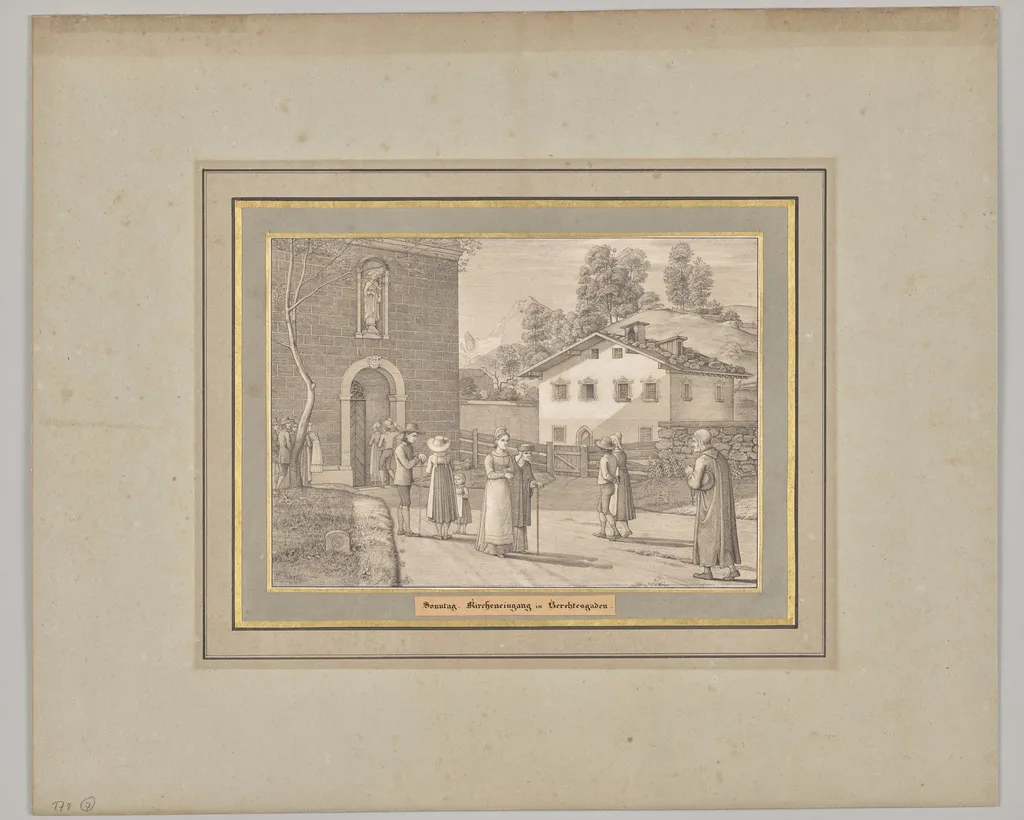
Sunday. Church entrance in Berchtesgaden is a print by the Romanticist artist Ferdinand Olivier. It dates from 1820 and is held in the collection of the Cleveland Museum of Art.
- Accession no.
- 2023.52.1
- Credit line
- John L. Severance Fund
About this work
Overview
Church entrance in Berchtesgaden, captures a serene moment of rural devotion in the Bavarian Alps.
Ferdinand Olivier's 1820 lithograph, Sunday. Church entrance in Berchtesgaden, captures a serene moment of rural devotion in the Bavarian Alps. The composition centers on a modest stone church, distinguished by a simple arched doorway and a statue positioned above the entrance, serving as the focal point for a gathering of villagers.
Olivier arranges the figures to suggest the rhythm of a Sunday morning: some approach the church, while others converse near a fence or stand in small groups, their attire marked by period hats. The background features a white house with dark shutters perched on a hillside, partially obscured by trees, which frames the scene and establishes the depth of the landscape. Executed during the artist's mature period within the Nazarene movement, the work reflects the group's emphasis on spiritual sincerity and a return to the clarity of early Renaissance art.
Rather than grand historical narratives, Olivier focuses on the quiet dignity of everyday religious life, utilizing the lithographic medium to render fine details in the architecture and foliage. This piece exemplifies the Nazarene ideal of finding the sacred in the ordinary, blending precise observation with a contemplative atmosphere characteristic of German Romanticism.
Subject & Meaning
The scene presents villagers strolling toward a simple arched doorway topped by a modest statue. Figures in hats pause to converse near a low fence, while a white house with dark shutters rises on a slope behind them, framed by trees and distant mountains. The composition emphasizes ordinary communal ritual rather than dramatic narrative.
Technique & Style
Executed as a print, Olivier employs delicate line work to delineate architectural details and the surrounding landscape. The restrained palette and emphasis on atmospheric perspective reflect Romantic interests in nature’s quiet presence and the dignity of everyday life.
History & Provenance
Created in 1820, the print entered the Cleveland Museum of Art’s holdings in the 20th century, though the precise acquisition path is not documented in the available sources. Its presence in the museum underscores the institution’s interest in early 19th‑century German printmaking.
Own this work as a print
Artist & collection


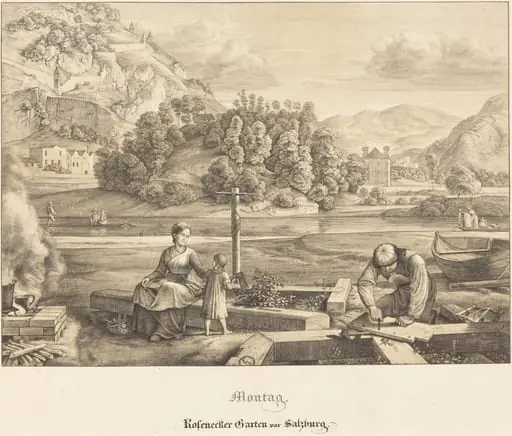 Montag - Rosenecker Garten vor Salzburg (Monday - Rosenecker Garden near Salzburg)
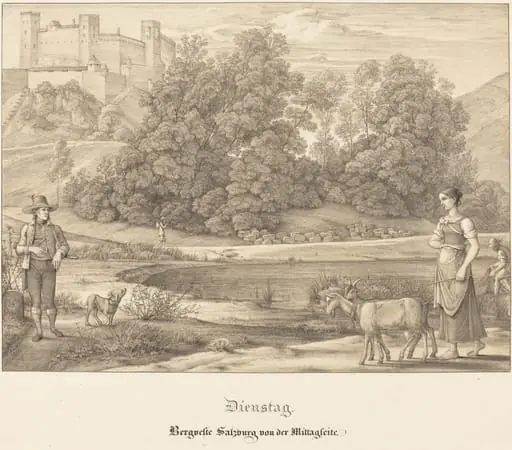 Dienstag - Bergveste Salzburg vor der Mittagseit (Tuesday - The Castle of Salzburg from the Noontime Side)
- Sonntag - Kircheneingang in Berchtesgaden (Sunday - Going to Church near Berchtesgaden)
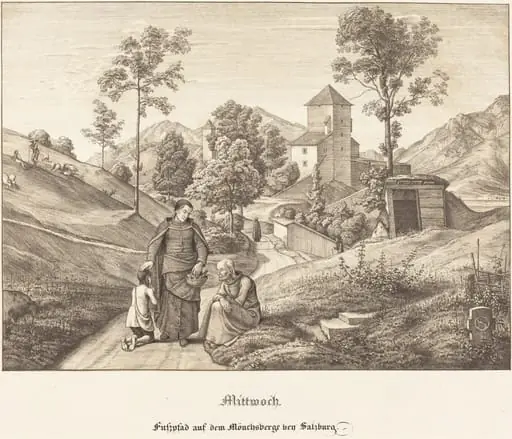 Mittwoch - Fusspfad auf dem Mönchsberge bey Salzburg (Wednesday - Footpath on the Mönchsberge near Salzburg)
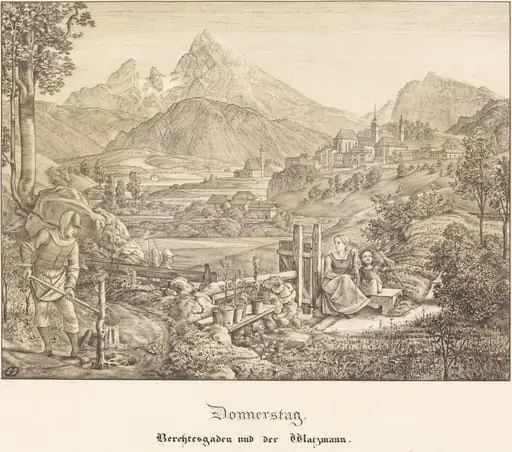 Donnerstag - Berchtesgaden und der Watzmann (Thursday - Berchtesgaden and the Watzmann Mountain)
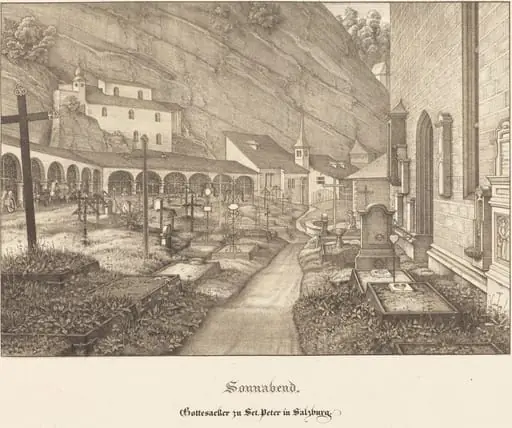 Sonnabend - Gottesacker zu St. Peter in Salzburg (Saturday - Graveyard of St. Peter's in Salzburg)
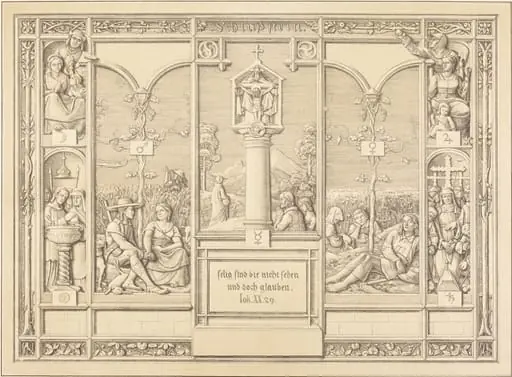 Tailpiece: Selig sind die nicht sehen und doch glauben (Blessed are those who do not
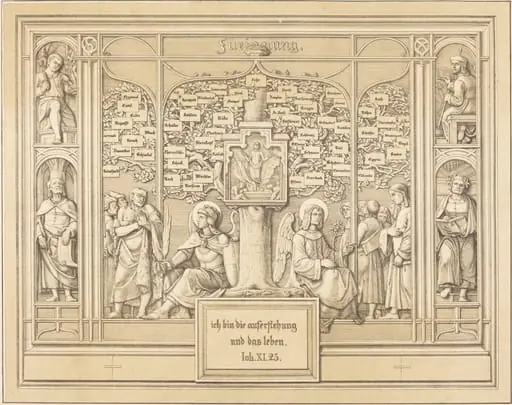 Dedication: Ich bin die Auferstehung und das Leben (I am the resurrection and the life)
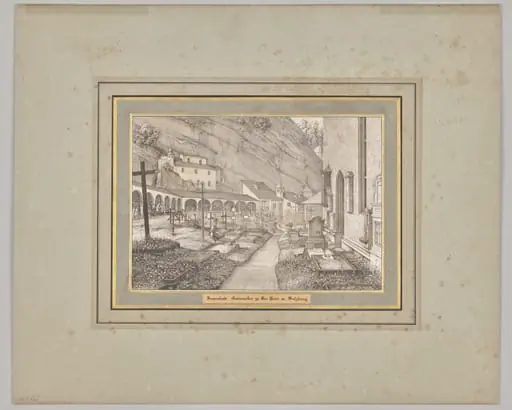 Saturday. Gottesacker to Sct. Peter in Salzburg
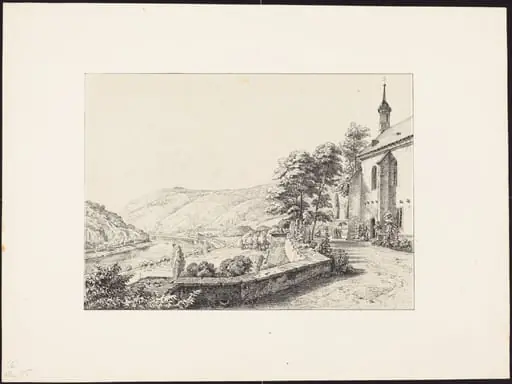 The Convent Terrace
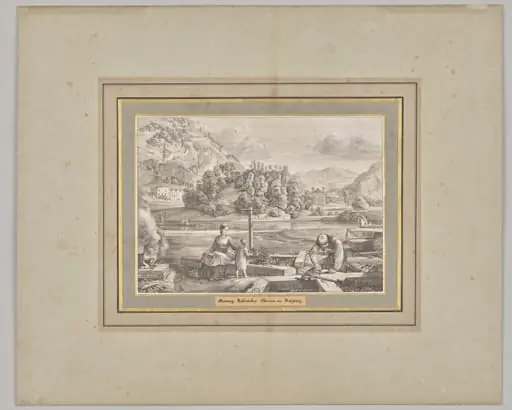 Monday. Rosenecker Garden in Front of Salzburg
 Untitled
 Fortificazioni dei bassi tempi sopra il Ponte Nomentano (Fortifications of the Ponte Nomentano)
 Entrance to the Convent Courtyard
 H Beard Print Collection
 Six Views of Heidelberg Castle: Castle Terrace
 Capstone. John XX, 29
 Nel Convento dei Cappuccini (In the Capuchin Convent)
 H Beard Print Collection