Artwork
Sonntag - Kircheneingang in Berchtesgaden (Sunday - Going to Church near Berchtesgaden)
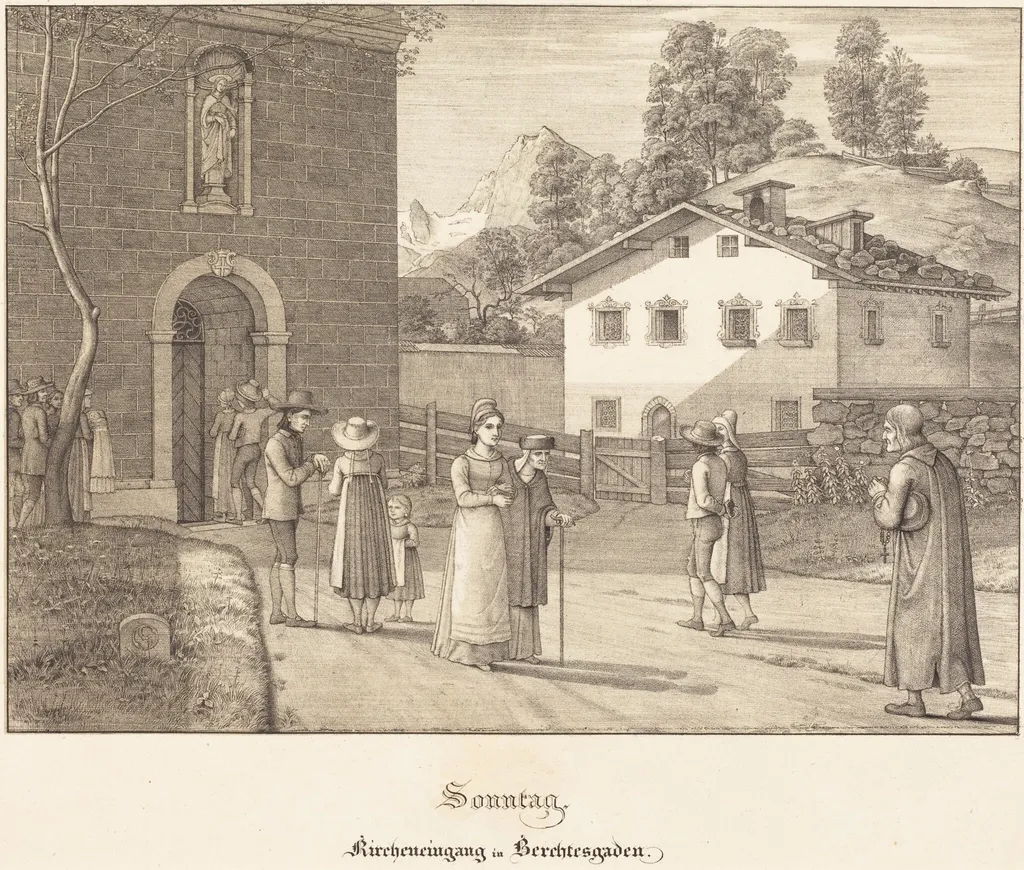
Sonntag - Kircheneingang in Berchtesgaden (Sunday - Going to Church near Berchtesgaden) is an ink print by the Romanticist artist Ferdinand Olivier. It dates from 1823 and is held in the collection of the National Gallery of Art.
About this work
Overview
Executed in black and white, the work utilizes the lithographic medium to render fine tonal gradations, emphasizing the textures of stone and fabric.
Ferdinand Olivier's 1823 lithograph, Sunday - Going to Church near Berchtesgaden, captures a quiet moment of rural piety in the Bavarian Alps. The composition centers on a stone church situated on the left, its arched doorway serving as the focal point where villagers gather. Men in hats and women in long dresses are depicted either entering the sanctuary or conversing in small groups, while children play nearby.
A solitary figure on the right adds balance to the scene. Executed in black and white, the work utilizes the lithographic medium to render fine tonal gradations, emphasizing the textures of stone and fabric. Created during the artist's mature period, this piece reflects the Nazarene movement's ideals of spiritual simplicity and a return to pre-Renaissance artistic values.
Olivier, known for his detailed landscapes and genre scenes, often infused such works with a sense of serene domesticity and religious devotion. The artwork stands as a significant example of early 19th-century German Romanticism, illustrating the intersection of daily life and faith in a specific regional context.
Subject & Meaning
The image focuses on the routine of worship: men in hats, women in long dresses, and children holding hands or playing near the entrance. By portraying everyday attire and casual interaction, Olivier emphasizes the social dimension of religious observance, suggesting that the act of going to church functions as both a spiritual and communal gathering.
Technique & Style
Executed in lithography, the print relies on the medium’s capacity for fine, fluid lines and tonal variation. Olivier employs a smooth, sketch‑like approach, allowing delicate shading to suggest texture in stone, fabric, and foliage. The black‑and‑white palette heightens contrast between figures and architecture, reinforcing the work’s observational quality.
History & Provenance
Created in 1823, the lithograph belongs to Olivier’s early output during his German period, when he traveled extensively in the Alpine region. While specific ownership records are sparse, the print has appeared in several 19th‑century collections of German landscape and genre works, reflecting contemporary interest in rural life and regional identity.
Own this work as a print
Artist & collection


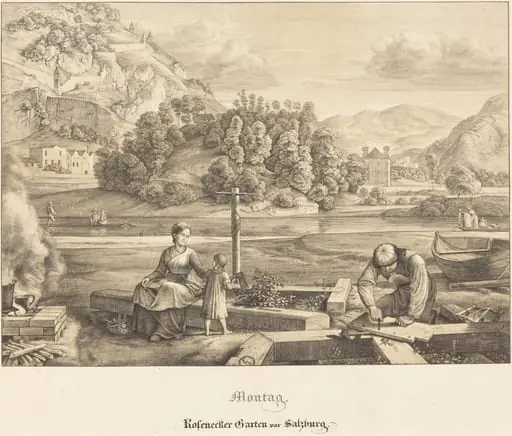 Montag - Rosenecker Garten vor Salzburg (Monday - Rosenecker Garden near Salzburg)
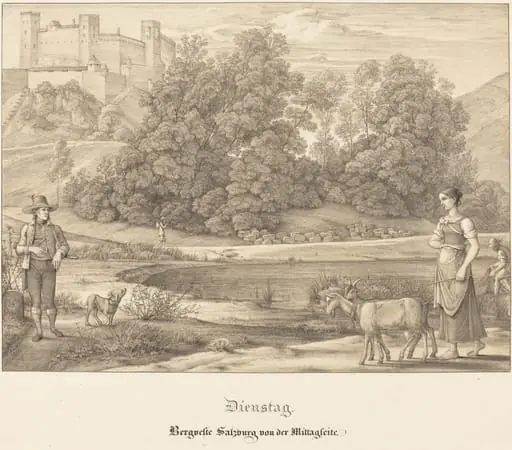 Dienstag - Bergveste Salzburg vor der Mittagseit (Tuesday - The Castle of Salzburg from the Noontime Side)
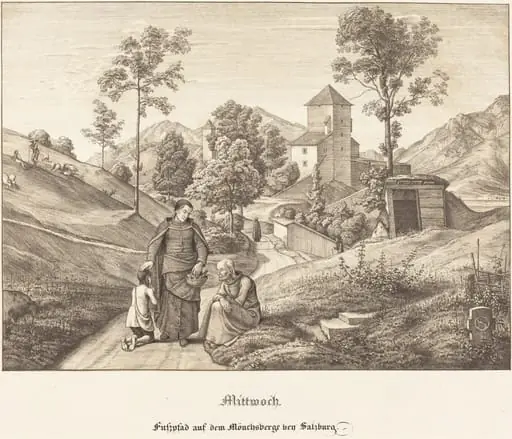 Mittwoch - Fusspfad auf dem Mönchsberge bey Salzburg (Wednesday - Footpath on the Mönchsberge near Salzburg)
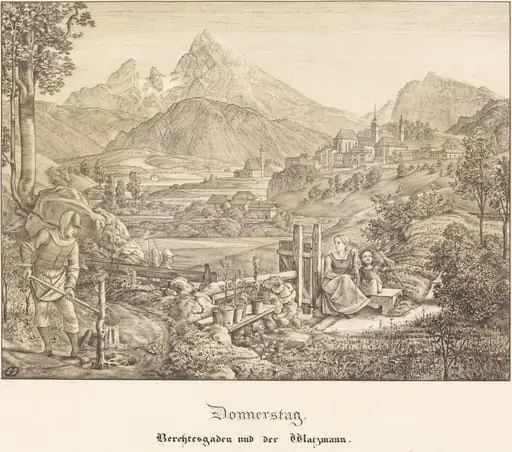 Donnerstag - Berchtesgaden und der Watzmann (Thursday - Berchtesgaden and the Watzmann Mountain)
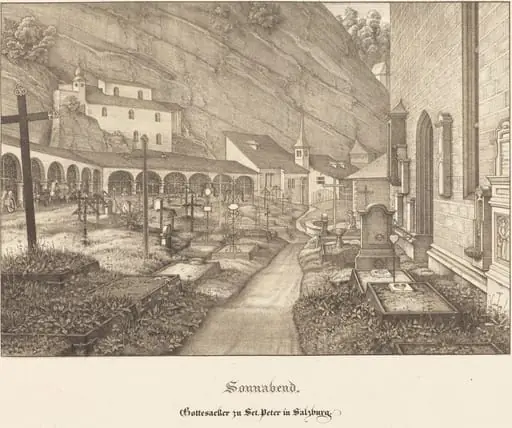 Sonnabend - Gottesacker zu St. Peter in Salzburg (Saturday - Graveyard of St. Peter's in Salzburg)
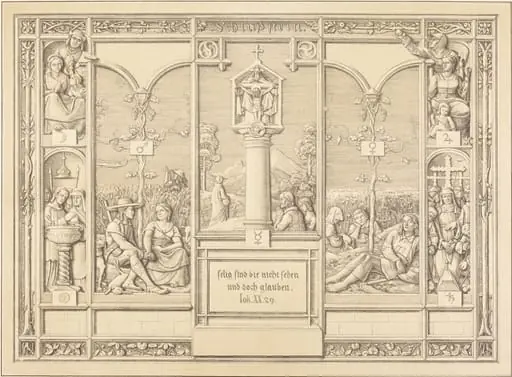 Tailpiece: Selig sind die nicht sehen und doch glauben (Blessed are those who do not
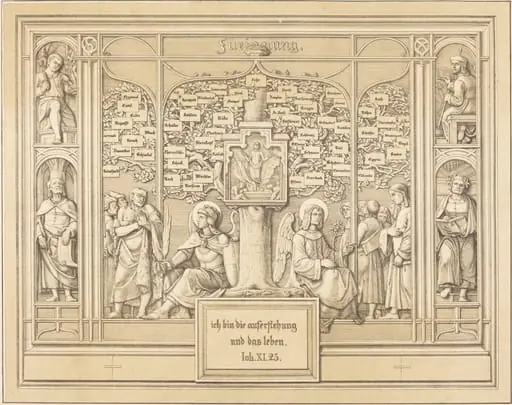 Dedication: Ich bin die Auferstehung und das Leben (I am the resurrection and the life)
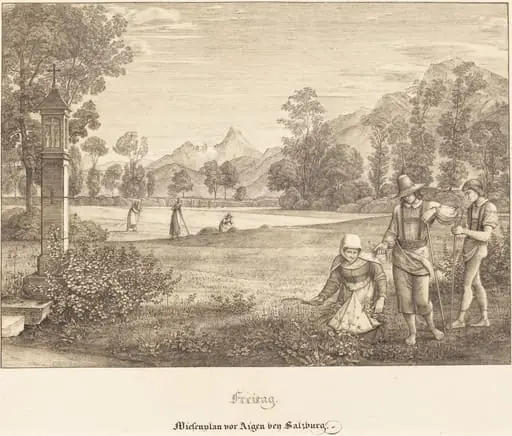 Freitag - Wiesenplan vor Aigen bey Salzburg (Meadow before Aigen near Salzburg)