Artwork
Old House, Dunstable, Bedfordshire
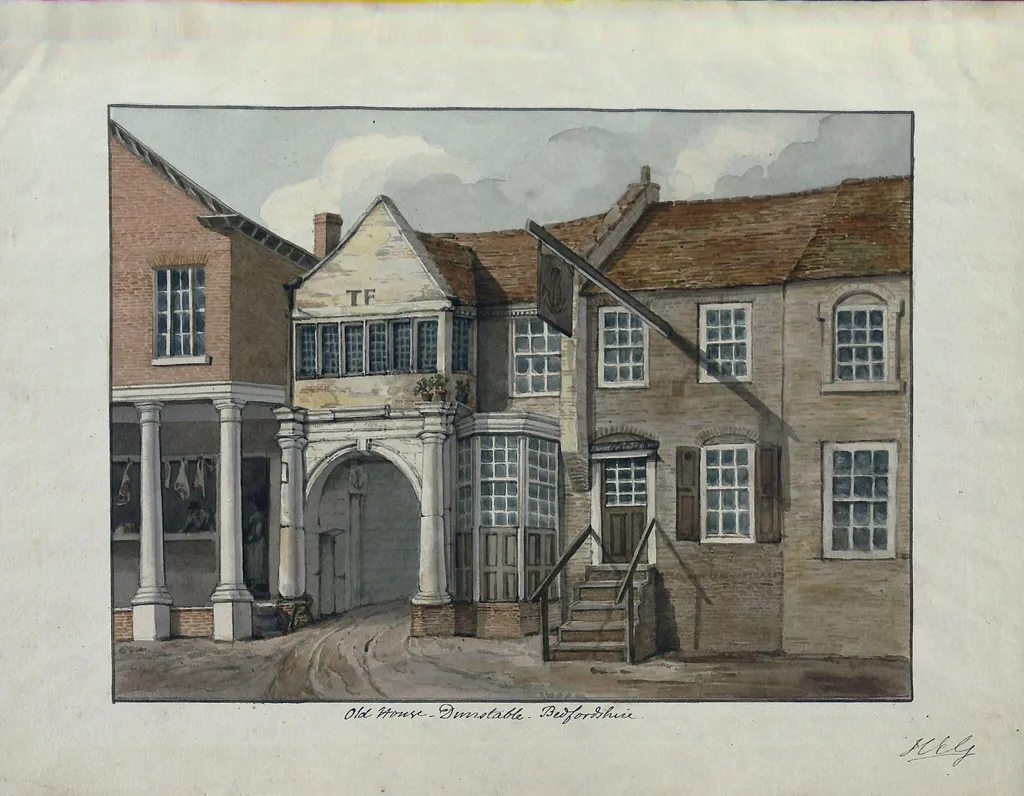
Old House, Dunstable, Bedfordshire is a watercolor work on paper by the Romanticist artist Thomas Fisher. It dates from 1812 and is held in the collection of the Victoria and Albert Museum.
About this work
It’s from around 1812 to 1822 by Thomas Fisher, an amateur artist who loved local scenes.
This watercolour shows an old house in Dunstable. It’s from around 1812 to 1822 by Thomas Fisher, an amateur artist who loved local scenes. Fisher wasn’t born in Bedfordshire but spent years painting its buildings.
Most of his surviving works are topographical views. He even wrote county histories. His art reflects the late 18th-century tradition of detailed landscape watercolours.
Look up the Victoria and Albert Museum.
Overview
Thomas Fisher, born in Rochester, Kent, was an amateur watercolourist and antiquary whose artistic output centered on Bedfordshire despite not being a native. Active between 1812 and 1822, he produced over a hundred topographical watercolours of the county’s buildings and landscapes, driven by a desire to document sites poorly recorded in print. His work, including this view of an unnamed house in Dunstable, reflects the closing phase of an 18th-century tradition focused on precise, factual representation rather than aesthetic idealization.
Subject & Meaning
The watercolour depicts a modest domestic structure in Dunstable, its façade softened by time, with an open-fronted butcher’s stall visible to the left. This unidealized scene captures everyday rural commerce and vernacular architecture, suggesting Fisher’s interest in recording ordinary life as much as historic fabric. The inclusion of a working shop implies a documentary intent, to preserve the visual texture of a place before it changed, aligning with his broader project of regional antiquarianism.
Technique & Style
Fisher’s technique reveals a self-taught hand: lines are hesitant, perspective is inconsistently rendered, and architectural details lack formal precision. Watercolour washes are applied with a flat, even tone, avoiding dramatic chiaroscuro or atmospheric effects. These qualities do not diminish the work’s value but instead underscore its authenticity as the product of an enthusiast, not a trained artist, working within the conventions of topographical illustration rather than fine art.
History & Provenance
Fisher’s connection to Bedfordshire began through friendships with local figures, notably Henry Humphrey Goodhall and Rev. Thomas Orlebar Marsh, who introduced him to patrons such as Sir Gregory Page-Turner and the Duke of Bedford. These relationships provided both encouragement and financial support, enabling his extensive documentation of the county. His watercolours were often commissioned or purchased, and many later entered institutional collections, including the Victoria and Albert Museum.
Context
Fisher worked during a period when topographical watercolour was transitioning from antiquarian record to emerging landscape art. While professional artists like Turner were refining expressive techniques, Fisher remained committed to the older model of accurate depiction. His two published histories of Bedfordshire reveal his scholarly side, positioning his art as an extension of his historical research rather than a pursuit of aesthetic innovation.
Legacy
Fisher’s legacy lies in his systematic preservation of Bedfordshire’s architectural heritage at a time when few others were doing so. Though his technique lacked polish, his body of work offers invaluable visual evidence of buildings and streetscapes now lost or altered. His dedication to local history, combined with his published writings, ensures his place as a key figure in regional antiquarianism rather than the broader canon of British watercolour painting.
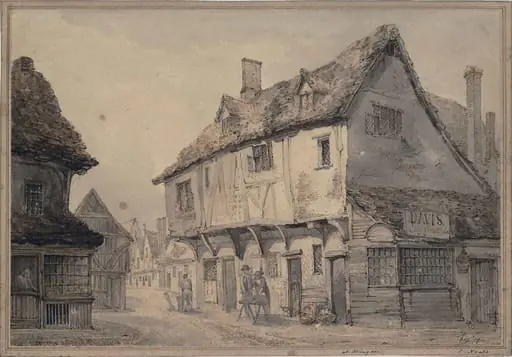
Own this work as a print
Artist & collection
Artist
Thomas Fisher never left his corner of England, sketching the same crumbling cottages and manor houses in Bedfordshire for years.

- Old Houses at Abingdon, Berkshire
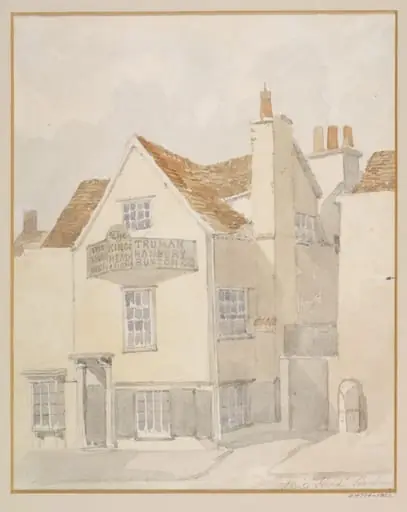 The King's Head, Hackney
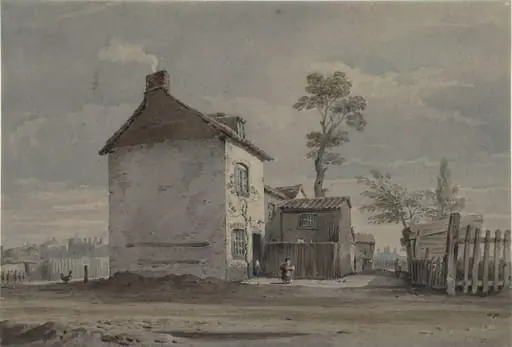 Cottages in a landscape
 The Flying Horse, Hackney
 Bagnigge Wells
 A Church in a Market Place
 Preparing for the Coronation, West Malling, May, 1937.
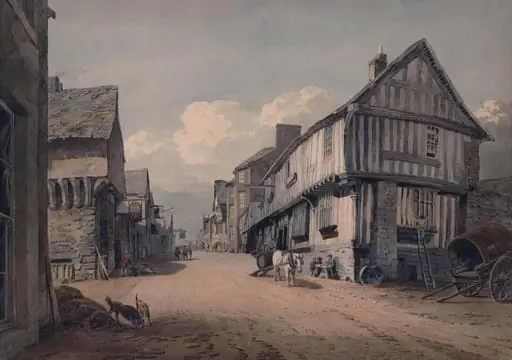 Looking up the High Street at Conway
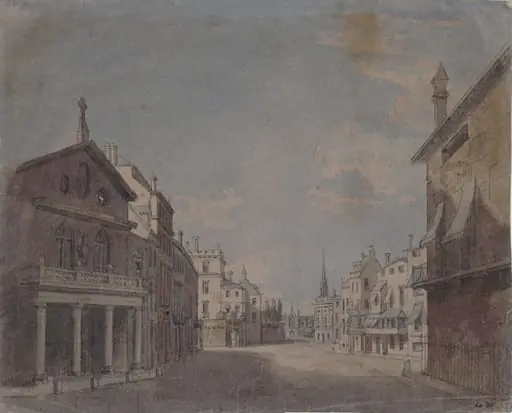 Street Scene
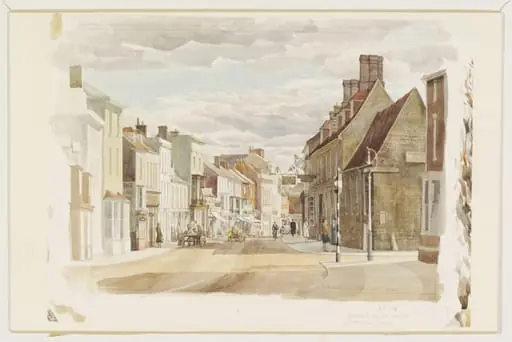 Towcester High Street from the Pomfret Arms Corner, Northamptonshire
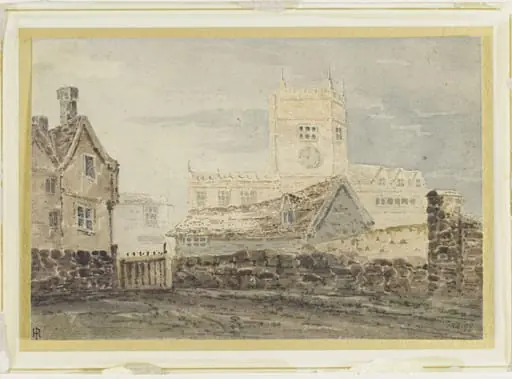 The school, Shrewsbury
 Charles Bicknell's House at Putney