Artwork
The Happy Family
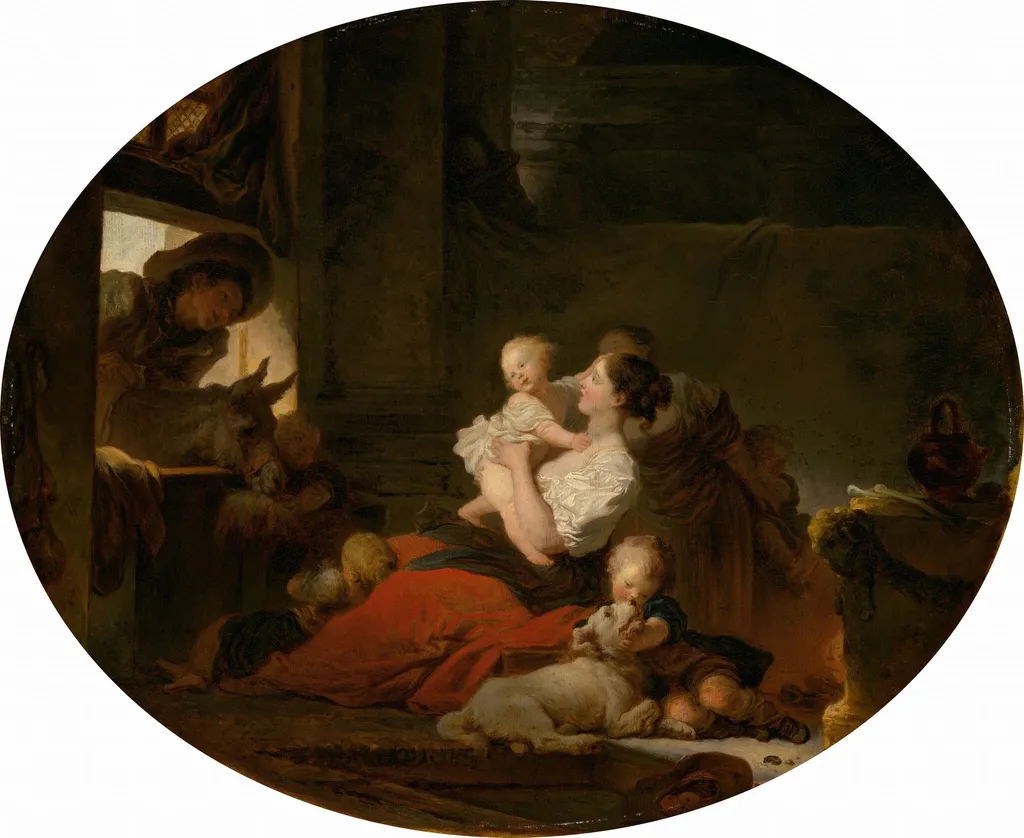
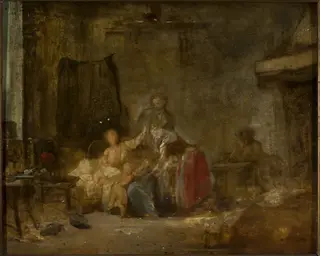
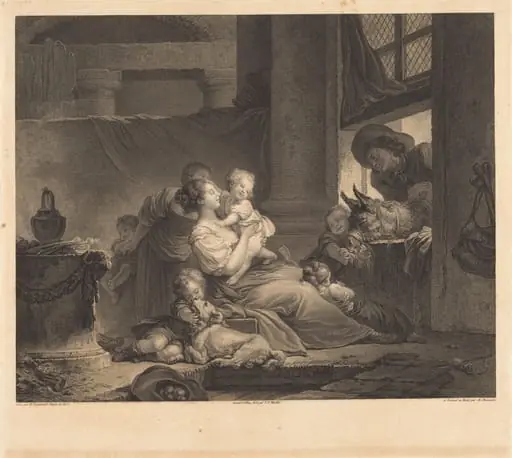
The Happy Family is an oil painting by the Rococo painting artist Jean Honoré Fragonard. It dates from 1775 and is held in the collection of the National Gallery of Art.
About this work
Technique & Style
The work is classified as a painting within the National Gallery of Art collection, where it entered in 1960 as part of the Timken bequest.
The Happy Family is an oil on canvas painting executed by Jean-Honoré Fragonard in 1775. The canvas measures 53.9 cm in height by 65.1 cm in width, a modest scale suited to the intimate domestic subject. The work is classified as a painting within the National Gallery of Art collection, where it entered in 1960 as part of the Timken bequest.
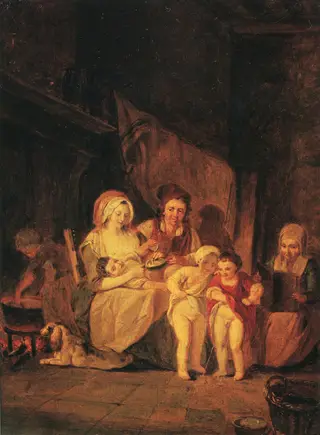
Numerous painted variants and engraved versions of the composition exist, which has complicated the identification of the original and the early provenance, since accurate size information and detailed descriptions were not always available to distinguish it from its copies.
History & Provenance
The Happy Family was painted by Jean-Honoré Fragonard in 1775, as recorded in both the corpus provenance entry and the Wikidata record, the latter giving an inception date of 1775 and dimensions of 53.9 × 65.1 cm in oil on canvas.
The early ownership history is uncertain, since numerous variants and engraved versions exist and accurate size information is lacking. The painting may have been in the collection of Monsieur Servat by 1777, or possibly appeared in the 17 February 1777 sale held by Alexandre J. Paillet at the Hôtel d'Aligre in Paris (lot 55, from collections including that of the Comtesse du Barry), where it was purchased by Aubert. Georges Wildenstein identified the National Gallery of Art canvas with the work in that sale, noting that the catalogue dimensions are close to those of the NGA painting.
The work later passed to the Duc de la Rochefoucauld-Liancourt (1747–1827) and then to the Poilleux collection in Paris. It was subsequently acquired by Eduardo Guinle (1878–1941) of Rio de Janeiro, and in 1919 was sold through Wildenstein & Co. to Nicolas Ambatielos of London. By 1935 it belonged to William R. Timken (1866–1949) of New York, passing by inheritance to his widow Lillian Guyer Timken (1881–1959), who bequeathed it to the National Gallery of Art in 1960.
The painting is held by the National Gallery of Art in Washington, D.C., where it was accessioned in 1960 as a bequest from Lillian Guyer Timken. Its inventory number is 1960.6.12. Prior to this acquisition, the work passed through the collections of Eduardo Guinle in Rio de Janeiro and William R. Timken in New York, who purchased it in 1919 from the dealer Wildenstein & Co., Inc.
The provenance traces back to an 18th-century sale in Paris on February 17, 1777, potentially linking it to the collection of Monsieur Servat or the Comtesse du Barry. While the National Gallery of Art currently houses the work, the provided sources do not list specific exhibition histories or dates for public display.
Overview
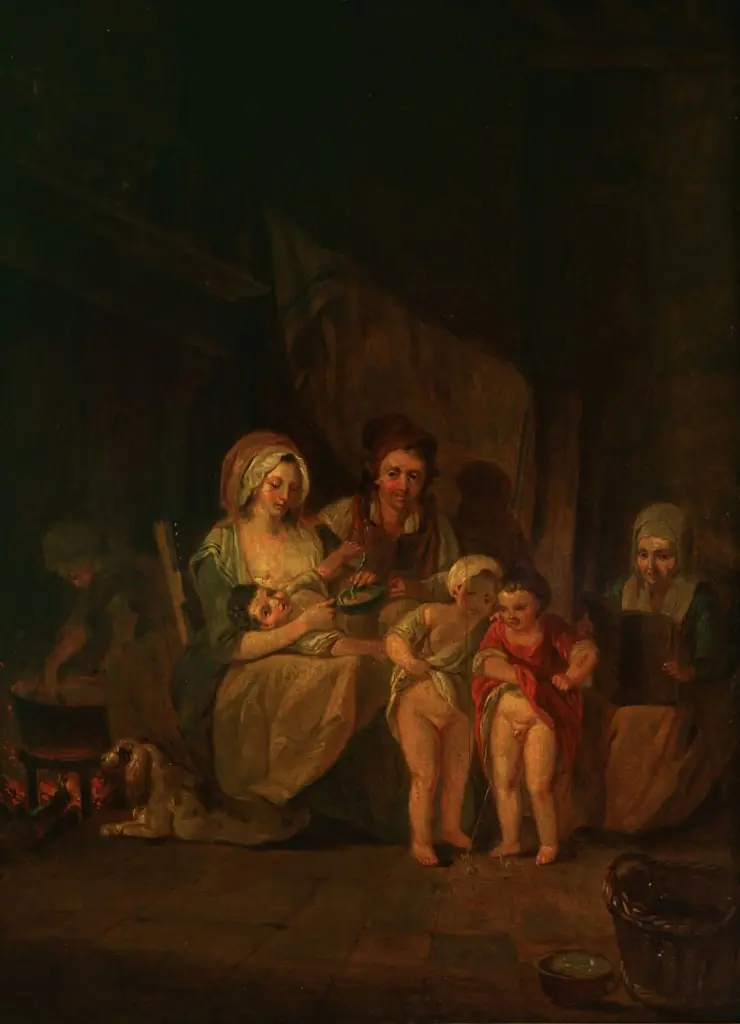
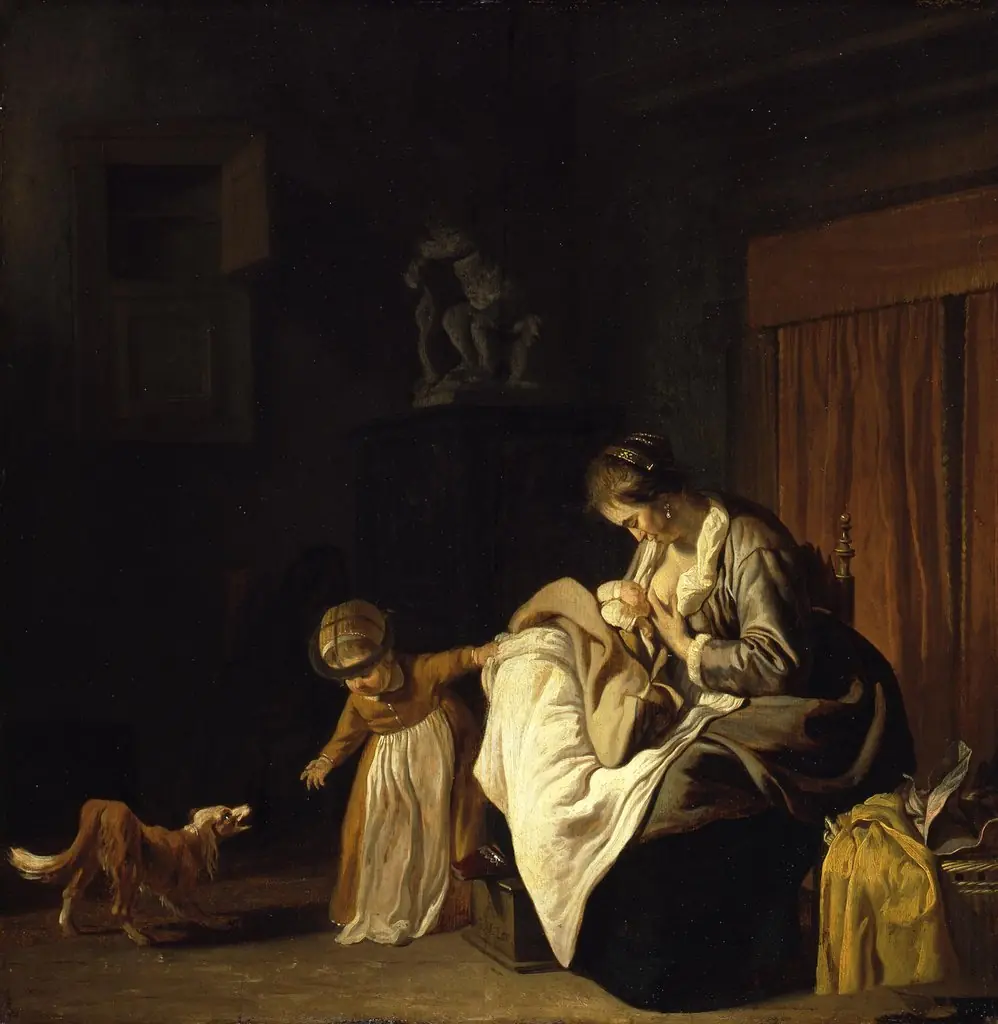
Jean‑Honoré Fragonard’s oil on canvas, dated around 1775, depicts an intimate domestic tableau. A mother cradles an infant while two young children engage with a dog on the floor, and a man observes from the background. The interior is rendered in warm hues of red, brown and earth tones, illuminated by a soft window light that gives the scene a tranquil ambience.
Subject & Meaning
The composition centers on familial affection, emphasizing the gentle interactions between mother, children, and pet. The figures are presented in modest attire, underscoring a sense of everyday domesticity rather than aristocratic display. The man’s quiet gaze suggests a protective presence, reinforcing the theme of familial cohesion within a private, comfortable setting.
Own this work as a print
Artist & collection

Artist
Jean-Honoré Fragonard was born on 5 April 1732 in Grasse, the son of a glover, and moved with his family to Paris in 1738.