Artwork
Judith and Holofernes
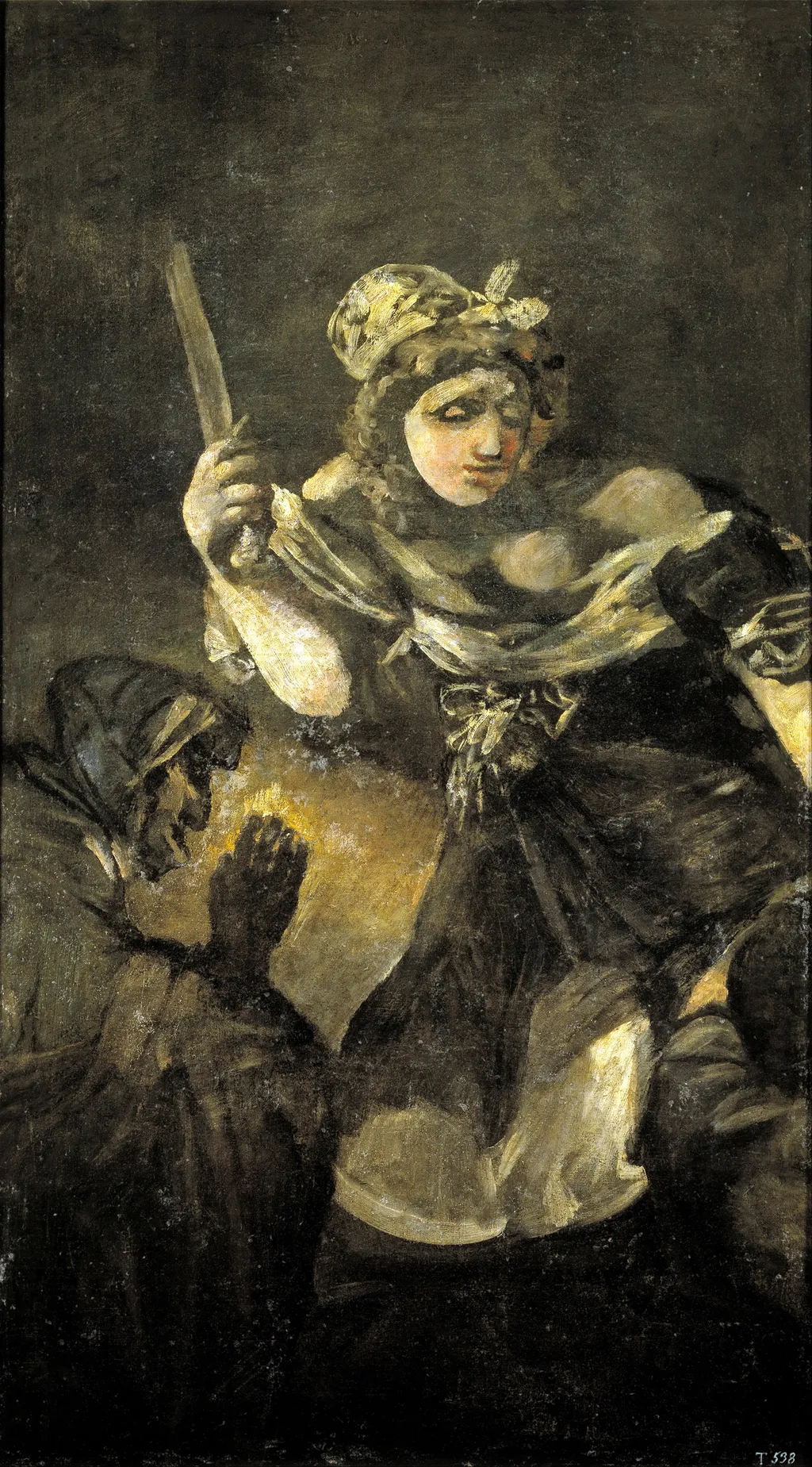
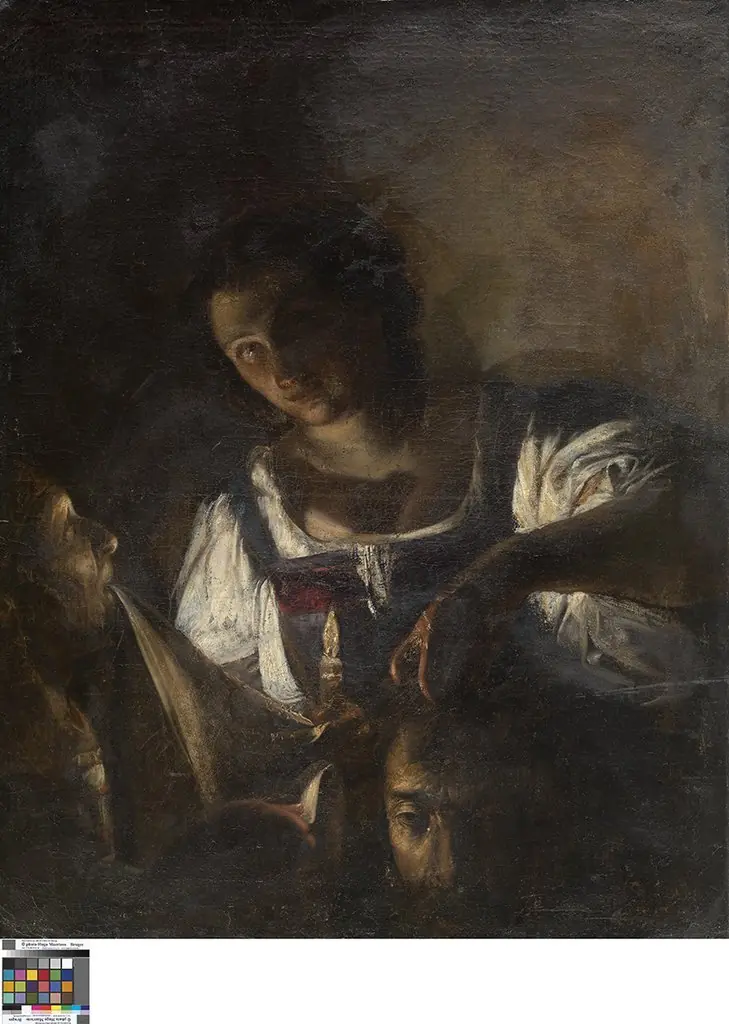
Judith and Holofernes is an unspecified painting by Francisco de Goya. It dates from 1819 and is held in the collection of the Museo del Prado.
About this work
Subject & Meaning
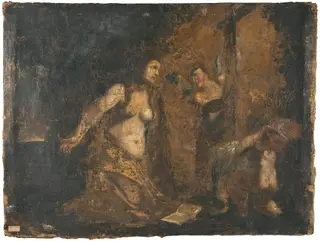
Goya's work offers a personal reinterpretation of the biblical narrative from the Book of Judith, in which the protagonist saves Israel by seducing and beheading the Assyrian general Holofernes. Unusually, the composition excludes Holofernes and the flowing blood from the visible frame, focusing instead on Judith with closed eyes and an old servant in prayerful shadow. The scene is illuminated theatrically, suggesting a night setting lit by a torch that highlights Judith's arm and face while leaving the background in semidarkness.
Scholars suggest the painting may function as a political allegory, with Holofernes representing King Ferdinand VII, whose restoration Goya privately despised, thereby symbolizing the defeat of tyranny. Alternatively, the imagery has been interpreted through a psychoanalytic lens as an allusion to the artist's relationship with Leocadia Zorrilla, representing the castrating power of women over men or the fury of an aging figure.
Technique & Style
Holofernes and the decapitation are deliberately omitted, focusing attention on Judith’s tense gesture and the elderly servant’s prayerful silhouette.
Executed in oil on plaster and later transferred to canvas, the work employs a restricted palette dominated by blacks and ochres, with sparse red accents, applied in broad, energetic strokes characteristic of Goya’s late manner. The composition is dramatically lit by a concentrated, torch-like source that isolates Judith’s face and outstretched arm in sharp relief while plunging the scene into shadow, emphasizing its nocturnal setting. Holofernes and the decapitation are deliberately omitted, focusing attention on Judith’s tense gesture and the elderly servant’s prayerful silhouette.
The handling combines loose brushwork with expressive distortion, aligning the painting’s stylistic qualities with the broader tendencies later termed Expressionist.
History & Provenance
Francisco de Goya created Judith and Holofernes between 1819 and 1823 as part of his series of Black Paintings. The artist painted these works directly onto the plaster walls of the Quinta del Sordo, a house he purchased in 1819. This specific mural likely occupied the first floor or the ground floor wall adjacent to Saturn Devouring His Son. Goya intended the series for private viewing, never planning for public exhibition.
In 1873–1874, the original wall paintings were transferred to canvas under the supervision of Prado curator Salvador Martínez Cubells. This restoration was commissioned by the French banker Baron Émile d'Erlanger, who initially sought to sell the works at the 1878 Paris Universal Exposition. When the paintings failed to attract buyers, d'Erlanger donated the entire series to the Museo del Prado in 1881, where the work remains today.
Judith and Holofernes is held by the Museo del Prado in Madrid, where it remains part of the museum's collection. Originally painted directly onto the plaster walls of Goya's residence, the Quinta del Sordo, the mural was transferred to canvas in 1873–74 by Salvador Martínez Cubells at the commission of Baron Émile d'Erlanger, a Franco-German banker who intended to sell the Black Paintings at the 1878 Paris Universal Exhibition.
When the works failed to attract buyers, d'Erlanger donated all fourteen canvases to the Museo del Prado in 1881, where they have been displayed ever since.
Context
Francisco Goya's Judith and Holofernes, painted circa 1819–1823 on the walls of his Quinta del Sordo, emerged from a period of profound personal and political disillusionment. The work belongs to the series of Black Paintings, noted for their stark compositions and expressive brushwork. Contemporary scholars interpret the scene as a personal reinterpretation of the biblical story, with some linking it to Goya's relationship with Leocadia Zorrilla and to covert commentary on the restored monarchy.
The painting's dramatic lighting, restricted palette of black, ochre and red, and the omission of Holofernes' head and blood have been highlighted as distinctive within the series and as precursors of modern expressionist concerns. Its transfer to canvas in the 1870s and subsequent acquisition by the Museo del Prado ensured its visibility, influencing later criticism that emphasizes both its psychological intensity and its subversive potential.
Legacy
Although created as a private decoration for Goya's home with no expectation of public viewing, the work's legacy was secured after its transfer from plaster to canvas in 1874. Following an unsuccessful attempt to sell the Black Paintings at the 1878 Paris Exposition, Baron Émile d'Erlanger donated the series to the Museo del Prado in 1881, where it remains today. Modern analysis identifies the painting's energetic brushwork, restricted palette, and dramatic composition as possessing stylistic traits that would later characterize twentieth-century Expressionism.
The piece is also noted for its original compositional choices, such as excluding the victim and blood from the frame, which heighten the psychological tension of the scene.
Overview
Francisco de Goya's Judith and Holofernes belongs to his series of fourteen "Black Paintings," executed between 1819 and 1823. These works were originally applied directly onto the plaster walls of the artist's private residence, known as the Quinta del Sordo. Created during Goya's final years, the series reflects a profound shift in his artistic expression, moving towards deeply personal and often somber themes.
Artist & collection
Artist
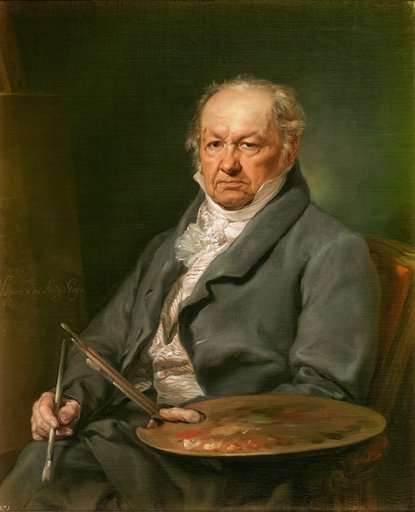
Francisco José de Goya y Lucientes was a Spanish romantic painter and printmaker.